Monday, April 2, 2007

Courthouses

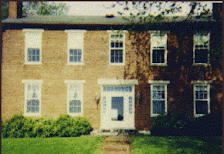
When I arrived in downtown Louisville this morning, I spied a sight I haven't seen in several years. The front doors to the Old Court House were propped open, wide open. This is the building located at 527 W. Jefferson that the Mayor of Louisville-Jefferson County Metro calls Metro Hall but very few others do. Some call it the Court House, others the Old Court House, but few call it Metro Hall. Gideon Shryock was the original architect, starting the project in 1830. The building sat unfinished for some twenty years, serving offices of both the County of Jefferson as well as the (old) City of Louisville, now known (under Merger) as the Louisville Urban Services District. It was completed under the direction of Albert Fink around 1860, about the time Louisville's current City Hall was begun. For a while under Merger, City Hall, located at 601 W. Jefferson Street, was called Legislative Hall. Nobody knew it though, and the large "City Hall" plaque remains on the side of the building at 6th and Jefferson Streets.

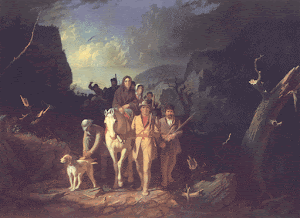
Since the events of September 11, 2001, our local governments have restricted access to both the Old Court House and City Hall. One enters City Hall via an entranceway sandwiched between the original Jefferson Street entrance and that of the City Hall Annex, whose front doors have also been permanently shut. From this entrance, access is made to the City Hall, the Annex, and the offices built in between the two in a space known until the late 1970s as the Louisville Police Court building. Entering the Old Court House isn't all that difficult, but neither is it as classical as it once was when one ascended the limestone steps which stretch along the central portion of the building, surrounded by gigantic columns, with the ultimate entry through two old tall wooden doors, oddly painted green. They've been green as long as I can remember. Attached to the building is a dedication to Louisville's founder, George Rogers Clark, who actually lived across the river at what became the Town of Clarksville, Indiana, located as pointed out in a previous entry right at Milepost 606 on the Ohio River, but on the Right Bank, not the Left.

There was at one time a movement, although admittedly not much of one, to relocate Kentucky's government from Frankfort to Louisville. The Commonwealth engaged itself in a Constitutional Convention in 1849. The leader of the convention was Louisville businessman James Guthrie, who in his life served as president of the L&N Railroad, the Louisville and Portland Canal, and the University of Louisville, which he helped to found. It was Guthrie's plan to move the capital fifty five miles west and to have Shryock's Greek Revival design of a building serve as the Commonwealth's seat of government. But, alas, that didn't happen, and Kentucky's capital remains in the lazy "S" curves of the Kentucky River at Frankfort. Ironically, the then-capital at Frankfort was another Greek Revival design by the same Gideon Shryock, also begun (but also finished) in 1830 - Shryock was twenty-five years old at the time. His building served in that capacity until the "New Capital", as they still call it in Frankfort, opened in 1910.

In my vocation and avocation, I have often found myself in Court Houses around Kentucky, searching records in Deed Rooms, called Recorder's Offices in Indiana. I have done title work both as a job and a hobby for many years. Another hobby, genealogy, requires similar research in old deeds, wills, and lawsuits. Many of Kentucky's counties have in recent years added either a new courts building, usually called a Judicial Center (as we have here in Jefferson County), or they have added a new Fiscal Court Building to house county offices and turned over the original Court House to the Courts system (as was done in Oldham County). Up in Scott County, Indiana, a few miles to the north, they built a replica of the Court House immediately next door to the old one and attached the two buildings so they look to be built as wings. Some old court houses have become museums, as is the case of both Nelson and Fayette counties. In other counties, Court Houses have expanded simply by adding wings to either end. In Bullitt County, they did all four - built a Courts building, a new Fiscal Court Building (named for the recently retired County Clerk), and expanded the old Court House with new wings, placing a museum in the original part of the building. Immediately across the river, both Floyd and Clark counties have combined City-County government building, neither one of which offer much in classical design, but both are adequate for the purposes they serve.

Over the years, I've been in many court houses throughout Kentucky and Indiana. Especially in Indiana, the doors are usually open with a nice breeze blowing through on days like today. Many are in the shape of a square, with a central foyer, and court rooms on the upper floors. The lower floors serve as a social center, and many are open around the clock. But, as I said, that isn't the case here, where we've shut the buildings up lest there be some terrorism I suppose. It is rather sad, in my opinion, that we have allowed such a feeling to come between the people and the government buildings which house the governments which serve them. Court Houses are the very essence of our democratic republican form of government, the "county" being the basic level of government throughout the Republic [although called a parish in Louisiana and a district in Alaska).

When I saw the doors opened this morning, I climbed the steps only to find a guard doing his job. He told me I had to go back down the steps and around to the back door, now the main entry. It seems the Air Conditioning system had failed over the weekend and the doors to the Court House were only open to let hot air out, not to let any people in. 'Tis a pity.

Sunday, April 1, 2007

76. Jesus, Easter, the Bible as history, the Bible as literature, and some other business at hand

I've been away for a few days, enjoying several days of absolute beauty and wondrous weather here along the Left Bank of the Ohio River at Milepost 606. The entry which follows is religion-laden. If such reading is not of interest to you, you are free to pass over this entry.

Today is April 1. It is also, at least in the Catholic Church calendar, this year's day for the celebration called Palm Sunday of the Lord's Passion, the day according to accounts in the Bible on which Jesus rode up the hill and into Jerusalem on a small colt, with his followers waving palms and making acclamations as to His greatness. To go into Jerusalem one necessarily goes "up." Unlike Rome (and Frankfort), which is surrounded by hills and one enters the city by going down, Jerusalem geograhically sits up on several hills, with valleys to the south and east. So Jesus rode "up" into Jerusalem.

On any Sunday which Catholics attend church, they will hear (and read if they choose) readings from three different parts of the Bible, first from the Old Testament, then from the New Testament outside of the gospels, then specifically from one of the four gospels of the New Testament, the third reading of which usually includes specific words alleged to have been spoken by Jesus Himself. If you were to attend church every Sunday of the year, you will have heard a great deal of the words written in what is often called the most popular book ever written.

This week's readings (including today's) are the longest at anytime during the year. "The Passion of the Lord" which recounts the story of Jesus' final hours, His arrest, trial, and crucifixion, is told to some degree in each of the four gospels, Matthew, Mark, Luke, and John. Like some of the stories I tell and then retell, the accounts differ slightly with the telling. Today's reading is from that of Saint Luke, running from Chapter 22 into and through Chapter 23. Later this week on Good Friday, a different account of the same events will be read, taken from the 18th and 19th chapters of the Gospel of Saint John. The two writers differ on the day on which the crucifixion took place, one placing it on the day of Passover, the other on the day after Passover. One of the most interesting bits of trivia from the Passion surrounds the idea of releasing one of the prisoners being held at Passover. While this has become an idee fixe in the modern world, no one can cite to this specific custom of releasing prisoners at Passover other than the accounts found in the Bible. There are accounts of releasing prisoners on several feast days, but none specific to Passover, although Passover itself is an ancient Jewish festival (called Pesach) commemorating the deliverance (or releasing) of the Jews from the captivity of Egypt. Nonetheless, it is a worthy idea - releasing prisoners - and doing so on feast days and holidays has become a practice. In the United States, such releases are often made at Christmas and New Year's, although one of the real (and often unstated) reasons is so that penal institutes will have as close to their appropriate number of prisoners in-house on a partucluar reporting date, either December 31 or January 1, as these are the statistics which make it into the record books and newspapers.

As this is Palm Sunday (or Passion Sunday), it is the first day of Holy Week, the week that culminates in Easter Sunday, the day celebrating the resurrection of the Lord, without which there would be no reason for a christian (little "c") church, with all its sects, deviations, and denominations. With the exception of the Easter Vigil on Saturday night (one of my three favorite masses of the church year) the readings will focus on Jesus. Saturday's Vigil is a lengthy set of five to seven readings from the Old Testament (one of which is the beautiful, even if quite unbelievable) passages from the very beginning of the Bible in the first Chapter of Genesis recounting the seven days of creation with each day's section ending with the hopeful yet forceful words "Evening came and morning followed"), a reading from one of Paul's letters, and the story of the visitation on Sunday morning to the tomb, where the "women of Galilee" went to prepare the body of the dead Jesus only to find that the "stone had been rolled away," and the angel telling them "He is not here, but he has been raised, as he said, on the third day." Those words are the central to and are in fact the only reason we have a christian church, that on the third day its leader arose from the dead and returned to the living.

As I have stated before, I am not a literalist when it comes to the words written in the Bible. There are passages I believe are true, some I believe to be mostly true, and a few which are literally out of this world, difficult to believe, and over time I've decided they are not literal truths, but which are very good stories, meant to convey a message in such a way as to make a lasting impression on those who hear or read them. I realize that in having such a belief, I have, by some folks practices of their personal religious beliefs, condemned myself to an eternal damnation of Hell, Fire, and Brimstone (itself an Old English word taken from "burnt stone" and now commonly called sulphur). The idea of Hell, Fire, and Brimstone is one of the parts of the Bible I don't believe in literally but which serves as an excellent example of words written to get and keep your attention, as it has for many people, Christian and non-Christian for two thousand years thus far. There are lots more.

During the several weeks following Easter and leading up to a second of my three favorite masses, that of Pentecost, the readings differ from those offered throughout the rest of the year. During this interregnum, from Jesus' role as King of the Jews on Earth to His Ascension into Heaven and his seating at the right hand of God, the first readings are taken from the Acts of the Apostles, a book of the New Testament accounting the days of the very early church as it was established in the region by those earliest followers of Jesus. The second readings are from the final book of the New Testament and of the Bible as a whole, that of Revelation. These readings tell of the final days (which are yet to come) of the world, and the establishment of a new Jerusalem, a new Earth, a new Heaven, and quite a few other things. It is frankly absolutely fascinating reading. The Gospel readings during this time period deal with Jesus' presence on Earth, following His death and resurrection, and ending with His Ascension. If there was ever a set of Bible readings assembled together as both historical and creative literature, these next few weeks from the books of The Acts and Revelation offer some of the best reading a person can do, irrespective of any belief in Jesus, God, or any other deity. It is literature par excellence.

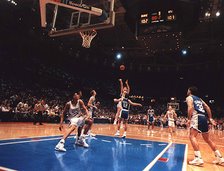
This week also marks then end of a far-less-than-religious but overwhelmingly-celebrated-by-Christians-Jews-Muslims-and others season known as March Madness, too big to fit into just March. Tomorrow the final game will be played between the winners of two games last night. On one side will be Ohio State, which defeated Georgetown of DC , 67-60. [My cousin, a graduate Georgetown College in Georgetown, Kentucky, has told me I should also include "of DC" when mentioning the other Georgetown lest people confuse the two]. The other side returns Coach Billy Donovan to his second NCAA championship game in as many years. In a rematch of last year's final game which UCLA lost to Florida 73-57, UCLA lost again to Florida 76-66. Tomorrow when Donovan's Florida teams defends its title, a win would afford Donovan and his team back-to-back titles, the first such back-to-back titles since Mike Krzyzewski took Duke there in 1991 and 1992 (and as a reminder having to defeat Kentucky along the way in '92). The last team that could have repeated - but didn't - was Kentucky, in 1996 when they won, and in 1997 when they failed in defending their title. Overhanging all this passion is an open position at the University of Kentucky, created by Tubby Smith's departure to the land of Golden Gophers. Billy Donovan is the number one choice of many UK fans to succeed Smith. I am among those who want the job to go to Coach Donovan. His ties to UK are through his college basketball coach, Rick Pitino. Donovan played ball at Providence, the final two years under Rick Pitino. After Pitino went to Kentucky, Donovan joined him in 1989 as an assistant coach. The year Pitino took Kentucky to the NCAA championship, Donovan went to Florida. Donovan is a prize catch. He is one of only three men to have played in a Final Four game and later to have coached a team to an NCAA championship, the other two being Dean Smith and Bobby Knight. Whatever you might think of coaches Smith and Knight, that is an impressive statistic. Donovan will be 42 this year. I wish him and his Gators all the luck they need in addition to the skills and talents they already have, in tomorrow's game. Come Wednesday, win or lose, the carpet will be unrolled and waiting for a glorious entry into Lexington should he so decide. I hope he does.

Happy birthday to both Melissa Mershon and Jeff LaDuke, both of whom are 54 today. Today was also the birthday of the late Thelma Stovall, born April 1, 1919, who passed away in 1994. She and former United Senator Wendell Ford were each elected to statewide office a record six times. She ended her public career as Kentucky's first (of two) female lieutenant governors. A native of Munfordvile in Hart County, where a county park resting along the Green River is named in her honor, at death she was interred at Rest Haven Cemetery in Louisville. May she Rest In Peace.

Wednesday, March 28, 2007

75. On the 2007 Session of the Kentucky General Assembly

Today's entry is a copy of an email letter I have sent this morning to my two representatives in Kentucky's legislature, as well as to about fifteen other legislators I count as friends. Additionally, I copied it to our Jefferson County Clerk Bobby Holsclaw, the Kentucky Democratic Party Chair Jerry Lundergan, and the Jefferson County Democratic Party Chair Tim Longmeyer. It is a letter of disappointment.

*****

Hon. Tom Riner, my state representative
Hon. Gerald Neal, my state senator
other friends in the legislature
March 28, 2007

This is a letter the jist of which is something I have written to some of you in the past, after the close of a previous session of the General Assembly.

I've made some entries in the last few days on a couple of the political blogs in the Commonwealth which have included my disappointment in the lack of successes achieved in this year's legislative session. It is my opinion that since the adoption of the constitutional amendment creating annual sessions, less work has been accomplished in more time, and more time equates to more money.

I didn't support that amendment when it was on the ballot, as it has been my usual practice not to support any amendments to the Constitution, unless they have been proposed by a Constitutional Convention, as opposed to the legislature. While there have been one or two exceptions over the years, I feel my votes, including those where I was in the minority, have been well-cast.

At the close of this year's session, as with many in the past, the media has been replete with stories of what didn't get passed, as well as the flurry of activity in the final hours to get things passed, activity which no doubt leads to bills being passed and amended by language never completely read or fully understood by those charged with voting yea or nay on them.

While there is a lot for which to be disappointed, as someone involved in the political processes at the precinct level, one of the greatest is the legislature's mishandling of the Run-Off provision in the gubernatorial contests. Most troubling is the unfunded mandate you have, by your lack of agreement, placed on local governments in each of the Commonwealth's 120 counties. In this instance, you have mandated an election while providing only 40% of the costs, by some estimates. As you may or may not know, we have approximately 500 voting precincts in Jefferson County. On the second election day you have mandated by your failure to fully address this issue, each of those precincts will require a voting location and four staff positions for the conduct of the Run-Off. In my roles over the years on the Democratic Executive Committee, me as well as many, many others work more than a few unpaid hours, in coordination with the County Clerk and her staff (on the Democratic side, that would be Cindy Brown) to ensure those positions are filled allowing for the proper administration of an election. This may seem like a simple task, but experience proves otherwise. In addition to those precinct staffers, there are many County Clerk staffers at the Board of Elections from well before the polls open at 6:00 am to well after they are closed twelve hours later, assisting voters and ultimately counting votes. And this process is repeated in the other 119 counties. Again, by your inability to arrive at a resolution on this very basic matter in a republican form of government, you have passed on to local government a burden you solely created.

There are many other issues and disappointments which will be addressed by others no doubt, and I will leave that to other writers.

In my blog entries, I have made two proposals. The first is to amend the Constitution to return to a Biennial Session. The second is to move the filing deadline in Legislative races to the Tuesday after Adjournment of the Session. Each of these actions would bring some needed efficiencies to the General Assembly. And, should the Biennial Amendment appear on the Ballot, I would break my habit and cast an "Yea" vote for once.

Respectfully,

JEFF NOBLE
514 S. Campbell Street
Louisville, KY 40204-1011

Tuesday, March 27, 2007

74. 40, 35, and 29 years ago today, and 15 years ago tomorrow

Some time ago I wrote about my great-grandmother Rachel Lewis and the fact of her death serving as my first memory of death and funerals. That death occurred forty years ago today. As I said then, I do remember her. We visited "the country" most every weekend, as did my mother, an only child, as she was growing up. In my childhood, "the country" is a stretch of real estate along what was then called Old Louisville Road, now Old 60, Lewis Lane, Sheep Pen (or sometimes Sheepen) Road, Taylor Branch Road, and Pea Ridge Road, all in western Franklin County. Out along these hills and dales lived my Lewis relations, whose numbers are legion. The children, grandchildren, and great-grandchildren still live in this area. These folks and their marriages and interrelations account for my large cousin-hood.

Going to my great-grandmother's usually meant my grandfather would drop us off at the Lewis home while he would go on into town to visit his family members which consisted of his brother Milford, who lived in downtown Frankfort in a boarding house, and his father and step-mother, who for a while lived on Devils Hollow Road and later on Cavern Drive just off of Parkside. The big house on Devils Hollow Road was built by my grandfather, his father, and his cousins, among others. There were several apples trees in the back and my step- great grandmother (Miss Alice or Mamaw Alice) made apple butter with regularity. She was a retired school teacher in the Franklin County system. I never really knew what my grandfather's brother Milford did. He and my grandfather enjoyed going to the Moose Lodge on Holmes Street or to the VFW on 2nd Street, playing pool, and drinking beer.

The visits to my grandfather's people were far more formal than to my grandmother's. They were like more like audiences, in that most of those relations didn't live anywhere near Frankfort and it was unlikely that one group would be visiting the same time as another. My grandfather had individual siblings in Frankfort, Louisville, Clarksville, Nashville, Springfield (Missouri), and Carmel on the west coast. At the Lewis household, it was quite normal for there to be fifteen or twenty there all the time. My grandmother's siblings lived across the street (Egg, then Jimmie), literally next door - although it was a few hundred yards away (Virginia Lee, and beyond her Dorothy Ann), and down the side road now called Lewis Lane (Henry). Uncle Bob, who never married actually lived upstairs. The others were spread throughout Frankfort in different places, in Graefenburg (Lura), in Choateville (Frances), one in the city (Billy), and another in the countryside in Switzer (Charlie).

All this Frankfort stuff was in stark contrast to my father's side of the family. There weren't that many and we all lived in Louisville. My father's parents operated a bakery, first in the South End of Louisville on Colorado Avenue, then later in the Strickland Center on Poplar Level Road in the Newburg business district. His older brother and his wife lived in Fincastle in Camp Taylor and his younger brother lived first at his parents, then later out in Simpsonville. He and his wife now live in Old Louisville as does my brother. We all see each other together and in one place maybe once a year. Dad's older brother passed away two years ago next month. His wife remains in Fincastle.

Now and then, especially on warm days in the summer and fall I think about all the activities that went on every weekend. How in the world did we find the time to do all that, and still play little league at Okolona and ride our bikes all through Silver Heights, Treasure Island, and the other places around the corner of South Park and Blue Lick roads? I do not have an answer, only the memory.

Another anniversary falls today. After forty-two years of coaching at the University of Kentucky, today is the day that in 1972 Adolph Rupp retired. The reins were eventually handed over to Joe B. Hall. Now it is Joe B. being asked as the senior statesman in Kentucky basketball about who will be the next coach. I can't honestly say I really remember Coach Rupp. [Just saying "Coach Rupp" has a bearing of authority]. The other day I mentioned an old poster of him which used to hang in the old Lynagh's Pub on Euclid Avenue in Lexington, advertising his call-in show on WHAS 840, back when WHAS was the real voice of the Wildcats and the Courier-Journal and Louisville Times really was a great newspaper company. I do remember listening to the Kansas-Kentucky basketball game on December 10, 1977, the night Rupp died. Kansas was the home state of Coach Rupp and he had attended college there and played college basketball under both Forrest "Phog" Allen and James Naismith, the inventor of the game. Cawood Ledford, a Kentucky legend himself, made the annoucement at the close of the game that Coach Rupp had passed away. Just four short months later, that Kentucky team would defeat Duke 94-88 in Saint Louis, Missouri. And that, too, is another anniversary. That game was played 29 years ago today, March 27, 1978.

Duke's revenge for that game came along fourteen years later. The greatest college basketball game ever played, and the most famous shot ever made in the game, happened on March 28, 1992. And that's why I picked Virginia Commonwealth to win in the first round in this year's NCAA.

Sunday, March 25, 2007

73. Change

The normal high and low for March 25 is 60 degrees and 40 degrees respectively. We topped those norms today by 20 degrees and then some. The same is expected for tomorrow, except that some precipitation is also expected. Today's weather was as close to perfect as might be expected for the first week of Spring. Of course, here along the Left Bank of the Ohio River at Milepost 606, or anywhere in the Ohio Valley, the weather is always subject to change, and some of those changes can be huge.

Change is one of those unchanging things in our lives. Like taxes and death. Although since the late 1970s, taxes have become less and less a part of our lives as governments at all levels, through the politicians we elect, have repeatedly lowered taxes or repeatedly exempted more and more groups from taxation. Some people think this is a good thing, saying that "the best government is that which governs the least." I do not accept that. The saying should be "the best government is the government which governs the best." Doing so requires adequate and appropriate taxation. Any politician who promises "not to raise taxes" a la Grover Norquist, is automatically precluded from any consideration from me. Of course, saying the opposite, as Walter Mondale did in 1984, is a sure way of getting yourself defeated, although Mondale had other problems as well, one of which was his opponent's affability, despite being one of the worst Commanders-In-Chief the American voters have ever hoisted upon themselves. But Mondale was right. Reagan lied when he said he would not raise taxes. He did raise them in 1986 just as Mondale said he would. Reagan lied a lot. But the American public believed him; he may have even believed himself.

As I said, President Reagan, for all of his inablilty to understand government, was a likable guy. He smiled and America smiled with him. When he was wounded a short two months into his first term, America helped nurse him back to health. When he reentered the hospital four years later for the removal of some cancerous mass, again America responded with open hearts. We all remember the president and Mrs. Reagan waving from the hospital window during his recovery from the cancer surgery in 1985. It was Reagan who finally restored the dark shadows left over the presidency from the failures of Nixon, the inflation of Ford, and the 444 days of captivity in the Iran Hostage Crisis under President Carter. America likes a likable guy as president.

When George W. Bush was selected by the United States Supreme Court to serve as our Republic's 43rd President (by a one vote margin), America thought it had another likable guy coming into office. The saying went around the country, both in the race against Al Gore, and again four years later against John Kerry, that you'd rather have a beer with George Bush than either of the other two. Again, with Reagan, a few beers had been taken, including a few celebrated ones with former Speaker of the House Thomas P. "Tip" O' Neill. Think about it - have you ever seen any pictures of Bush fils having a cold one? Like me, Bush has given up alcohol officially. I gave it up in September, 1996, although I've been known to have a glass or two of wine now and then. This past election night, anxious and happy about the ascendance of my political party after twelve years in the wilderness, I opened a bottle of Old Forester Bourbon (a Brown-Forman product) at 6:30 pm, against the advice of my friend Aaron Horner, who suggested I wait until a little later. By the end of the night, I had finished that bottle and started on another one, but I was happy. I knew that at least partial control of the Republic had been restored to reasonable, intelligent, and hopefully questioning souls. I had every right to celebrate, not just for the win of my friend John Yarmuth, and that of Baron Hill over on the Right Bank of the Ohio River, but far more importantly all the folks who had been struggling to understand what had become of the America we all knew and loved. On that night, we had all won. But, I digress.

The question is "Is George Bush (still) someone you'd like to have a beer with?" I am confident that a great deal of people would answer that question negatively. The truth is, some people are so fed up with his snide remarks, constant smirk, and apparent inablilty to deal with being wrong, they would just as soon never having to encounter him for fear of giving him a piece of their mind, and maybe accidentally calling up some pugilistic efforts to set the man on a path of rightful thinking. He simply refuses to accept that he, damn near personally, lost the election in 2006. While his name wasn't on the ballot, it was certainly on the minds of many voters.

Now the time is upon us when we voters are beginning to pay attention to the votes of those we sent to Washington to serve as our "hearts and voices" in the Halls of Congress. One of the things we are looking for is the role of the Congress in the system of Checks and Balances, especially on the Executive branch of the Republic. A few days ago Tony Snow, the White House spokesperson, suddenly bereft on the most elementary aspects of a constitutional republic, made the comment about the Congress, "It does not have constitutional oversight responsibility over the White House . . . . ." The appropiate response to Mr. Snow for such idiocy is What the Fuck?

Just as a reminder to the hapless Snow, the Congress does have some authority. First and foremost, it has impeachment power [Art. I, Sect. 2, Para. 5 and Art. I, Sect. 3, Para. 6]. One house brings the charges, the other house holds the trial. It has veto power if it has enough votes, which unfortunately we Democrats currently do not have [Art. I, Sect. 7, Para. 2]. Importantly in the current discussion, it has the power to declare war, and arguably then, the power to undeclare such a declaration [Art. I, Sect. 8, Para. 11]. To pay for a war, among other things, it has the power to levy taxes, thus producing income, and then has the responsibility to responsibly use that income for the good of the Republic [Art. I, Sect. 8, Para. 1]. Again, arguably, if it has the power to fund a war, it also has a power to defund such a funding. All of these powers are delineated in the United States Constitution as noted.

But what is important for me and other voters like me is not that Tony Snow understands the Constitution. In the current administration, that is asking far too much. Since the president and his co-horts in crime aren't willing to follow the Rule Book, Senator Byrd's pseudonym for the Constitution, then it is imperative that the Congress do so. It is imperative that the Congress hear the hearts and voices of those who by their votes hired them as their representatives. We did not ask for change only to be presented with lukewarm nuances toward some minimal nudgings in the direction of the country. When voters in Kentucky's Third went from Anne Northup, a former moderate Republican who over time had become a confirmed conservative ideologue with tendencies toward a plutocracy, to John Yarmuth, an avowed liberal with 800 pages of opinions to prove it, that was a vote for real change.

I described last week's vote in the House on the War and its funding as "a start." That is all that it is. It is imperative that votes of this nature, that is votes which are prima facie antagonistic to the president, are continually raised and continually passed. Eventually other members of Congress will get the message that the dissidence isn't going away. The president has promised not to be worn down by these votes. Conversely then, the Congress should promise not to be worn down by his inability to accept that the America which elected him in 2004, and the one which came close to electing him in 2000 (but didn't), has changed. Change is inevitable. And an inablilty to change with the changes confirms a more important inability to govern a changing country. Bush has confirmed this. He lacks the ability to govern. It is time for the Congress to assert itself by votes such as the one it took last week 218-212 telling the president that the time to change is now.

Friday, March 23, 2007

72. It's A Start

The bill written about in entry #71 passed the United States House of Representatives today by a vote of 218 to 212. Roll Call Vote #186 on HR 1591 passed at 12:43 pm, Washington time. My congressman John Yarmuth joined with his neighbors in Indiana-8, Brad Ellsworth of Evansville, and Indiana-9, Baron Hill of Seymour (who represents Jeffersonville, Clarksville, and New Albany) in voting Yes. Congressman Ben Chandler, of Kentucky's 6th, also voted Yes.

Kentucky's war-mongering Republicans in the Congress stayed the course with George Bush in voting No. Fourteen Democrats also voted No, while two Republicans voted Yes. The two Republicans were Congressman Walter Jones, of North Carolina's 3rd (basically the Outer Banks counties) and Congressman Wayne Gilchrist, of Maryland's 1st District, representing the Chesapeake Bay area (including one of my favorite destinations, Ocean City).

It's a start.

71. Six Hundred Sixty Eight Days is too long to wait.

"When you reach a fork in the road, take it." That was Yogi Berra's line, used by Congressman Rahm Emanuel, to describe where the congress was with regard to the funding v. pullout bill before the House. It seems we are at such a fork, and it is better to get half a loaf than nothing at all. Government by cliche. The bill has some real deadlines in it, one as soon as this summer. The big ones come next year, in March just after all the big primaries, and August just in time for the political parties' conventions.

Meanwhile, the administration has Secretary Gates and Spokesperson Snow warning of the troops running out of money while the congress is on vacation and being left stranded. Everyone knows that isn't going to happen, but it pulls at the heartstrings of lots of folks. More hype, no substance. The president and his flock of war-criminals know the Pentagon is in desperate need of about $100,000,000.00 right now, if they are to keep the war afoot. They must, therefore, give in to the liberals in the congress who are pleading the case of most Americans, who are saying it is time for the war to end.

The bill calls for a $124,000,000.00 appropriation. The add-ons made a date-certain for withdrawal something more than just wishful thinking. It is also not just a suggestion. Over in the Senate, where the bill calls for $2,000,000.00 less in spending, the plan moves the date for pullout up to March, but it isn't a requirement, just a goal. Their bill faces a more difficult path to passage as a handful of recalcitrant Democrats hold the fate of the war in their votes.

Of course, it is all for naught. President Bush has said he will veto any of these bills that make it to his desk. His plan is to ignore the votes of the people from November, 2006. Unlike the Lord, who in Exodus 3:7 recognized the cries of the people, saying to Moses from the Burning Bush, " . . . I have surely seen the affliction of my people, . . . . . and have heard their cry by reason of their taskmasters; for I know their sorrows." The president isn't willing to accept the true sorrow many Americans feel for our military forces. The president isn't willing to say or do anything any differently than his own original plan, which he apparently believes is inerrant. It isn't and neither is he.

In the last few days, I've emailed my congressman's office over these matters. I've made it clear the frustration felt by me and many others. Everyday brings a new matter of concern. This administration has run roughshod over the laws, the Constitution, and the will of the American people. While it is favorbale that our government operate as seamlessly as possible, there comes a time when one side must out the other for their lack of honesty, lack of sincerity, and lack of humility. Every day we move closer to such a day in the Bush administration. A lot of people are willing to wait another 668 days, until that cold day in January, 2009, when a new president is inaugurated. On some matters, I am too. But on matters of the squandering of the lives and resources of Americans in a war with no end in sight, and one in which America stands to gain very little, a wait of 668 days is out of the question.

I am hopeful that Congressman Yarmuth and others will continue to take the president to task. This will also mean continually forcing the Speaker and others within the leadership of our Party to stay the course in doing so, holding hearings, having press conferences, and proposing legislation aimed at rescuing America from the tyranny forced upon us by a 5 to 4 vote of the Supreme Court. Things must change.

Two readings come to mind. Ibsen's An Enemy of the People, and the speech by Mario Savio on Berkeley's campus in December, 1964.

Thursday, March 22, 2007

70. Some new numbers.

First, Jefferson County's population has surpassed 700,000 according to the United States Census bureau. They estimate the current population at 701,500, up 1.1% from 693,604 in April, 2000. I can just imagine the Mayor and his people doing the math to see if Louisville-Jefferson County Metro's increase moves us up in the rankings from 43rd, 26th, or 16th (depending upon who is counting) to 42nd, 25th, or 15th. Truthfully, only the Mayor is really counting, and he is using funny math. Other counties in the area are among Kentucky's fastest growing. Spencer, Shelby, and Oldham are all in the top six. Spencer is the fastest growing county in the Commonwealth. Sadly, 31 counties, almost all either in the southeast or southwestern parts of the state, lost population. Fulton County, the farthest west of any Kentucky County, lost 10.4% of its numbers, down to 6,949 people.

Spencer County, to Jefferson's southeast, is one of the fastest growing counties in the entire Republic, growing 40% since 2000, bringing the number of souls in that county to 16,485. It is the 18th fastest growing county in the United States. Much of that growth is on the northside of the county, between Fisherville and Taylorsville, in the Wilsonville and Elk Creek areas. My friend Taylor Coots grew up out there, closer to Elk Creek than Wilsonville. Several years ago, the parents of another friend - Shawn Spears - Jerry and Anna Thomas Spears, moved from South Park View in Jefferson County to Normandy Station, building a new home on five acress, off on the east side of KY 155. Anna has since passed away, but Jerry is still out there enjoying his retirement from General Electric.

Once you get down into Taylorsville, the population growth ends. Taylorsville itself is a mile-long, two block wide town set in the valley created by the confluence of Plum Creek and Brashears Creek with the Salt River, which flows along the southern border of the tiny city. The Court House sets along the north side of Main Street. There is a nice funeral home a block west, and some government housing also on the north side, just before you pass over the Plum Creek bridge at the west end of the town.

Back on the northside of town, several years back, the Commonwealth built this big new road called KY 44/248, which someday will connect to the proposed new Heartland Parkway, beginning to take shape along US 62 in western Anderson County. The idea of the parkway is to have a road running between the Martha Layne Collins Bluegrass Parkway and the Louie B. Nunn Cumberland Parkway, connecting the bottom side of Taylorsville Lake, running through Campbellsville and Green River Lake, to the northwest side of the Lake Cumberland area. North of the Bluegrass, one can jump onto KY 248, near where Anderson and Nelson counties come together along US 62. At that point, KY 248 is nothing but a narrow two lane road. It runs north out of Johnsonville toward what used to be Van Buren and Briar Ridge. Those communities were inundated by the rising waters that became Taylorsville Lake. 248 continues in a northwest arc, joining up with KY 44 near Little Mount, where it becomes a full-fledged four lane highway, complete with a median. I can safely say there has never been a traffic jam on that highway so far. Someday maybe, but not yet. Ky 248/44 comes to an end at its intersection with KY 55, just north of Taylorsville, where the new Spencer County High School was built several years ago, and to where a few years later the United States Post Office for the 40071 zipcode was relocated.

Several years back there was a big meteor shower, the Leonids, I believe in November. In the middle of the night, taking along my mother and my oldest nephew Jacob, the three of us wanted to see the big event, and I felt it would best be done away from the lights of the city. We trekked out the Snyder Freeway to Taylorsville Road, then out KY 155 to this new KY 44 I wrote of above, and from there over to the road which leads to the Taylorsville Dam, KY 2239, sometimes called Overlook Road. We parked along the west side, spread out a blanket on the ground and waited for the meteor shower. And we were treated to quite a show. The shower lasted for about 30 minutes and lit up the sky in all directions, with meteors searing across the sky, then burning out in some spectacular fireworks. It was all pretty cool. Driving back to Louisville as the night ended and sunrise was still about an hour off, we were startled to see all the deer along the sides of the highways, more than usual. We all wondered if they had been spooked by the meteor shower.

I should say the reason I went all the way out to Taylorsville to view the meteor shower was based on an earlier experience several years in the past. A group of us from college had heard about the big meteor shower coming up on a Friday night. This was somewhere in the 1980s, a decade which at this point is shrouded in fog. That night the group of us camped out on the golf course at Cherokee Park. I'm not familiar with that course, but I can tell you we were well away from the clubhouse, out on a pretty high point. There were lots of others out there doing the same thing. What none of us planned on that night was a sprinkler system. About 2:30 am, the system, on automatic pilot, turned on all over the golf course. All kinds of folks who had generally been enjoying the very warm night waiting for some skyward highlights, were treated instead to water sprays coming in all directions. People went running hither and yon to get away from it. As for my group, we were already drenched and thus chose to remain right where we were. Whether or not we ever witnessed the meteor shower has escaped my memory. There may have been beer involved.

For the next four days, there is likely to be beer involved again as the NCAA marches toward its maddening climax in Atlanta on April 2. My brackets are, for the most part, shot. That aside, here are predictions for the next two nights, based on what I have left that could happen on my brackets.

1. Southern Illinois defeats Kansas. I actually have this game on Bracket #2.
2. UCLA defeats Pittsburgh. I have this game on Bracket #1.
3. Texas A&M defeats Memphis. I have this game on Bracket #2. Bracket #1 has Memphis defeating Louisville.
4. Ohio State defeats Tennessee. I have this on Bracket #2.
5. Florida defeats Butler. I have Florida defeating Maryland, but I'll take the points on both brackets if they win.
6. Oregon defeats UNLV. I don't have this game on either bracket.
7. Vanderbilt defeats Gerogetown. I have this on Bracket #1. On Bracket #2 I have Georgetown defeating George Washington.
8. North Carolina/USC. Since I have Texas winning this game, and in fact have Texas in my Final Four on both sheets, I'll go with Southern California, a team I used to follow in football many years ago.

Tipoff in the Southern Illinois and Florida games is at 7:10 tonight.

Wednesday, March 21, 2007

69. A Short Entry on the event of our 1,000 Hits

Sometime yesterday or the day before, our site-meter turned over its first thousandth time. We've surpassed a thousand hits. I am grateful for the interest. We've had readers from over 1/2 the states in our Republic, the District of Columbia, 27 foreign countries, and more than a few unknown locations, although I assume they fall into one of the categories above.

Most of the writing has been local, historical, or political in nature, reflective of my values and views. There hasn't been a lot of responding messages, but that is ok. I've said before I'm not inclined to respond to messages left, but rather see that as an opportunity for readers to react to what has been written. Maybe my entries are just not all that exciting enough.

In any event, please keep reading. I am under the weather today and am having two teeth extracted, something that wasn't a part of my regularly scheduled programming.

So, thanks. My ego appreciates your interest.

Tuesday, March 20, 2007

68. An answer, an alleged error, a real error, and an abridged essay

First, there was a trivia question somewhere a few days ago. The answer is the State of Rhode Island and Providence Plantations. One letter for each square mile. No, not really, but close. The island named Rhode is now called Aquidneck. But the island that was supposedly named for Luisa, the one-time Queen Mother of France and now called Block Island, was done so because the Giovanni de Verrazzano said it was about the size of the Island of Rhodes, the easternmost island of Greece in the Aegean Sea. I had two wonderful geography teachers, one in 4th grade at Prestonia (Miss Martin) and the other in 8th grade at Durrett (Mrs. Higdon).

Someone emailed me alleging an error. They were right, sort of, but got the error wrong. Yesterday I mentioned the Fourth Anniversary of George W. Bush's War in Iraq. They told me today (the 20th) is the anniversary. It was the 20th in Iraq when Bush's War of Identity started, but due to a difference in time zones, it was still the 19th here along the Left Bank of the Ohio River at Milepost 606. Where I did err, and for the exact same reason, was two entries ago when I said Spring would start at 12:07 early tomorrow morning. I even added "if I read the charts right." I didn't. It will start at 12:07 am in Greenwich, England, which will be 8:07 pm tonight here along the Left Bank. Mea culpa.

As to the War, whether one marks the occasion yesterday or today, the fact is it is entering its fifth year and it is time for America to end her occupation of a country seething in a civil war. Our mission there was to remove the Weapons of Mass Destruction, which was easy given they were already gone, and remove Saddam Hussein from power, which wasn't as easy but nonetheless has been accomplished. The time for the American occupation of Iraq should be over. The time has come to end America's involvement in a war on the other side of the globe, involvement for reasons known only to the egos of those in the junta controlling the residency of 1600 Pennsylvania Avenue NW. The war has resulted in the deaths as of this writing of 3,219 Americans. How long can the politicians in Washington sign off on this mass murder of America women and men?

In November 2006 Americans went to the polls all throughout the Republic, electing as their trustees in the federal House of Representatives a number of new members. For many of these new members, their elections were made manifest by the actions of their respective opponents in the support of this war. Here in Kentucky's Third Congressional District, John Yarmuth defeated Anne Northup in large part due to her 91% support of the president. Very high on the list of reasons Yarmuth was elected was his constituents' opposition to the war, to its leader the president, and by extension the president's supporter, Mrs. Northup. (That and the fact that he had a very good field plan from early in the summer, a plan which was executed with near-exactness by his volunteer coordinator Ben Basil).

I believe the time has come for this freshman class of congresswomen and congressmen to come to terms with the power the voters granted them last fall. Further, there is a power in their numbers, a power which should be made clear to both the Speaker of the House as well as the Majority Leader at the other end of the building. There are axes of power in Washington, whether at the two ends of Pennsylvania Avenue, or the two ends of the Capital itself. That was in the days before partisanship had overtaken Capital Hill. Unfortunately, some Democrats in the Senate are re-creating the old rivalry of the two ends of the building, staying the course with the president on this war. It is to these leaders that the freshmen class of congress need to say in a loud, inerrant, and clarion call, "Enough!"

This Republic has a rule book. It is called the United States Constitution. Ask West Virginia Senator Robert Byrd about it if you have an hour or two to spare. While it is the Executive's prerogative to conduct a war, it is the Legislature's power to pay for it. The power of the pocketbook in Washington DC lay in Section 7 of Constitution. That privelege is granted to the House, and by amendment to the House's work, the Senate. A number of the people and voters of the Third Congressional District feel the time has come for Congress to use their Constitutionally granted power to either rescind or reauthoirze the authorization granted to the president in October 2002 paying for this war, or more aggressively, defund the future payment of the war.

There is no doubt that Louisville is being better served in Washington with the election of John Yarmuth to Congress. There is no doubt that those first one hundred hours represented the sort of change many of us sought for several years, and especially since the election of the current president. It is now time to move forward, from ideas to sound government, from sound bites to real leadership. This war must come to an end, if not this year since that has already been conceded, then next year. If the Congress is to get this done, they must start soon. A few entries back, I used Scarlett O' Hara's closing words from Gone With The Wind, saying we'll do something tomorrow.

President Woodrow Wilson once said "today's greatest labor-saving device is the idea of tomorrow." He also said, "You are not here merely to make a living. You are here in order to enable the world to live more amply, with greater vision, with a finer spirit of hope and achievement. You are here to enrich the world, and you impoverish yourself if you forget the errand."

A plea to the Congress is "Please, don't forget the errand."

Monday, March 19, 2007

67. Weekend Questions and An Unfortunate Anniversary

Over the weekend I spent some time in Frankfort, Lexington, Winchester, and Richmond. In Frankfort, I was in on a discussion which found me questioning myself and certain commitments I have to open participation in politics, versus setting quotas to ensure political participation.

The meeting was a group of Democrats charged with the task of establishing an outreach and participation program for historically underrepresented groups in preparation for next year's Democratic National Convention, and by extension, the quadrennial reorganization of the Democratic Party structure, from bottom to top commencing next year on the first Saturday in April. By the way, the convention will be held in Denver, Colorado, from August 25th to the 28th.

In the delegate allocation, Kentucky is to receieve 55 delegates and 8 alternates. They are selected in a variety of ways and some of the seats are guaranteed, as they go to PLEOs, an acronym for Party Leaders and Elected Officials. The task of this panel was to find ways to encourage participation in such groups as "African Americans, Hispanics, Native Americans, Asian/Pacific Americans, women, ethnics, youth, persons over 65 years of age, lesbians and gay men, workers, [and] persons with disabilities." I tried to add Appalachians as a group, but the committee did not like that idea. The discussion then focussed very specifically on involvement by youth. There was general agreement at the table that youths need more encouragement and support to be involved in the Party's processes. The question then arose about whether certain of the 55 delegate and 8 alternate seats should be guaranteed.

I found myself arguing that they shouldn't, which frankly, in retrospect, has me a little troubled. I have written a lot over on another blog about "the process." The jist of that argument is one must be interested enough to follow the process, if one wants a seat at the table. I made the point that our group, and the Party's governing body as a whole (of which I am a voting member at least until June, 2008) should encourage, support, educate, and whatever else it takes to create the oppotunity for young people to be involved. (Incidenatlly, in Kentucky, youths are described as 35 and under. There was a discussion to lower that age, at least for the purposes of this committee, to 25).

We are to undertake an educational program encouraging participation, presenting classes which outline the process. I discussed the county and legislative districts parts of this process in an entry a few days ago. There is a two pronged process and it is important that everybody understand how to particpate, if they want to participate. We did not resolve the issue of guaranteeing seats, and indeed, all this committee can do is recommend such a move to the full Executive Committee. There is at least one opportunity where the Committee has some power to designate who is going, that is at the "add-ons" meeting of the newly elected State Central Committee immediately following the state convention. I made the comment I was not particularly happy with the greased-wheel approach taken at that meeting in 2004. However, another of the participants pointed out that if the person in charge is good, it is through that greased-wheel approach that such guarantees may be met.

From there I went to Lexington where I visited some old haunts while watching a basketball ballgame being played just down the street in Rupp Arena. Suffice it to say, the game did not go exactly as some had hoped, but it was an exciting day of basketball. Earlier in the day, Ohio State had defeated Xavier 78-71 in a cross-state rivalry that went into overtime. Louisville's game was very close at the end when freshman superstar Edgar Sosa attempted a three-pointer which would have tied the game, but missed. Nonetheless, Sosa had a career high 31 points and was easily the star of the game. Louisville lost to Texas A & M 72 to 69.

I was only in Winchester briefly, and even less so in Richmond. But the trip between the two gave me the chance to ride by two of Kentucky's off-the-road historic sites, Boonesborough, a place that technically is no longer there, and White Hall. At Boonesborough, we do have a state park along the Kentucky River and a replicated fort which I visited as a kid. A few miles away to the west of there, on the other side of I-75 is White Hall, the home of Kentucky's famous journalist/abolitionist Cassius Marcellus Clay. If you aren't familiar with Mr. Clay you should read up on him. He was quite an interesting guy.

But each weekend comes to an end and work recommences, real life issues, some with no real answers in sight. One of those will be today's 4th Anniversary of the War in Iraq, President George W. Bush's War of Identity, supported by people such as Mitch McConnell and Anne Northup. On the road between Frankfort and Versailles, across from the Sunset Memorial Gardens Cemetery, just inside Woodford County on the south side of US 60, is a set of four much-larger-than-life numbers. Saturday those numbers read 3205. They will have to be changed today. The numbers represent the American casualties of the Bush/McConnell/Northup War in Iraq. It is a grim reminder of the real cost of a War which we need to get out of.

May the souls of each of those Americans as well as all the departed souls of this world Rest In Peace.

Sunday, March 18, 2007

66. Spring is in the Air

I think all the games of the second round have been played. Bracket #1 isn't faring well, getting only 9 of the 16 winners. Bracket #2 got 11 of 16. I had reported earlier I had 23 of 32 in Round One on Bracket #2, but I was wrong. Like pulling one of those "Bank Error in Your Favor" cards from the Community Chest in Monopoly, I actually had 24 of 32. Neither of my brackets will go far as both have teams in the Final Four who are not advancing to the Elite Eight. Oh well. As is said at the end of many a competition, "Wait til next year!"

As I said before March Madness is one sure sign that Spring is on the way. It will actually arrive later this week, very early on Wednesday, at 12:07 am, if I read the charts right. That day is known as one of the two equinoxes (equinoctes in Latin), a word which literally means equal nights. The other equinox will occur in September, this year (as in most years) on my birthday, which is the 23rd. For many years, readers of the Courier-Journal editorial page were reminded of these equnioxes, as well as their quarter-later seasonal equivalents called solstices, by a letter to the editor from the late Colonel R. K. Walker, of Louisville's south end. Colonel Walker would write a letter a week or so before each new season began which would annouce the arrival of the new season, always referring to them as a "cardinal point" on the calendar. The Courier would publish his letters in a little box all to themselves, set apart so people would know the seasons were changing. I do not remember if Colonel Walker wrote letters on other topics as a habit. He was a Republican alderman many years ago, and operated the Colonel R. K. Walker Flag Company from his home. The business is still in operation, now overseen by his two daughters, one of whom, Donna Walker Mancini, has appeared on the ballot as a congressional candidate running as the Libertarian nominee in 2000 against Anne Northup and Eleanor Jordan, and in 2006 against Anne Northup, John Yarmuth, and Ed Parker. She ran third in both years. She also ran for Metro Mayor in the new allegedly merged Metro government of Louisville-Jefferson County Metro in 2002; she ran third in that race as well. Chances are we haven't seen the last of Ms. Mancini.

Hopefully, the advent of Spring will bring some regularly scheduled warmer weather. While I am sure we might have a few more cold days, maybe even some scattered flurries, the time for all that is passed. Today, for a variety of reasons well beyond any logical explanation, the youngest three of my nieces and nephews finally got to their maternal grandmother's house to open their Christmas presents. Mamaw has been patiently waiting for their arrival, with the presents sitting on one of the couches in her living room, the couch itself as well as a side table still adorned with some Christmas decorations. With this event passed, the last remnants of Christmas can be put away as Louisville and Kentucky prepare for the next real event on the calendar, the 133rd running of the Kentucky Derby, this year scheduled for May 5th.

Some trivia: The average length of a year presently stands at approximately 365.242190419 days, just a few thin hairs under 365 and 1/4. Next year is a leap year which will put us back on schedule.

Saturday, March 17, 2007

65. First Rounds

Ok, let's be honest. The first thing a lot of people did this morning was not check the weather, or take the dog out, or brush your teeth - well maybe that's pushing it. What most of us did was check the scores from last night's basketball games. The first round of the NCAA is over.

I am in two pots and naturally have a few picks where one is different from the other. I got 24/32 on the first and 23/32 on the second. On Bracket #1, I lost Arizona, Old Dominion, Notre Dame, Georgia Tech, Villanova (don't tell anyone), Holy Cross, Gonzaga, and Brigham Young. On Bracket #2, I lost Old Dominion again, Notre Dame again, Illinois, Duke, Marquette (I miss Al McGuire), Arkansas, George Washington, and Creighton.

In today's games, I have Maryland, Pittsburgh, UCLA, Louisville, Ohio State, North Carolina, Georgetown, and Memphis winning on Bracket #1. On Bracket #2, Maryland, Duke (there's a loser), UCLA, Texas A&M (they have to beat Louisville, I have them winning it all on this bracket), Ohio State, North Carolina, Georgetown, and Memphis. Let's hope I can improve here, and even moreso with tomorrow's games.

Last night I watched the Virginia Tech and Kentucky games with a friend at Carly Rae's, an new restaurant and bar at 1st and Oak streets in Old Louisville, enjoying a bottle of cheap red wine as the night progressed. I haven't yet made plans for tonight, but I know I won't be up as late, given that I am a lector at the 8:30 am Mass tomorrow morning.

I'm off to Frankfort today for a meeting at which will be discussed how the Kentucky Democratic Party will ensure minority representation in our delegation to next summer's Democratic National Convention. The process is long and the purposes are valid. Today, like Thursday and Friday's basketball game, is sort of the first round of the process.

I'll probably have to do some explaining, as well, on the other political blogs in the state as to the appearance of my name in a story concerning Steve Henry in this morning's Courier-Journal. Suffice it to say here that I was a supporter of Steve's until one of his opponents chose Irv Maze as his running mate. At that point I switched. Steve and I discussed it at length and remain friends. But, as is indicated on the several blogs, many think this is just the first round of this matter for Steve.

In any event, we'll all be working hard, given that it is unlikely anyone will make the 40% mark in the Primary. That makes the Primary a first round as well. Primary Election Day, at least Round One, is about two months off. The real day of reckoning comes this fall when Kentucky's first Republican governor in 32 years is defeated in his bid for reelection, assuming he wins his Primary, which I believe is a safe assumption.

Redemption draweth nigh.

Friday, March 16, 2007

64. A very short entry on tomorrow, St. Patrick's Day

Last Saturday Louisville held its Saint Patrick's Day Parade. Yes, last Saturday, on March 10, the date in the Catholic calendar usually reserved for the Forty Martys of Sebaste, who were frozen to death for their allegiance to Holy Mother the Catholic Church sometime around 316. Bet you've never heard of them before. Neither had I until preparing this essay. Anyway, since last week I was celebrating the Forty Martyrs and not Saint Patrick, I missed the parade. I can remember back in the day when the Saint Patrick's Parade was held down Main Street, from the Hancock Street overpass to 6th Street. There used to also be a parade from Saint Louis Bertrand Catholic Church at 6th and Saint Catherine streets down to the Cathedral of the Assumption on S. 5th Street, orchestrated by the local Ancient Order of Hibernians. Back then I used to come down and help John Kilroy paint the green stripe down the middle of Main, a line put down to serve as a guide for those who by 11:00 am had already partaken of some green beer. Kilroy, who was for years an aide to former Congressman Romano L. Mazzoli - now there's an Irish name (at least on Saint Patrick's Day) - owned and operated some sort of factory there on Main and had a little line-striping contraption that was probably only used that one day a year. The year the Humana Building was being built, at 5th and Main, they made the parade end a few blocks earlier, and thus not as much green paint was used in striping the course. The parade now follows down the Bardstown Road/Baxter Avenue corridor; no green stripes are put down.

Enjoy the weekend, the beer, the corned beef and cabbage, and the basketball games. We'll do a follow up on the brackets sometime soon. Erin Go Bragh!

By the way, although I am Catholic, the name Noble is Welsh and historically Protestant.

Thursday, March 15, 2007

63. An Inconvenient Truth

I know that most of you probably watch movies all the time and probably have for years, both in your homes and in the theaters. I'm not a movie goer, never have been. I've never been enthralled by shows on screens, either large or small. I don't know if I have mentioned it before, but I do not watch TV either - haven't since 1984. I spent the summer of 1984 happily unemployed, somehow flush with cash, and living in Lexington with two friends, Mary-John Celletti and Chris Greenwell, who later married, had a son, and later divorced. Their son is now a senior at Saint Xavier High School here in Louisville. But, I digress. That summer, for fun, I took two classes at what was then called the Lexington Technical Institute. Truthfully, I enrolled so as to participate in the University of Kentucky's student government legitimately. I had been involved before when I was a freshman.

Two friends of mine, Tim Freudenberg and David Bradford, were back-to-back UK student government presidents, both of whom I helped. David wanted to appoint me to some position, but one needed to be a student. So, I enrolled in the classes. One was a public speaking class, ironically taught by an Indian professor, and the other was a theatre class of some sort. I passed both classes. Lexington Technical Institute later changed its name to the Lexington Community College, and much later changed names again and is now called the Cooper Campus of the Bluegrass Community and Technical College, a part of Kentucky's system of community and technical colleges located throughout the Commonwealth. They were all once a part of the University of Kentucky system, but were made independent a few years ago. LTI, then LCC, and now the Cooper Campus of the BCTC, is located on Cooper Drive on the UK campus, south of South Campus, and north of Commonwealth Stadium. A little to the east is the Kentucky Educational Television headquarters.

I spent that summer working with student government and hanging out at a place called Charlie Brown's, a bar on Euclid Avenue. Occassionally I'd go around the corner to the Saratoga, a neat old place in the style of the Oak Room in the Seelbach, on E. High Street, where I'd occassionally find my late Uncle Noble Hedger indulging in a sasparilla of some sort. (A sasparilla of some sort was also the favorite drink of my old and sadly deceased friend Jerry Kleier, a South Louisville politician, veteran of WW2, and all around great guy, but his stories will have to wait). The Saratoga was rather high-brow, but I enjoyed it. My friend David Gore lived in an apartment somewhere in that block, perhaps on the second floor above the Saratoga. On the other hand, Charlie Brown's was quite laid back, and tres chic I suppose. It had several sets of couches and large-cushioned chairs, and a library along one wall. A group of us would discuss the plight of the world and of the United States while enjoying drinks (I preferred bourbon and soda at the time), listening to A Whiter Shade of Pale, and a eating a Charlie Brown burger, which distinctively was adorned with a large dollop of Grey Poupon Mustard. The group I hung out with was living our own version of Margaritaville, casually living through the events of a summer of drinking and socializing, and having the student government as a backdrop. The truth is, I miss it, I miss it all.

That summer, Lexington (and American) television viewing offered three big events, the same three they offer in each leap year, that of the Summer Olympics, and the two national political conventions. I watched all three, mostly on a sofa in an apartment in the Lakeshore Drive area of Lexington, out Richmond Road in behind the new Henry Clay High School, set against the Lexington Reservoir, the "lake" part of Lakeshore, Laketower, and the Two Lakes communities.

The National Democratic Convention was up first, in mid-July. The Democrats held their convention in one of the most beautiful places on the planet, the city of San Francisco, California. There the delegates gathered to nominate my Party's nominee based on either state caucusses [cauci?] or primaries. Earlier that Spring I had participated in Kentucky's one-and-only real presidential delegate caucus, at least in my lifetime. As a voter in Kentucky's Third Congressional District, I supported the delegates who were supporting the Reverend Jesse Jackson. The site for my area's convention was none other than the TV classroom of my high school alma mater, Durrett, a room I had never been in during my time as a student. Jackson's delegates won Kentucky's 3rd CD although he did not fare as well in other parts of the Commonwealth. Neither did Jackson fare well at the convention, although he did place third, behind the eventual nominee former Vice President Walter "Fritz" Mondale and former United States Senator Gary Hart, who might have come back four years later, but for some Monkey Business on a small boat. The first real highlight of the convention was the nomination of Queens (NY) Congresswoman Geraldine Ferraro as the vice presidential candidate, chosen over, among others, San Francisco Mayor Dianne Feinstein, San Antonio Mayor Henry Cisneros, and Kentucky Governor Martha Layne Collins. The other highlight was the keynote speech given by former New York Governor Mario Cuomo.

The Summer Olympics followed from sunny southern California, in the City of Angels. A little trivia. The official name of what is usually just called "LA" is El pueblo de Nuestra Señora la Reina de Los Angeles de Porciúncula. An unrelated trivia question: Name the state which has the longest official name (or just give me the official name). The 1984 Summer Olympics ran from late July into August. They were overseen by none other than the incumbent president, Ronald Wilson Reagan, who was also running for re-election. How convenient. Carl Lewis was one of the stars, running sprints and laps around oval tracks setting four world records, equalling the number achieved by Jesse Owens from forty-eight years earlier. Zola Budd, the South African-suddenly-turned-Brit, also gave Americans something to talk about, as she and Mary Decker bumped a few times, eventually sending Decker into a tumbling fall into the infield. The other name of memory from that summer's Olympics is Mary Lou Retton, a young lady from West Virginia, who stole the hearts of many viewers with her gymnastic triumphs. She was the first female to appear on a box of Wheaties and was most recently seen in the 2004 Republican National Convention, now an outspoken Christian Conservative, where she led the Pledge of Allegiance in the convention which renominated the worst president in the history of the Republic as their standardbearer.

The final event that summer was the lackluster Republican National Convention, held in late August in a city that no one will ever say rivals San Francisco for beauty, Dallas, Texas. Incumbent President Ronald Reagan and his incumbent vice president, George Herbert Walker Bush, were renominated without opposition. I cannot remember any highlights of this convention. And with the close of this convention, my summer viewing, and indeed regular daily viewing of TV of any kind, came to a close.

That isn't to say I haven't watched TV at all during the ensuing twenty-three years. That's hard to do in a country which values its TV viewing habits, while at the same time criticising them as detrimental, with some going as far as saying they will be part of the downfall of the American empire. Anyone who visits a mall, or a friend, or a relative, is likely to encounter a television [we used to call them television sets] which more likely than not is "on" whether anyone is watching or not. The advent of cable TV has expanded viewing options over the years, and satellites even moreso. Nonetheless, I have pretty much stuck to my aversion of TV through thick and thin. Most recently, in 2004, I watched only the funeral procedings of President Reagan, whose body was shipped back and forth across the continent several times before finally being laid to rest at the Reagan Library in Simi Valley, California, on June 11th in a very beautiful ceremony, held just as the sun was setting (so Reaganesque). A few weeks later, tornado-like weather hit Louisville on July 13th. I had been caught in the 4th Street underpass by the U of L campus from where I watched what I thought was a tornado pass in front of me. I went home and tuned in the TV to see what had happened. Something called a derecho had moved through Louisville and done some significant damage. LG&E reported its largest number of power outages since the deadly April 3 tornado 31 years earlier. In 2005 and nearly all of 2006, I can not say that my TV was ever turned on, although to be fair, due to illness in 2005, I cannot recall much of anything from May to September. I did turn it on those last few days of 2006 to watch the funeral rites of yet another president, Gerald Ford, who had died on December 26. President Ford was the longest-lived president, surpassing President Reagan by forty-five days. Since President Ford's Mass in Washington DC, my TV has been dark. It sits in a corner of one of my bedrooms.

I started this discussion talking about not the small screen but the big screen. That juxtaposition of small screen-big screen reminds me of the exchange between Joe and Norma Desmond in the American dark-classic Sunset Boulevard. Joe the newspaper reporter said, "I know you. You're Norma Desmond! You used to be in silent pictures. You used to be big!" Norma, delusional, responded, "I am big! It's the pictures that got small!" On the "profile" page of this blog, I have listed a few of my favorite films. That was easy for me because I haven't watched all that many films of any sort. I mentioned the ones which immediately came to mind. I should have included Guess Who's Coming To Dinner, The Sound of Music, Star Wars and maybe The Ghost and Mr. Chicken.

The one sort of acting I do like is stage - theatre. But I do not get there often enough. My last trip to the theater was last fall, actually about a week before Autumn technically commenced. With my friend Stuart Perelmuter, I went to see Actors Theater's production of My Fair Lady, one of my favorites. I first saw it performed live in 1980 at the Youth Performing Arts School on S. Second Street. I've seen it several times over the years, and will see it again should the time and place of its performance allow. Other favorite plays include Lunatics At Large, The Importance of Being Earnest, and most any Shakespearean play. Maybe that is one of the reasons I like politics - and religion. There seems to be a lot of drama involved in both. We are all just actors, playing out our varying and various parts on different stages. Much as soliloquyed by Jacques in the second scene of As You Like It.

All the world's a stage,
And all the men and women merely players;
They have their exits and their entrances,
And one man in his time plays many parts,
His acts being seven ages. At first, the infant,
Mewling and puking in the nurse's arms.
Then the whining schoolboy, with his satchel
And shining morning face, creeping like snail
Unwillingly to school. And then the lover,
Sighing like furnace, with a woeful ballad
Made to his mistress' eyebrow. Then a soldier,
Full of strange oaths and bearded like the pard,
Jealous in honour, sudden and quick in quarrel,
Seeking the bubble reputation
Even in the canon's mouth. And then the justice,
In fair round belly with good capon lined,
With eyes severe and beard of formal cut,
Full of wise saws and modern instances;
And so he plays his part. The sixth age shifts
Into the lean and slippered pantaloon
With spectacles on nose and pouch on side;
His youthful hose, well saved, a world too wide
For his shrunk shank, and his big manly voice,
Turning again toward childish treble, pipes
And whistles in his sound. Last scene of all,
That ends this strange eventful history,
Is second childishness and mere oblivion,
Sans teeth, sans eyes, sans taste, sans everything.

Incidentally, last night I watched a movie. It is called An Inconvenient Truth. It is former vice president Al Gore's documentary on global warming, with some personal and political highlights thrown in. He introduces himself as the guy who used to be the next president. It's well worth a view, even if you don't like the big screen, or Al Gore. It presents a very valid inconvenient truth we've all been living with for years. Someday we'll have to address it. Someday. If not soon, we'll end up like Jacques' man in his last scene, sans everything. But like the Old South's most famous heroine, Scarlett O' Hara, America will think about that inconvenient truth tomorrow. After all, tomorrow is another day.

Monday, March 12, 2007

62. Jose Marti

A short quick note.

A while back I wrote about the Jose Marti statue which had disappeared from Shively Park. I had spoken to State Representative Joni Jenkins about it, since her father had been mayor of Shively when it was removed. She didn't have encouraging news. My friend Marty Meyer, who works for Congressman John Yarmuth, mentioned it at a luncheon he and I shared a few weeks ago with Stuart Perelmuter, Yarmuth's Washington based Press Secretary, at Otto's in the Seelbach. He had read about Jose here on the blog. Today Marty has called with news of Jose's whereabouts. According to Shively Mayor Sherry Connor, the remnants are at the Boone National Guard Center in Frankfort. How or why they are there I do not know, but this will be looked into further.

A new adventure!

61. Brackets

Hallmark has Mother's Day. The local florist has Saint Valentine's Day. Retailers have Black Friday (the day after Thanksgiving) - although the Saturday before Christmas is now the day they move from "Red" to "Black." Copy paper folks have today - the Monday (at work) on the day after the NCAA Pairings have been announced the night before. All across the Republic, and indeed anywhere basketball and/or gambling is a topic of interest - and being in Louisville, Kentucky certainly qualifies - reams and reams of copy paper will be used today to "xerox" the brackets. News stories will run about the number of hours consumed filling in the teams, and water cooler conversations will cover topics like "they're only an '8' seed," or "Rupp Arena is a neutral site?" It's called March Madness. And in Louisville it serves as a prelude to the Kentucky Derby Festival, which starts with Thunder three weeks after the NCAA Final Game is played April 2nd in Atlanta, Georgia.

Below are some very unscientific thoughts on the first round of this year's pairings.

In the East: Eastern Kentucky Colonels against North Carolina. It is bad enough that Louisville is a 6 seed, Kentucky an 8, and WKU didn't make it. Eastern is a 16 seed. Marquette-Michigan State, the first of four 8-9 seeded games, some of the most difficult to pick. Go with Michigan State. Look for an upset between USC and Arkansas. Texas is going far, and New Mexico State is only the first step along the way. Vanderbilt, the team you used to want to play your homecoming against is really a good team. Washington State defeats Oral Roberts. Another tough call is Boston and Texas Tech. We'll go with Boston. Georgetown looked impressive Friday night and Thompson III still has a few wins left this season.

In the West: Look for #1 Kansas to hold onto that title for a while. Kentucky v. Villanova should be Tubby's last win of the season. Villanova has fond memories of Rupp Arena, but not of Kentucky. Virginia Tech may go down in a close one to Illinois. That could set up a match with cross-state rival Southern Illinois, picked for another upset over Holy Cross. Then there is Duke. I'm from Kentucky, so naturally there is a place very deep in my soul which cries out against Duke no matter who they are playing or where or when. Thanks, Christian. I'll go for VCU. Pittsburgh dominates Wright State (I thought they were just Wright?). I'm going against close-to-hometown Indiana, choosing Gonzaga, who fifteen years ago no one had ever heard of. UCLA, as usual, yes.

In the South: Ohio State wins over Central Connecticut. Imagine spelling Connecticut with your band out on a football field. Brigham Young v. Xavier. I'll go with the Catholics over the Mormons. Long Beach State volunteers a win to Tennessee. Who is Albany? That's a new one for me. The plural Cardinals will travel ninety miles to defeat the singular Cardinal, who travelled 2400. Another Texas, A&M, is on its way to several victories. Creighton might not be favored, but I'm foing there over Nevada. As a Louisvillian, I shouldn't be for Memphis, but they should have no problem with the University of North Texas, formerly North Texas State, alma mater of former Kentucky First Lady Phyllis George Brown.

Finally, the Midwest: Florida and its band of thugs will go far. Old Dominion, out of Norfolk, will upset Butler. I wrote a few weeks back about the accident I had on my 18th birthday, the day UK played Butler. So, I cheer against them. Maryland over Davidson then pits them against Old Dominion. Cheers, Cheers for Old Notre Dame! Oregon should defeat the other Miami - but can you really cheer for the Mighty Ducks? Nevada-Las Vegas goes Chicago-style to defeat the Rambling Wreck of Georgia Tech. I remember the first time I heard Wisconsin's fight song. I said "They stole Durrett's fight song!" I had it backwards. I always pull for Wisconsin.

That's the first round. We may or may not revisit this topic. Here are some rhetorical questions. Why is the Midwest's #1 seed Florida, clearly a team in the South. Why is the West's #1 seed Kansas, obviously in the Midwest? Why is the South's #1 seed Ohio State, like Kansas, a midwestern state? North Carolina is arguably in the east if only because it is on the eastern coastline, but we all know it is a southern state.

Finally, if you haven't noticed, none of the preliminaries are being played in Louisville. Someday, when we have an Arena, we'll have a return of the NCAA to our fair city. Someday. And when we do have the Arena, thanks should first go to Steve Magre, Dan Johnson, and J. Bruce Miller. Someday.

Sunday, March 11, 2007

60. Sixty - and some other numbers (41A, 31W, 400, and S. Third)

Six-O. Our sixtieth post. Sixty is one of those numbers which has some special place in my life. I was born in 1960. The other numbers in my birthday have a relation, at least to the number six, if not sixty. Nine, Two, and Three have a six hidden in them. 9/3x2=6. 6x2-3=9. 9x2/3=6. Its one of those numbers thing again.

Since April 1984, I have been calling out numbers (and prefixed letters) as a Bingo Caller at my church, Holy Family Catholic Church. I was trained to be a bingo caller - I know you are saying "they get trained?" with some degree of unbelief - by the late Pete Habeeb, who called at Holy Family as well as the Highland American Legion Post on Bardstown Road. I've known Pete my whole adult life. I worked for him in different capacities, including a stint as the night manager of his restaurant Min's Cafe (Dirty Mins) on Story Avenue in 1989, 1990, and 1991. I also wrecked his 1973 Chevrolet pickup truck once, pulling out into traffic in front of our church and clipping some woman in a big old Oldsmobile. His youngest son, now a horse trainer, and I were friends in high school and his oldest daughter, Sherry who works for Dr. Bennett in Camp Taylor, and I have been friends for nearly 20 years. I also rented an apartment once from his second youngest son, David, for a few months. Pete died last year, on October 1.

In Bingo, Pete taught me to say "six-o" for sixty and "five-o" for fifty, to distinguish those words from "sixteen" and "fifteen," which in a bingo hall, with 250 people chattering away, simultaneously playing gin rummy, reading a novel, smoking a cigarette, drinking a beer, opening pull tabs, and talking on a cell phone, can seem to sound a lot alike. It is something I have done ever since. "Gee-Sixty -- Six-O." Another old Bingo caller friend is Norb Weisemann, although I haven't seen Norb in some time. We called together at Bellarmine College (where I rolled up most of my college credits, after transferring from UK and before transferring to Spalding). We also called some at Saint Therese's in Germantown, where the Bingo caller is housed in an upstairs "pit" of sorts, looking out over the crowd in the gym below. Norb's signature number is B-11, which coming from him sounds like "bee-ee-oh-ull-lev-in." It takes him a while to get B-11 out, but if you ever heard him once, you wouldn't forget his extended syllabication of what should be a four syllable combination. Sundays are Bingo nights at Holy Family. Tonight, for the first time in several years, we are changing the program some. I'm not sure what changes are coming; I was just told they would be made tonight. That will no doubt create some criticism and panic as bingo players like to think they are very set in their ways, but the truth is, they will go along with any change you make, as long as they have a chance to win. And, everyone has a chance to win. It won't be as late a Sunday night as it has been for a while, since the clocks were moved forward last night, thus moving an hour of our lives from this weekend to one sometime in November when we get the 2:00 to 3:00 am hour returned.

I started yesterday morning in a different time zone, Central, in Oak Grove, Kentucky, the suburban strung-out-along-a-highway community which serves the Fort Campbell Army Reservation in southern Kentucky. Most of the acreage of Fort Campbell is actually in Tennessee. But because the post office happens to be in Kentucky, Kentucky gets credit for the good work the women and men of Fort Campbell do in service to our Republic. On those unfortunate occassions when an American in uniform gives the ultimate sacrifice of service, it is Kentucky which mourns the loss as the nation identifies Fort Campbell as part of Kentucky. The suburban stringtown of Oak Grove becomes Clarksville upon crossing into Tennessee. But Clarksville differs from Oak Grove in that further out the highway, there is a real town, an old river city, perched in a curve of the Cumberland River, complete with a riverwalk, old and new buildings, an ancient looking original town on the waterfront largely destroyed by a tornado in the 1990s, and a state supported university, Austin Peay, where the athletic teams are called the Governors, after the gentleman named Austin Peay, who served as Governor of Tennessee from 1922 until his death in 1927. He is the only Tennessee governor ever to die while in office. As I recall, my cousin, Greg Austin (a coincidence in names) attended college there playing basketball and baseball after a successful high school career in those sports at Lafayette High in Lexington. Greg is known around Lexington as a musician, among other things. He is one of the cousins in my family with whom I am familiar, but the use of the word cousin is misleading. I have no first cousins whatsoever. Greg's grandmother and my great-grandmother were half-sisters, through their mother, Anne Choate Brawner Collins. But, I digress.

I was saying Clarksville is a real city, with its suburb to the north simply serving as an extension of Oak Grove, Kentucky, the only difference being you are in a different state, with a different area code, and a different zip code. I'll note that all of Fort Campbell carries a Kentucky Zip Code, starting with a 4 like the rest of Kentucky, including the majority of the acreage, which, as I said, is in Tennessee, where all zip codes start with the number 3. The highway along which these strung out communities are strung is US 41A, or Alternate 41, as they call it. Louisville has an Alternate 60. Does anyone know where it runs?

Alternate 41 serves as the main road between Hopkinsville, Kentucky (where Governor Austin Peay was acutally born) to Clarksville (where Peay made his political career), then onto Nashville, then south and then east, where it joins US 41 (and I-24) up on top of Monteagle Mountain in Monteagle, Tennessee. That is the big hill you cross over between Nashville and Chattanooga. The eastbound lanes of I-24 are on the southwest side of the mountain, while the westbound lanes are on the northeast side. I-24 should probably be labelled as a north-south route instead. But, again, I digress. From Hopkinsville to just north of Clarksville, US41A is called Fort Campbell Boulevard.

If someone were to pick you up from Alternate 41 in the Oak Grove-Clarksville area and drop you back down along Dixie Highway in the Radcliff/Fort Knox area, you may not be able to tell the difference. The same sorts of businesses serve both areas from non-descript 1950s-1960s strip mall type centers, loaded up with used car lots, fast food joints and "Chinese banquet halls," mobile home dealers, pawn shops (especially dealing in guns and knives), a large number of older mobile home parks, and their modern day equivalents, inexpensive apartment houses, all advertized in both English and Spanish. US 41A itself, like US 31W in Hardin County, is three or four lanes in each direction, with a median. The similarities are honestly remarkable.

Separating Oak Grove, Kentucky from Clarksville, Tennessee, at least on the east side of the road (as Fort Campbell runs for several miles on the west side) is KY 400, called State Line Road. State Line Road actually follows the stateline for about 1/2 mile, crossing over the Illinois-Central Railroad, where it juts about four blocks northward into Kentucky, along one of those old mobile home parks, called "Edgeoten." Creative! After another 90 degree curve, it follows east over to the Clarksville-Pembroke Road which is KY 115 (at least in Kentucky). This State Line Road (KY 400) is one of two such roads, and I know there are more, including one near Guthrie, where they do just that - run along the state line. The houses on the southside of KY 400 are in the 931 area code and Clarksville Zip Code, while those along the northside are in 270 and the Oak Grove zip code. The house numbers are similar, but not exactly related. Clarksville numbers the entire first four blocks as two blocks. Kentucky numbers it as four blocks, so that Saint Michael the Archangel Catholic Church is in the 400 block on the odd side, while across the street is a house numbered 228. I mentioned the State Line Road to the east in Guthrie; several counties to the west is another one of these state line roads, running west along KY 129 from Dukedom in Graves County to Fulton in Fulton County. Driving east along the same route, one is in the Tennessee counties of Obion and Weakley. If you were to cross over the yellow lines several times (assuming there are no badge and gun wielding officers of the law around), one could change jurisdictions any number of times. It would be similar to driving in and out of the old Louisville City Limits (now the Louisville Urban Services District) along Hikes Lane between the Buechel By-Pass and Taylorsville Road. The jurisdiction changes eighteen times. But now that we have Merger, and other than the fire district lines still being there, the taxing district lines still being there, the precinct lines still being there, and the city and county police operating on different radio frequencies and thus not communicating, those old Louisville City Limit lines are a thing of the past.

After returning from the Central Time Zone to the Eastern one where I normally am, I had to chance to have several bowls of chili, serving as a judge in the Bullitt County Democratic Party's Mayor's Cook Chili Cookoff. I served in this role with State Representative Larry Belcher, Democrat of the 49th, one of the House seats we took back in the '06 elections. Larry defeated Mary Harper (who is older than Jim Bunning), the lady who had defeated him a few years earlier. The event drew some of the statewide candidates, including my candidate, Jefferson County Attorney Irv Maze who is running for Lieutenant Governor with Jonathan Miller, who was stuck down in the the Central Time Zone in Paducah. Bruce Lunsford, Gatewood Galbraith, and Steve Henry also attended, as well as Bruce Hendrickson who is running for Secretary of State (with an opponent, Madonna White, who like me is an alum of Durrett High School) and Todd Hollenbach, who is a candidate for Treasurer. You will recall several weeks ago I was concerned about Jack Wood, a longtime Republican now registered as a Democrat, being the only Louisvillian in that race. Todd is an attorney from Louisville, two months older than me, and a friend since we were teenagers. There were about 80 to 100 people there to enjoy six different recipes of chili, five of them made by the mayors of Shepherdsville, Lebanon Junction, Hillview, Pioneer Village, and Mount Washintgton. Joetta Calhoun is the Mayor of Mount Washington and her chili recipe was judged Best! She got a wonderful trophy and accolades from the crowd. A cake auction was held with most of the winning bids put in by the politicians, after some coercing from the auctioneer, former Shepherdsville Mayor Joe Sohm. The event was held at the Bullitt County Shriners Club off KY 44 in Mount Washington.

My evening came to a close last night at the home of a friend, Nick Wilkerson, who hosted his annual fete at his home, actually a mansion, on S. Third Street, on "Millionaire's Row" in Old Louisville. The party ran late and I'll probably need that hour between 2 and 3 back long before November.

Friday, March 9, 2007

59. Obama - and Nixon as a New Deal president

If the most important thing to any of you is choosing someone who did not cast that vote or has said his vote was a mistake, then there are others to choose from,” Mrs. Clinton told an audience in Dover, New Hampshire. Mrs. Clinton said that on February 17th. I may take her up on that. There has been no more all-consuming issue in my adult life that the poorly defined execution of the current Iraq War.

I've been weaving my way between support for Mrs. Clinton and support for Mr. Obama, in much the same way I've been roaming around in other churches because there are issues in mine which cause me concern. I like Mrs. Clinton. And I like Senator Obama as well. As to her, I firmly believe that having served as First Lady under Bill Clinton for eight very hectic years, in addtion to serving eight years in the United States Senate, is probably as good a training as you can get in preparation to lead the Free World from the Oval Office at 1600 Pennsylvania Avenue NW in the capital city of our Republic. I've always felt that the most prepared presidents came from the Senate. That's isn't to say they were necessarily the best, but they were the most prepared, and usually most able. But, that hasn't been the trend recently. But then recently, with the exception of Mr. Clinton, our presidents haven't been exceptional.

Bush, of course, was perhaps the least prepared of any president in [recent] history, ranking up there with Jimmy Carter. But, Carter did have some military service and was unquestionably an intellectual. Bush's military service was in the Alabama National Guard working for the political campaign of some friend of his father's. As to his intellect, no one has ever talked about it. It is as if it isn't there. The senior Bush served two terms in the House but failed in his only Senate bid. However, he came to the White House with an incredible resume of service both to the country and his political party. He also had left the United States Navy with the rank of lieutenant, having served in World War II.

Ronald Reagan led the world's fifth largest government when he served as Governor of California. For some insight into that era, you might want to read how he handled the Free Speech movement at California-Berkely. I'd recommend Professor Rorabuagh's Berkeley At War. Prior to serving as governor, he had no other government experience. As president, he nearly destroyed our country with his trickle-down economics, a theory his successor correctly labelled a form of voodoo. Up until Bush fils, he held the record for running up the deepest credit card bill the Republic had ever known. As nice an image as he portrayed, and as good as he made most of us feel, he was a horrible president, unable to handle the reality of running a government, constrained by laws and a constitution.

To get back to a Senator serving as president, you have to go to Nixon, the most unusual man ever to occupy the office. His predecessor, Lyndon Baines Johnson, also a powerful senator, was probably the second most unusual man ever to hold the office. But each of them used their senate collegiality to pass legislation that otherwise would not have been passed under a weaker - or less committed - president. President Nixon was, arguably, the last New Deal president, using the power of the country, to push along initiatives of the country in helping its people. He sponsored and sigend the EPA, the Water Quality Act, the Endangered Species Act, OSHA, the racial quota system sometimes called the Philadelphia Plan, and the Title IX nine law dealing with various aspects of women's rights, and for people my age, the bill that caused a lot of new high school gyms to be built, with the school usually allocating the "old" gym to the ladies, while the "new" gym was for the men. Finally, Nixon's Civil Rights Attorney wasn't someone handpicked by James Dobson and Trent Lott, but rather was someone named Leon Panetta. And how did he do all that? He had help from his friends in the Senate. And he had watched LBJ struggle valiantly with the issues that were important to him, while suffering under the burden of the Vietnam War, a war that draws parallels with today's War in Iraq (and maybe Iran, soon). Like LBJ, he knew the secret to governing lay at the other end of 1600 Pennsylvania Avenue NW.

So, the time has come to promote a United States Senator from the second most exclusive club in the world, to the first, the one whose membership currently stands at 42 (since Grover Cleveland joined twice). I believe the 44th president of our Republic should be a sitting U. S. Senator. I have pointed out that I am not happy with Senator Clinton on the War. I will add there are issues on which Senator Obama's votes and rhetoric has been less than satisfactory, in particular his left-of-center but nonetheless waffling on some gay rights issues, and more importantly his support for the 700 Mile Mexican Wall and all that entails, including by extension the prisoner-of-war type camps America is operating in south Texas, about which I have written in a previous post.

But, broadly speaking, I think he is where our country needs to be on a number of other issues, especially on the War in Iraq. So, I am hoping that for the first time in my life, I will voting for a candidate for president who is younger than me. I was born in September 1960, just a little over one year after the Hawaiian Islands achieved American statehood by a vote in the United States Congress. Senator Obama was born in Honolulu, Hawaii on August 4, 1961.

The Archives at Milepost 606

Personal

Louisville, Kentucky, United States
Never married, liberal Democrat, born in 1960, opinionated but generally pleasant, member of the Episcopal Church. Graduate of Prestonia Elementary, Durrett High, and Spalding University; the first two now-closed Jefferson County Public Schools, the latter a very small liberal arts college in downtown Louisville affiliated with the Roman Catholic Sisters of Charity of Nazareth. My vocation and avocation is politics. My favorite pastime is driving the backroads of Kentucky and southern Indiana, visiting small towns, political hangouts, courthouses, churches, and cemeteries. You are welcome to ride with me sometime.