Friday, November 20, 2009

Tom Owen Cultural Studies and Greyhound Cultural Studies

My friend and fellow historian Dr. Tom Owen is offering the following class for learning a lot about a lot of Louisville culture in a few short hours. Tom, of course, is Louisville's teller of hisotry. He is having a special show this Sunday, Novbember 22 at the Clifton Center called Everybody's Gotta Be From Somewhere - Close. It is at 2 o'clock and is free. I'd suggest attending this little lecture for a quick and concise lesson on Louisville and her neighborhoods. He will also be showing highlights from his six videos taken around town.

In another way of learning about Louisville cutlture, Dr. Owen suggests boarding the TARC Route #18, sometimes called Preston/18 or 18th Street or Preston Highway line. This particular line starts out in southwestern Jefferson County near the intersection of Watson Lane and Dixie Highway, arguably as deep in the "heart of Dixie" as one may be within the confines of Jefferson County, Kentucky. It follows northward along Dixie Highway from Valley Village to Valley Station to Pleasure Ridge Park to Shively to the Hallmark neighborhood to the Algonquin neighborhood to the California neighborhood, then at an offset intersection continues north on 18th Street through the Russell neighborhood and into Portland where it turns east along the Market/Jefferson streets corridor. It this section, one passes through Beecher Terrace, the Downtown Business District, and the East Market Street corridor (which some do-gooders are proposing we call NuLu). At Preston (going south) or Jackson (going north), the route follows southward out of downtown and into Clarksdale, the new Liberty Green, the U of L Medical Cpmplex, Smoketown, Shelby Park, Preston Park, Swiss Park, Parkway Village, Audubon, North audubon (which is actually south of Audubon), Audubon Park, the Fairgrounds area, Prestonia, and points southward. Preston Street becomes Preston Highway and the route continues through the western edges of Newburg and into Kentucky's largest unicorporated population center, Okolona. The route then courses a little to the east through suburbia into and out of Jefferson Mall, the terminal point.

One can only imagine the variety of souls one may encounter by repeatedly riding the full course from one end to the other and back. On a recent trip to San Antonio, Texas, in an attempt at a broader understanding of varying cultures, and because I simply like to watch the countryside as I am travelling along, I made my way there and back as a passenger aboard a Greyhound bus. This is Tom Owen's cultural lesson expanded exponentially.

THE TRIP THERE

It would be simple to say that the route was not long: I65 to I-40 to I-30 to I35E to I-35. Short and simple. Such a description of the tour would be an unjust way of describing what was, despite some setbacks, an interesting and enjoyable visit through four states and numerous seatmates.

We left Louisville on Tuesday evening en route to Nashville, Tennessee. Getting out of Louisville was time consuming as it was lane-switching day for the construction along I-65 from the Watterson Expressway out to the Snyder Freeway. This was to be a recurring problem throughout the trip, evidence of "Your Obama Stimulus Tax Dollars At Work" on most the interstates in all four states. It takes a while for the conversations to commence on such a trip, but once they do, there is a cornucopia of ideas related between passengers. The passengers themselves offer an interesting cross blend reflecting the melting pot of America's citizens. There were young couples, old couples, blacks, whites, browns, and others. Single women between college and home; single men between wives and girlfriends. A number of young black men who congregated together in the back of the bus oddly along with what could only be described as redneckish whites. And on each bus were a handful of Amish and a larger handful of Hispanics, mostly Mexicans. Understanding the Spanish langugage is very useful when touring America in this fashion. Dominating the conversation from Louisville to Nashville within my earshod was a retired truck driver from Bowling Green who has some medical problems and an aging hippee maiing his way from Canada to Florida. The hippee had spent three days in Louisville and was impressed by the "radical downtown architecture." He commented on West Main Street, the Glassworks, as well as the Court House and City Hall. After a short stop in Bowling Green, we arrived in Nashville at twilight. The young guy sitting next to me from Louisville to Nashville (and on to Memphis) did not say a word.

In every bus center save one (Louisville), there is a sign saying "Welcome to [name of city, name of state]."

After a short stay in Nashville, along with the discharge of some passengers and the boarding of others, we left for Memphis, Tennessee along Interstate 40, Tennesses's rendition of the Western Kentucky Parkway. As it was dark, the conversations, if any, were much quieter. My little area was controlled, so it seemed, by a young lady intending on telling all of us to be quiet as she needed some sleep. Keep in mind that it was only about 6:00 pm. Our next stop was a pick up at Jackson, Tennessee, the hometown of my dear friend Jarvis Wade. But, before arriving there, we came to a dead halt - near the town of Bucksnort. And for forty-five minutes we sat. And finally the kid sitting next to me spoke up. He, like all of us, was curious about the delay. He went on to say he was from Columbus, Ohio and was going to see his wife in Memphis. I didn't ask why the two were in separate cities. We had plenty of time to talk at that point. For the next three hours we travelled a total of nine miles, eventually coming upon the cause of our delay, a fatal single-vehicle accident (and fire) along the side of the road. Passing this unfortunate site, we continued to Jackson, the county seat of Madison County, Tennessee.

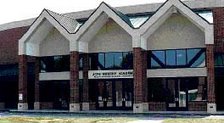
At Jackson we picked up passengers who had been waiting in front of a long-closed-for-the-evening Greyhound Bus Station (shown at right), one built in the art-deco style of similar design to Louisville's former bus station on Broadway, but of a much smaller scale. One of the newbies was an older man whose occupation involved driving newly built trucks from one point to another, using the Greyhound to make his connections between trucks. He was headed for a truck frame somewhere in Texas which he would subsequently drive to Indianapolis for additional work. He was from Henderson City, Tennessee and I mentioned that I thought I had distant relatives from there, related to my Grandfather Noble's brother, who lived in nearly Jackson. He knew of several Noble families in the area.

We travelled together from Jackson to Memphis for starters. At this point we were about three and half hours hours behind schedule.

The less said about my additional four-hour stay in Memphis the better. Nothing about it was pleasing and the Greyhound Bus Company should be fined for their operation in that city. For the record, the random Drug Check turned up nothing. And the jerk that was driving the 3:00 AM bus to Amarillo was not just "licking his lips." He stuck his tongue out at me and that was the cause of my outburst. At this point we were about seven hours behind schedule.

We left Memphis headed west to Dallas, quite a long haul somewhat diagonally across Arkansas, which when crossed diagonally is quite a trip. This took us through the capital city Little Rock with the Bill Clinton Presidential Library clearly in view off to the north, as well as other places that in the pre-Bill Clinton days most of us did not know of - one town named Hope and another named Hot Springs. Hope of course is the hometown of the former president, where as a child his last name was not Clinton but Blythe. Blythe is the maiden name of my great grandfather Lewis's mother, Sarah Catherine, but they were from the Owensboro area to my knowledge. Hope, by the way, is also the hometown of former Louisville Mayor and Kentucky Attorney General Dave Armstrong.

Further south of there was a town with a familiar name - Okolona. I'm sure like all the other Okolona's except for the one in Jefferson County, theirs is named for a tribe of Native Americans. We made a stop in Prescott, Arkansas and another one in the 400 block of the East I-30 Frontage Road in Texarkana, Arkansas where four blocks to the west is State Line Avenue and one enters Texas.

Texas. Texas is truly a different state of mind. Texans seem to be a rather independent sort, still not comfortable with their status as a state of the United States of America rather than their lone star status as the Republic of Texas, this despite the fact they've been a part of the American Republic since December 29, 1845.


Crossing no hills and no dells, we entered into Dallas after passing over a large body of water known as the Ray Hubbard Lake (at right), an artificial body of water serving as a reservoir for the drinking and other water needs of Dallas. It is a vast empoundment (23,000 acres) where one can see miles and miles of water across a fairly flat plain, differing from of Corps of Engineers lakes in Kentucky which tend to fill up a number of valleys in their formation.

We stopped in Dallas where, I have to say, the transfer from one bus to another was the most organized. Among all the bus depots, Dallas' was the cleanest, largest, and seemed to be very well operated.

We left Dallas southward along Interstate 35E which after a few miles becomes simply Interstate 35 en route to Waco. I must have slept through the stop at Waco since I have no recall of it at all. When I awoke we were already headed to Austin, shown in the picture above. Sitting next to me was a tall, muscular, handsome, and very fair complected young man - Andrew, the only person's name I learned on the entire trip. He is a vocational student, studying welding, at some Texas Vocational College. He was headed to Austin to meet his parents, girlfriend, and some others for dinner. The next morning he was going to Beaumont where he would pick up his new ride, a 2005 Dodge Ram Pickup. He was clearly excited about it talking the entire trip between the two cities. He told me all about growing up in Austin, doing the music scene - he plays guitar and piano - and generally liking being a Texan. He also mentioned politics, the only time along my trip anyone did. He had voted as an 18 year old for the first time last year and he voted for Barack Obama. Talking to an 19 year old from Texas who voted for Obama in his first trip to the polls. I was almost in love - it was too much to handle. I wished him well when he departed at Austin. His big broad hand completely covered mine in the handshake the way the late Mel Meiners did. Austin, by the way, is a much, much larger place than I had imagined. According to the Census Bureau, the population within the Austin city limits is close to 750,000 with the metropolitan area having about 1,600,000. That contrasts with the entirety of Louisville-Jefferson County Metro (small cities and unincorporated territory included) which has a population of aboout 711,000.

It is hard to determine where the suburbs of Austin end and the suburbs of San Antonio begin. Sandwiched between the two is the city of San Marcos, the seat of Hays County. We make a brief stop there and then moved on to our desitnation. My seatmate from Austin to San Antonio was an interesting looking fellow, looking something along the lines of Monty Python. Young, tall, and very thin and wearing a hoodie, he clutched in his hands an unsecured collection of papers and books which he told me was his "guide to the future." He is to be a monk in some very small very conservative Catholic monastery. He was going to San Antonio to meet his Superior. I wished him well; he said nothing more.

I finally arrived at San Antonio, eight hours later than expected, but still there and made my way by cab over to my hotel.

THE TRIP BACK

The return trip wasn't nearly as exciting, partly because I was now an accustomed traveller. One learns the nuances, getting of the bus and immediately getting into the reboarding line, even if you aren't reboarding for another 45 minutes. There is also the drill of rushing over to the Charging Stations, something travellers of the past did not have. These are banks of electrical outlets used for recharging cell phones and laptops. You exit a bus, drop your bags in the reboarding line, and head to the charging station to claim a plug. Then an interesting thing happens. You plug your phone in, with all the others, and walk away. Noone seemed to be hovering around to protect their valuable phone or lap top, not even in Memphis. I found that reassuring.

We left San Antonio a little later than scheduled due to an "misunderstanding" about whether 24 bottles of Mexican Tequila could safely travel in the underbelly of the bus against state and federal laws. After some deliberation, it seems that such transport can happen. I think at that point there were only 22 bottles to be transported, the distribution of the other two perhaps making the trip possible. Maybe. This trip northward had more than the usual share of mexicans, most of whom had arrived from Laredo (and Mexico itself) on an earlier bus. My companion from here to Dallas was a young mexican about 22 years old (veinty-dos). I never learned his name and as it turned out, he and his family made the exact same trip as I did, all the way to Louisville. But he switched seats at Dallas. We didn't talk much as he spoke no English other than to say his age and that he was headed to "Loo-Eese-Bee-Yay" which translated is Louisville. While not saying much he showed me some of his official papers along with some pictures from his wallet, which was attached to him by a long silver braided chain. But I never did learn his name. Along the way, we made the same stops - San Marcos, Austin, Waco (which this time I saw), and Dallas, arriving there about 11:30 pm.

As I said before, the Dallas depot is a very large and greatly organized operation, method amid chaos. We left from there headed to Little Rock and eventually to the hellhole at Memphis. My seatmate was an older Amish man with long hair tucked up in a hat dressed in the usual black. He was travelling with his wife, their two children, and one other young person. They were en route to Pennsylvania. None of them said much at all - not to each other or to anyone else. I was curious about always seeing the Amish on the bus since I've never seen them in the car. Finally, I worked up the nerve to ask why this apparent discrepency? He allowed several reasons. The do not drive cars, but they are allowed to hire others to drive them if travel distances are extreme. This seems unorthodox to me but what do I know. I'm just trying to find my way from the Catholic Church to the Episcopal Church which on the surface seems easy but so far has taken me going on six years. But, I digress.

He went on to say something about families travelling together trumping the law against use of a car as well as the idea that a car extols the prominence of its owner while riding public transportation puts all on the same level palying field. His explanantion completed, he said no more.

We stopped briefly in Prescott, Arkansas and a few other towns, one to pick up eight recently released convicts from a prison van. All young, all white, all carrying their little see-through cotton mesh bag of belongings, all eight of whom immediately made their way to the back of the bus joining the everpresent young blacks and young white rednecks, all seeming headed to either Atlanta or Detroit, niether one of which was on my route. At some point I drifted off to sleep, waking only when we arrived at the depot in Little Rock - actually in North Little Rock.

There is one of those ubiquitous coffee dispensing machines in Little Rock. Simple $1.00 Dixie Cups of coffee. I added sugar although I usually drink it black. I had gotten a cup from the same machine on the way south and it was relatively good. So was this second cup. I really wanted to be awake so as to see the Mississippi River once we crossed back into Tennessee. Crossing this great body of water is always a somewhat moving experience for me. Although I've crossed it a few times in the air, seeing it at ground level can be emotional. I had actually missed it when we left Memphis on the way down. It is one of those major marking points in our Republic, like crossing the Alleghenies in the east or the Rockies in the west. Thus, I was awake for my transposition back into Tennessee on Interstate 40 across the Hernando DeSoto Bridge (shown below with Memphis in the background).


Memphis in the daylight and less the confusion is a little better than what I experience on the way down but not much. I had been in Memphis as a little boy when my grandfather was working there building a Kroger distribution center. This would have been in the mid 1960s so I do not remember much. We stayed in some extended stay apartments called the Bellevue and there was a pool but it had no water. We visited Graceland, then home to an alive-and-well Elvis Presley and also visited some military base closeby. I may go back someday but I doubt it will be anytime soon.

For the first time since before leaving Louisville, there skies were overcast and we eventually drove into rain, rain which would be with us through Nashville and into southern Kentucky. I do not remember who weas seated next to me on this part of the trip. After the brief stop in Jackson I went to sleep.

I woke up outside of Nashville where we transferred to our "destination" bus to Louisville. Leaving Nashville I was ready to be back home. My final seatmate was a young lady, a junior in college from somewhere in upstate New York. Where she had been I do not know. She introduced herself and said very little else. I remained awake for the final leg of the trip. She spent the entire time texting people. She must have texted everyone of her contacts, as she never let up all the way into Louisville.

It hit me somewhere just south of Shepherdsville that I was home - my long trip halfway across the country and back at an end. Back to whatever business is at hand, I will always remember my lesson of cultural studies aboard the Greyhound to San Antonio.

Dorothy was right. There's no place like home.

Don't forget Tom Owen's program at 2:00 pm on Sunday at the Clifton Center on Payne Street.

Saturday, November 14, 2009

More from San Antonio

The RiverWalk is so cool. Walked quite a bit of it late last night with a group of friends. Earlier we had been to dinner at Buchanon's Steak House, ranked the 2nd Best Steak House in Texas. Thinks Morton's on steroids. To my knowledge we don't have anything like Buchanon's anywhere in Kentucky.

The RiverWalk is Fourth Street Live times five all set along both sides of the San Antonio River and some offshoots all in downtown. We ended up at a place called Republic of Texas (creative name) where the DJ never let the music slow down or the volume go down. He played a combination of music from 1960s through last week - lots of hip hop, lots and lots of Hispanic music thrown in. Dancing was fun.

Today I'm going to hear Doris Kearns Goodwin at a luncheon. I have her book Team of Rivals for her to sign. I've read most of her books over the years. More later.

Friday, November 13, 2009

Live From San Antonio


I'm just checking in. I'll be posting more later. I'm staying the Menger Hotel which is literally next door to the Alamo. Kinda neat. The hotel itself is of an historic nature. In the past it has hosted Robert E. Lee, Theodore Roosevelt, and Bill Clinton to name a few.

I'm going to be doing some tinkering with the comment section as the blog is being bombarded with spam advertising. I've had more commenters in the last week than I've had since the commencement for the blog. Sorry for any inconvience.

Wednesday, November 11, 2009

Veterans Day in America


Today is Veterans Day, a day we set aside for the honor and memory of those women and men who devoted a part of their lives, and in many cases their very lives, in service to our country. I was raised by one of those who served their duty in World War Two. My grandfather Daniel Hockensmith, was a Seabee in the United States Navy. He died in 1983 long after his service was ended. Others have died on the battlefield, in medical hospitals, and elsewhere. Some, like my grandfather, had the opportunity to live out their lives; others did not.

Yesterday, the President travelled to Fort Hood, Texas to address the memorial service for those who were killed in an outbreak of violence there this week. Thirteen women and men lost their lives on American soil. The president's speech was very moving, very emotional. I am sure it was one of the most difficult speeches he has ever given. I have copied the text of the president's speech below.

Today, or someday soon, remember our Veterans, if only by nodding your head in acknowledgement while driving past a cemetery. Veterans are buried in many cemeteries, but their graves are most easily seen in our National Cemeteries. The Louisville area has three - Zachary Taylor on Brownsboro Road, a part of Cave Hill on Baxter Avenue, and the New Albany National Cemetery across the river in Floyd County, shown in the picture above. In nearby Hardin County is the Radcliff Veterans Cemetery created and owned by the Commonwealth of Kentucky.

May the souls of these veterans and all the departed Rest In Peace.

*****

The text of President Obama's speech, November 10, 2009:


We come together filled with sorrow for the thirteen Americans that we have lost; with gratitude for the lives that they led; and with a determination to honor them through the work we carry on.

This is a time of war. And yet these Americans did not die on a foreign field of battle. They were killed here, on American soil, in the heart of this great American community. It is this fact that makes the tragedy even more painful and even more incomprehensible.

For those families who have lost a loved one, no words can fill the void that has been left. We knew these men and women as soldiers and caregivers. You knew them as mothers and fathers; sons and daughters; sisters and brothers.

But here is what you must also know: your loved ones endure through the life of our nation. Their memory will be honored in the places they lived and by the people they touched. Their life's work is our security, and the freedom that we too often take for granted. Every evening that the sun sets on a tranquil town; every dawn that a flag is unfurled; every moment that an American enjoys life, liberty and the pursuit of happiness - that is their legacy.

Neither this country - nor the values that we were founded upon - could exist without men and women like these thirteen Americans. And that is why we must pay tribute to their stories.

Chief Warrant Officer Michael Cahill had served in the National Guard and worked as a physician's assistant for decades. A husband and father of three, he was so committed to his patients that on the day he died, he was back at work just weeks after having a heart attack.

Major Libardo Eduardo Caraveo spoke little English when he came to America as a teenager. But he put himself through college, earned a PhD, and was helping combat units cope with the stress of deployment. He is survived by his wife, sons and step-daughters.

Staff Sergeant Justin DeCrow joined the Army right after high school, married his high school sweetheart, and had served as a light wheeled mechanic and Satellite Communications Operator. He was known as an optimist, a mentor, and a loving husband and father.

After retiring from the Army as a Major, John Gaffaney cared for society's most vulnerable during two decades as a psychiatric nurse. He spent three years trying to return to active duty in this time of war, and he was preparing to deploy to Iraq as a Captain. He leaves behind a wife and son.

Specialist Frederick Greene was a Tennessean who wanted to join the Army for a long time, and did so in 2008 with the support of his family. As a combat engineer he was a natural leader, and he is survived by his wife and two daughters.

Specialist Jason Hunt was also recently married, with three children to care for. He joined the Army after high school. He did a tour in Iraq, and it was there that he re-enlisted for six more years on his 21st birthday so that he could continue to serve.

Staff Sergeant Amy Krueger was an athlete in high school, joined the Army shortly after 9/11, and had since returned home to speak to students about her experience. When her mother told her she couldn't take on Osama bin Laden by herself, Amy replied: "Watch me."

Private First Class Aaron Nemelka was an Eagle Scout who just recently signed up to do one of the most dangerous jobs in the service - diffuse bombs - so that he could help save lives. He was proudly carrying on a tradition of military service that runs deep within his family.

Private First Class Michael Pearson loved his family and loved his music, and his goal was to be a music teacher. He excelled at playing the guitar, and could create songs on the spot and show others how to play. He joined the military a year ago, and was preparing for his first deployment.

Captain Russell Seager worked as a nurse for the VA, helping veterans with Post-Traumatic Stress. He had great respect for the military, and signed up to serve so that he could help soldiers cope with the stress of combat and return to civilian life. He leaves behind a wife and son.

Private Francheska Velez, the daughter of a father from Colombia and a Puerto Rican mother, had recently served in Korea and in Iraq, and was pursuing a career in the Army. When she was killed, she was pregnant with her first child, and was excited about becoming a mother.

Lieutenant Colonel Juanita Warman was the daughter and granddaughter of Army veterans. She was a single mother who put herself through college and graduate school, and served as a nurse practitioner while raising her two daughters. She also left behind a loving husband.

Private First Class Kham Xiong came to America from Thailand as a small child. He was a husband and father who followed his brother into the military because his family had a strong history of service. He was preparing for his first deployment to Afghanistan.

These men and women came from all parts of the country. Some had long careers in the military. Some had signed up to serve in the shadow of 9/11. Some had known intense combat in Iraq and Afghanistan, and some cared for those did. Their lives speak to the strength, the dignity and the decency of those who serve, and that is how they will be remembered.

That same spirit is embodied in the community here at Fort Hood, and in the many wounded who are still recovering. In those terrible minutes during the attack, soldiers made makeshift tourniquets out of their clothes. They braved gunfire to reach the wounded, and ferried them to safety in the backs of cars and a pick-up truck.

One young soldier, Amber Bahr, was so intent on helping others that she did not realize for some time that she, herself, had been shot in the back. Two police officers - Mark Todd and Kim Munley - saved countless lives by risking their own. One medic - Francisco de la Serna - treated both Officer Munley and the gunman who shot her.

It may be hard to comprehend the twisted logic that led to this tragedy. But this much we do know - no faith justifies these murderous and craven acts; no just and loving God looks upon them with favor. And for what he has done, we know that the killer will be met with justice - in this world, and the next.

These are trying times for our country. In Afghanistan and Pakistan, the same extremists who killed nearly 3,000 Americans continue to endanger America, our allies, and innocent Afghans and Pakistanis. In Iraq, we are working to bring a war to a successful end, as there are still those who would deny the Iraqi people the future that Americans and Iraqis have sacrificed so much for.

As we face these challenges, the stories of those at Fort Hood reaffirm the core values that we are fighting for, and the strength that we must draw upon. Theirs are tales of American men and women answering an extraordinary call - the call to serve their comrades, their communities, and their country. In an age of selfishness, they embody responsibility. In an era of division, they call upon us to come together. In a time of cynicism, they remind us of who we are as Americans.

We are a nation that endures because of the courage of those who defend it. We saw that valor in those who braved bullets here at Fort Hood, just as surely as we see it in those who signed up knowing that they would serve in harm's way.

We are a nation of laws whose commitment to justice is so enduring that we would treat a gunman and give him due process, just as surely as we will see that he pays for his crimes.

We are a nation that guarantees the freedom to worship as one chooses. And instead of claiming God for our side, we remember Lincoln's words, and always pray to be on the side of God.

We are a nation that is dedicated to the proposition that all men and women are created equal. We live that truth within our military, and see it in the varied backgrounds of those we lay to rest today. We defend that truth at home and abroad, and we know that Americans will always be found on the side of liberty and equality. That is who we are as a people.

Tomorrow is Veterans Day. It is a chance to pause, and to pay tribute - for students to learn of the struggles that preceded them; for families to honor the service of parents and grandparents; for citizens to reflect upon the sacrifices that have been made in pursuit of a more perfect union.

For history is filled with heroes. You may remember the stories of a grandfather who marched across Europe; an uncle who fought in Vietnam; a sister who served in the Gulf. But as we honor the many generations who have served, I think all of us - every single American - must acknowledge that this generation has more than proved itself the equal of those who have come before.

We need not look to the past for greatness, because it is before our very eyes.

This generation of soldiers, sailors, airmen, Marines and Coast Guardsmen have volunteered in a time of certain danger. They are part of the finest fighting force that the world has ever known. They have served tour after tour of duty in distant, different and difficult places. They have stood watch in blinding deserts and on snowy mountains. They have extended the opportunity of self-government to peoples that have suffered tyranny and war. They are man and woman; white, black, and brown; of all faiths and stations - all Americans, serving together to protect our people, while giving others half a world away the chance to lead a better life.

In today's wars, there is not always a simple ceremony that signals our troops' success - no surrender papers to be signed, or capital to be claimed. But the measure of their impact is no less great - in a world of threats that know no borders, it will be marked in the safety of our cities and towns, and the security and opportunity that is extended abroad. And it will serve as testimony to the character of those who serve, and the example that you set for America and for the world.

Here, at Fort Hood, we pay tribute to thirteen men and women who were not able to escape the horror of war, even in the comfort of home. Later today, at Fort Lewis, one community will gather to remember so many in one Stryker Brigade who have fallen in Afghanistan.

Long after they are laid to rest - when the fighting has finished, and our nation has endured; when today's servicemen and women are veterans, and their children have grown - it will be said of this generation that they believed under the most trying of tests; that they persevered not just when it was easy, but when it was hard; and that they paid the price and bore the burden to secure this nation, and stood up for the values that live in the hearts of all free peoples.

So we say goodbye to those who now belong to eternity. We press ahead in pursuit of the peace that guided their service. May God bless the memory of those we lost. And may God bless the United States of America.

Tuesday, November 10, 2009

562. Weather, Wendell, and Wander

Weather

Most of my six faithful readers live somewhere in the Ohio River Valley and for them my comments on the recent weather will not be news. But for the rest of you, across the country and around the world, it should be noted as newsworthy that the high temperatures here along the Left Bank of the Ohio River near Milepost 606 have, for most of November, been somewhere in the 70s. The average high temperature for November in this area is 56, which is the mean temperature in this area for the entire year. Of course, there are twenty days left to cool down those temperatures as there is a reason it is called an average. And we haven't broken any records although we did tie one. The record high temperature in any November for Louisville is 86 degrees. After today, there aren't too many more 70s forecast.

Wendell

One of Kentucky's favorite and famous authors is Wendell Berry. Mr. Berry is a native and resident of nearby Henry County. Henry County is a beautiful largely agricultural county whose courthouse town, New Castle, is about 33 miles from Louisville. Berry's family is part of the gentry of the county where the Berry name remains very familiar. Berry lives on the far side of the county away from Louisville in the village of Port Royal where he has maintained a farmstead for nearly a half century. He writes about the agrarian way of life, sustainable farming, and other such lore, along with poems, newspaper articles, and magazine contributions. He is a graduate of the Millersburg Military Institute in northeastern Bourbon County along Hinkston Creek and of the University of Kentucky. (Note to self: someday I should write about MMI - an intersting place).

Tomorrow, Mr. Berry will be speaking to the Metro Democratic Club at their regular monthly meeting. I'm sure he will talk about the things he regularly speaks of, things that urban dwellers like to hear but usually do not have the intestinal fortitude to make happen - this writer included. I heard Mr. Berry speak many years ago at Bellarmine College. The Metro Club meeting will begin at 6:30 pm at the American Legion Highland Post on Bardstown Road, three blocks north of the Watterson Expressway. It should be a very interesting and informative night.

Wander

Unfortunately, I will not be in town to hear Mr. Berry speak. Of the many Metro Club meetings I've attended, this is one I would not want to miss. But I will. Earlier this year, I arranged to attend a convention which starts tomorrow in San Antonio, Texas. I'll be leaving during the day tomorrow and will thus miss Mr. Berry's address. Rather than take conventional transportation to the Lone Star State - a plane - I've opted to travel by Greyhound bus, something I haven't done since college. Earlier this summer two friends of mine crossed the country to Los Angeles - and then came back - aboard Greyhound busses. As they travelled, I got occasional text messages of where they were and what they were seeing - quite a show.
One part of the show, at least while the sun is shining, is watching the scenery pass by as we travel from Louisville to Nashville to Memphis to Little Rock to Benton to Dallas to San Antonio - and back. Another more interesting part of the show will be my fellow travellers themselves, maybe like Hemingway's Basque peasants encountered on the bus by Bill and Jake enroute to Burguete. I'm hoping to interact with a few along the way - hear their story - share with them mine, and so on. Wanderlust is an intersting affection.
*****

I probably won't be posting again until next Tuesday. Enjoy the week.

Sunday, November 8, 2009

561. Healthcare Voters along MP606

I can't honestly say that when I voted last year for Barack Obama that healthcare was one of the overriding reasons. I'm sure it was one of the reasons, but not a the top of the list. Getting us out of Iraq was probably at the top. Or maybe it was getting George W. Bush out of Washington - that is more likely. Looking back at the entry of Election Eve, 2008, written the night before the day we elected Barack Obama the 44th President of the United States, this is what I had to say about George W. Bush:

George W. Bush has led our country into war, into debt, and into isolation with the rest of the planet. He has almost single handedly destroyed the integrity and pride of the United States of America. He had been aided and abetted in this travesty by his Vice President, Dick Cheney, a former congressman and Secretary of Defense from Wyoming. He has further been aided and abetted by voters all across the country who reelected him in 2004, or more properly elected him for the first time, as it is totally unprovable that he was ever elected the first time.


There isn't a word in there about healthcare. On other occasions, I've written about America's need to address its failing infrastructure. I've written a lot on the evils of continually lowering taxes and exempting taxpayers from the revenue rolls of the Republic, but, honestly, I've written very little about healthcare. A search of the blog indicates I've used the word twelve times, seven since Obama's election; five before then. So, why now?

It isn't like it is a new subject. My congressman has been talking about it since his first election in 2006. America has herself addressed the subject in bits and pieces over time. We've created Medicare and Medicaid, along with the Veterans Administration hospitals, all of which are forms of government-ran healthcare systems. I see very few people refusing the services of any of these three so-called "socialist medicine" programs. Yet, when it comes to expanding these programs to all people, nationwide, there is an unfortunate pushback.

Despite the pushback, the United States House of Representatives last night passed, by a very narrow margin, a healthcare bill. My congressman, John Yarmuth, of course, supported such legislation. His neighboring congressman, Baron Hill, along the Right Bank of the Ohio River near Milepost 606 also voted Yes, something of a pleasant surprise. His fellow Democratic congressman from Kentucky, Albert Benjamin Chandler III, voted with the Republicans - that is Ben voted with every single Republican save one - from Louisiana - voting against the bill.

At a dinner a few weeks ago in Lexington Congressman Chandler, in addressing a room full of Kentucky Democrats at the Red Mile Race Course, waffled on the matter, saying he thought it was a good idea but was worried about the cost. Imagine a Kentucky politician worried about the costs of healthcare. I must wonder on just what is it Congressman Chandler would rather have us spend money? He hasn't told us the answer to that question - only that this measure was too much for his blood. I think it is worth asking with which other "socialist" programs he might have problems? Does he think the school lunch program is worth the dime? Or Social Security? Or Medicare? Or the outlay for veterans at the Lexington VA hospitals [they have two, one on Leestown, one on Cooper Drive on the UK campus]?

Maybe it isn't fair to ask these questions as these are all programs already in place, programs which have been in place for many years. But, with all the talk for shrinking the government, one must wonder if they weren't, would the present congress, including the congressman from Kentucky's Sixth District, vote for such programs?

I've written in the past that the best advantage and worst aspect of a democracy is that people get to vote. Keep in mind America, we are a representative democracy, as the forefathers - there were no foremothers - assigned to the people no right to vote on everything, offering instead the right to vote for people who would then represent them in the congress. Fortunately, we are also a government of three branches. Obama runs one of them, the Conservatives control the Federal Bench, but it is unclear who controls the third, where the Democrats at least seem to be in charge at least on paper.

Ours is a big tent party. Thus, there is room for a blue dog like Chandler. To his credit, Chandler has supported some left-of-center initiatives. Like Yarmuth and Hill, Chandler was an early supporter of Barack Obama, endorsing him on April 30, a few weeks before Kentucky's primary. He has led the fight on Clean Water programs, something a lot more vitally important to his district than most of his constituents realize. And he has been against coal in the mountaintop removal argument, which takes some big chunks of coal to do in this state. So, maybe I'm being too harsh. (For the record, I am closer to Mongiardo's stance on coal than I am on Conway's, my candidate for the U.S. Senate). Nonetheless, at some point someone has to say, "Ben, based on your concern about costs, which group of Kentuckians is it you don't think should have healthcare?"

Thursday, November 5, 2009

560. In The News

For one thing, I was in the news, although if I had my 'druthers, I would not have been. Yesterday's edition of LEO carried a story, which had at least one mistake I've asked the writer to correct, concerning Ken Herndon's filing to close his lawsuit (while allowing the opportunity to reopen it) which was seeking to find who was behind a defaming mailer which likely caused him his race for Council in 2008. This filing brings to a close a long chapter of ugly politics which began in May 2008. I am glad that chapter has closed but I find it unfortunate that the evil-doers, whoever they are, will go unpunished. We can all expect this sort of thing again in the future. And when it happens, all fingers will likely be pointed at the same suspect(s) and probably for the same reason(s). One down side - of many - is that the handling of the mailing and of the subsequent lawsuit has caused friends to part and political alliances to crumble. The mailing was a mounmental effort with monumental consequences among a varied groups of people in the Louisville political and cultural community. So, this too, has passed.

More political news yesterday came in reports of what had happened the day before when elections were held in various places across the Republic. I pored through the electronic media pages from Virginia and New Jersey where the Democrats lost governorships. I also looked at the gay marriage votes and the mayoral votes in New York and Boston. It is a mixed bag of results but one thing is clear - the electorate in Tuesday's locations was, for the most part, down considerably from 2008, especially among younger voters and black voters, and in many places incumbency was a burden, not a help.

Mayors Michael Bloomberg and Thomas Menino are exceptions. Menino won a 5th term in Boston making him the longest serving mayor in that city, despite calls that he and his cabinet are too white, too WASPy, and all this in a town we all think of as Irish. He beat an Irish-American who had promised to hire as his deputy a Korean-American. Clearly the voters sought less diversity, weren't interested in hyphenated-ethnicities and Menino, the white guy, won easily. Bloomberg in New York barely won despite spending a fortune and running against a nobody. Bloomberg's win is unprecedented in that he just last year had the laws changed which would allow him another term. While the effort left a bad taste in some voters' mouths, he still eeked out a win. Out in both states, Republicans and challengers did better than Democrats and incumbents. Having said that, New York City remains a strongly Democratic city, with all the boroughs but one (Staten Island (Richmond County) - long a Republican center and the least populated - literally an island) easily electing Democratic leaders, Bloomberg being the exception.

In Maine and Washington, the vote turnout was better, in the 50s (it is hard to determine Washington's as they are still accepting mail in ballots). Both states pitted one side of the state against the other - in Washington it is coast v. inland, in Maine it is south v. north. Washington voted pro-gay marriage, Maine didn't. As a side note of interest, the same voters who turned down gay marriage in Maine overwhelmingly voted to expand the state's medical marijuana laws, which will now have the state actually growing and harvesting weed for sell to patients in need, an interesting step. It should be noted that marijuana legalization is not a liberal issue and draws considerable support from all sides, especially libertarians. I believe it is something Kentucky should take a serious look at. Hemp production was, at one time, something we were Number One in - and we're not number one on too many lists. And anyone who is paying attention knows the weed contiunes to grow, whether wild or cultivated, all across the Commonwealth. But, I digress.

I won't go into Virginia and New Jersey, where we lost both states. The New Jersey loss was something of a surprise. I think, like any local race, local issues combined with President Obama's lack of progress, gave the wins to the Republicans. Independents, very important voters for Obama in 2008, moved from leaning left to rambling right, tilting the scales even further. Obama needs to stop playing and start producing. Let me say that again. Obama needs to stop playing and start producing. Once more, say it with me. Obama needs to stop playing and start producing.

Finally, while everyone is talking about New York's 23rd Congressional District, where a Democrat was elected in this area (but not necessarily in the 23rd District) for the first time in 100 years, turnout was miserable. The vote was about 60% of those who voted in 2008, and about 3/4 of those who voted in 2006. Black turnout wasn't a factor here as this northerly-most New York district is 94% white. Last week Vice President Biden went up there for a rally - the turnout was 200 people.

The bottom line is this. A number those people who turned out to vote for change, to vote for the first African-American president, and to vote against eight years of the Borrow, Bully, and Spend tactics of the 44th Best President in America; they've done their part and are now sitting back. What's left are traditional voters in both parties and neither group is all that happy. We on the left are tired of waiting. We won the House and the Senate and the Presidency. We seek decisive action. Those of the right, an ever diminishing group, think all government is bad and wont be happy til Grover Norquist and those of his ilk control all the strings which make the government move. The great majority is in the middle watching and waiting. And like Dathan called to Moses in the Book of Numbers, their question is "How long must we wait?"

Sunday, November 1, 2009

Surprise Birthday

November 1st is my father's birthday - his 70th in a series. The entry title is a bit of dark humor. Attaining the age of 70 (and entering his 71st year) has been something of a struggle for my dad, a surprise of sorts that he wasn't anticipating. While for some time he has not been in the best of health, his mind is fine and his attitude about turning an unhealthy 70 is par for him - he told me last night, "this getting old is no good at all" he said with a dry laugh. I reminded him I was none too happy about it either - I'll be 50 the next time I celebrate a birthday, to which he responded, "damn, are you that old?"

So, for my Dad on his 70th birthday, Happy Birthday Old Man. Grow old and prosper.

Monday, October 26, 2009

558. Weekend Wrapup

I was busy the entire weekend. Covered a lot of ground in many different places and a few different ways.

The busy weekend started with my friend Morgan Ransdell at Actors Theater on Main Street in downtown Louisville. It was a production of William Shakespeare's Midsummer Night's Dream. It was quite a production that, had it been a movie, might have been rated R or at least PG-13. The acting was interesting as the story was set somewhere in haze of the drug-infused 1960s, replete with a Volkswagen full of second-rate actors for the play-within-the-play, a Shakespeare staple. Older readers might recall sets from Rowan and Martin's Laugh-In or the old Dating Game.

As written by the Bard, the stars are Oberon, Titania, and Puck, respectively the King and Queen of the Faeries, and Oberon's special servant, Puck, sometimes known as Robin Goodfellow. As performed, the characters of Puck and Bottom (the Ass, from the Players Troupe) took the center stage of the viewers' attention. Eric Bondoc , my favorite for the night, played a very seductive and somewhat homoerotic Puck to his master King Oberon, played by Edward O'Blennis. Puck's unusual singing voice, a sultry lower-middle range, added to the intensity. O'Blennis' portrayal was a cross of Jimi Hendrix, Richard Pryor, the performer once and presently known as Prince, and a few others. He was great. Bottom was portrayed by Aaron Munoz who is transformed as an ass and plays lover to Queen Titania, which was played by Jessica Morris. Munoz as the Ass as well as his Bottom was over-the-top in so many ways. His ramblings around the stage interacting with nearly every other cast member at some point was excellent. We laughed through the entire production which was a litte long on time but never short on creativity and excitement. A great Friday night.

Saturday and Sunday were spent with Preston Bates touring the counties which comprise the 14th Kentucky Senate District, a district where it is anticipated a Special Election may be called for December 8. Preston was already in the area with his U of L History class on some sort of field trip to the Perryville Battlefield State Park in Boyle County, one of my favorite places in Kentucky and our stake in the tourist department for Civil War buffs. Waiting for Preston's class to end, I hiked one of the two loop trails, a distance of about 1.5 miles through Parson's Ridge, the Widow Gibson site, overlooking the Bottom House, up and down Loomis' Heights, along Doctor's Creek, and eventually returning to the Trailhead near the Confederate Cemetery and the Union Monument. I can use the exercise, and this little hike was probably the most I have had in years.

Eventually Preston and I joined up, leaving Perryville and headed to Harrodsburg. We viewed the site for the new Court House, going up on the same Civic Square where three previous courthouses have been erected. Harrodsburg is the county seat of Mercer County, one of the five counties in the 14th Senate District. We headed north out of town and out of the district into Anderson County toward the BG Parkway. As Preston's class had centered on the Civil War, I took him to the Salt River Baptist Church Cemetery in Lawrenceburg where, among many others, are buried distant cousins of mine, the Moore brothers, Samuel and James. Samuel and James were Confederate soldiers under the command of Louisville's Lt. Col. Bennett Young. Here is a trivia question for you. The Moore brothers of Lawrenceburg, Kentucky participated in the northernmost skirmish of the Civil War as privates in the 8th Kentucky Cavalry of the Confederate Army. The "raid" occurred fifteen miles from the Canadian border. Any takers on the name of the raid?

Also buried in the Salt River Cemetery is my 5-Greats Uncle and 6-Greats Grandfather, the same person, Johann Michael Hockersmith, a veteran of the Revolutionary War whose grave is marked by a Sons of the American Revolution plaque. He died around 1812. The cemetery and church date from 1798.

From there, as it was getting late, we took the Bluegrass Parkway over to the western side of the 14th District, to its most populous county, Nelson, and its county seat of Bardstown. However, again a detour. Preston has asked me in the past about the Catholic population of central Kentucky. Nelson County is the base of this popluation, and even before Bardstown was the community of Saint Thomas, home for Bishop Flaget's cabin, the Saint Thomas Church, and the original building which housed Nazareth College, the forerunner of my alma mater, Spalding University. The building dates from 1814. From there we went into Bardstown where we ate supper at a Mexican restaurant on Third Street. We called it a night and proceeded back to Louisville.

Sunday's trip covered the rest of the 14th District, beginning in far southern Taylor County at Tebbs Bend. This beginning again took us into Civil War territory. On July 4, 1863, while the rest of the country was focussed on battles at Gettysburg, Pennsylvania and Vicksburg, Mississippi, another smaller battle was being fought over the Green River Bridge at Tebbs Bend in Taylor County. A confederate cemetery marks the spot and among its graves are those of James Hockensmith and Alexander Hockersmith, cousins of mine, both from the family of Johann Michael mentioned above. We left the cemetery driving into Campbellsville with its very non-descript courthouse built in the 1960s as well as Campbellsville University on the northwest side of town.

From there we headed north on US68 and the detoured onto KY208, an older path between Campbellsville and the Marion County seat of Lebanon. This road takes us through Calvary, a small town memorable for me as the place where my Ford Ranger PickUp crossed the 100,000 mile mark on the odometer a few years back. Ah, the memories. In Lebanon, we drove around several parts of town noting the statuary at the corner of Spalding Avenue and Walnut Street. Spalding heads out of Lebanon and Marion County and into Springfield and Washington County, following KY55. Nine miles of very good highway separate the two county seats.

In Washington County I am always interested in passing the Mordecai Lincoln House, once belonging to the president's uncle. I helped with its original fundraising drive for restoration back in 1979. Upon the death of Mordecai's father, Abraham, who was killed in a Native American raid in Jefferson County, Mordecai inherited his father's property in Washington County. The president's parents were married a little north of this site in 1806. Three years ago, a reenactment of that marriage was the official opening event of our country's celebration of President Lincoln's bicentennial. The marriage license marking this event can be found in Washington's 1816 courthouse, Kentucky's oldest still in daily use.

We ventured north out of Sprinfield past the Lincoln Homestead Park, using KY555, Kentucky's proposed Heartland Parkway. Although this is a very wide two-lane highway, you can see the even wider right-of-way marked by the fencelines, right-of-way which someday could allow for the construction of another two (or more) lanes. I've written before about this connecting road between Green River Lake and Taylorsville Lake, and it was on KY555 and its connecting KY248, that we returned home to Louisville, thus completing our tour of the 14th District's five counties, counties we will need to know all we can in a few weeks as we approach the Special Election.

I will add pictures later.

Monday, October 19, 2009

557. Out of sorts

That last few days have been not quite but almost difficult because of a rift between me and a friend of very long standing. We've disagreed on something very important to both of us. Like all things, this too shall pass. In the meantime, I've sought diversions where they may be found. Friday afternoon Preston and I went to Frankfort and toured the Old Capital on Broadway, designed by a very young Gideon Shryock - notice the spelling - the same young architect who designed our Jefferson County Court House. We did a few other touristy things in my favorite capital city before returning home. Saturday afternoon was yet another trip to central Kentucky, this time to Lexington for a political dinner held in an old refurbished barn. Sunday I was a reader at church, reading the Prayers of the People for the Twentieth Sunday After Pentecost, praying for all sorts of folks. Today I did go back to work, but I remain a little dulled by the situation at hand. After work, again with Preston, I took in a faculty concert given by Paul York and Michael Gurt playing selections from Bach and others in Comstock Hall on the U of L campus. Afterward, we went to Denny's on Crittenden Drive [don't act like you don't know Denny's on Crittenden Drive] where we, unwittingly, became engaged in a conversation with someone who was intent on telling all about his educational, ideological, and professional career. At some point through the discussion, which included this man telling me he recognized my voice from when I did radio voiceover commercials in the late 1980s and early 1990s, I realized I knew who this man was. To confirm, I asked if he had a business card. He offered one. It idenifies him as the founder of the Kentuckiana Cinematography Club, a producer, writer, director, DP [I don't know what those letters mean], actor, aerial videographer, and cinematographer. His name? Brennan Callan. I remain out of sorts.

Sunday, October 18, 2009

556. Barnyard Affair


My guess is General Wesley Clark has spoken in lots of different places in his various careers - military man, politician, venture capitalist. Last night he addressed the Kentucky Democratic Party's Jefferson-Jackson Dinner crowd from a barn, shown in the picture. Not just any barn, but a well-known fixture at Lexington's Red Mile Race Track, the Round Barn. It sits on the track's campus, an eight-sided three story wooden structure with a cupola on top. More on the barn later.

Last night's event was presided over by the very likable Chair of the Kentucky Democratic Party, Charlie Moore of Union County. Although all the tables in the barn were filled, it did seem like there were a number of prominent Democrats missing from the crowd. House Speaker Greg Stumbo was absent, as was most of the Democratic delegation of the General Assembly. The only State Senator in the room was Kathy Stein, although if you could only have one, and you think and vote the way I do, she makes an ideal member of the Upper House. House members included Majority Leader Rocky Adkins, as well as Jesse Crenshaw, Charlie Hoffman, Susan Westrom, and Ruth Ann Palumbo. There were no legislators from Louisville although I did see former State Representative Eleanor Jordan, who was seated with Representative Palumbo.

Other than Lieutenant Governor Dan Mongiardo, all the Democratic constitutional officers were present: Auditor Crit Luallen, Treasurer Todd Hollenbach IV, Attorney General Jack Conway, and, of course, Governor Steve Beshear, who spoke several times. Mongiardo was doing similar duties about 100 miles away at the Bullitt County Jefferson-Jackson Dinner, also held last night. Although he didn't speak, Kentucky's true political rock star, former United Senator (and Governor) Wendell Ford was also present, showered with adoration throughout the evening. There were also maybe eight of us who serve on the State Central Executive Committee present. They included gubernatorial aide Chad Aull, Lisa Tanner (who sang the Star-Spangled Banner), By-Laws Chair George Mills, Jane Jensen, Barren County PVA Brad Bailey, and Tim Longmeyer. KDP EXecutive Director Kyle Cox was present as well as most of the KDP staff. The Kentucky Young Democrats were also well represented. The night began with an invocation by Colman Eldridge, recently elected as Vice President of the National Young Democrats. I also spoke with Austin Redman of Shelby County, Walker Mattox of Fayette County, and Lyles Taylor of Woodford County, all leaders of the Kentucky Young Demcrats.

General Clark was the keynote speaker for the Party's somewhat-annual fundraising dinner. After an introduction of himself and his military career, including his years at West Point, as well as time spent in Brandenburg, Kentucky and Fort Knox, Kentucky, the retired military leader launched into an explanation of why he is a Democrat, what being so means to him given his background, and why he thinks the Democratic Party is the cure for what ails the Republic.

He pointed out than in the last century, wars were won under the leadership of a Democrat citing Wilson in WW1 and Roosevelt in WW2. He blamed the loss of Vietnam on President Johnson's decision to withhold troops in 1968 which led, a few years later, to the fall of Saigon, in one of the less-noble of America's military ventures. There are a nubmer of parallels between then and now and I got clearly mixed signals from him on how President Barack Obama is handling our current several foreign wars. His strongest point, though, was how honorable it is as Americans to have as president a winner of the Nobel Peace Prize, perhaps the most prestigious accolade in the world.

After the military discussion, he moved into the current economic situation, acknowledged by one and all as not good. He explained, as well or better than any business or economics professor ever has, how the economy works or doesn't work under certain conditions. He talked at length about the value of the American dollar, the volume of those dollars making their way into foreign hands, especially the hands of the Chinese.

He went into an explanation of oil and gas and natural resources and how the world economy is built around their exploration, discovery, and use. He offered an interesting idea to bring those costs home to Americans. He suggested that whenever we purchase gasoline at the corner market, that our receipt should include where those dollars we just spent actually go. The receipt would not only say "10 gallons at $2.499 per" (the price I paid yesterday) for a total of $24.99, but also how many of those dollars go to oil interests other than the United States, in places like Canada, Saudi Arabia, and Venezuela. Maybe such a system would lead people to believe that if we are to sustain our present use of oil (an idea opposed by many in the left wing of the Party), then we must also find ways to produce more here in the United States.

He segued from oil and gas over to a discussion on global warming and included in that discussion was both a veiled threat to as well as support of the use of coal, one of Kentucky's "cash crops." The applause for the two different sides of the discussion was interesting. I suppose the Conway supporters applauded at different times than the Mongiardo supporters, as the camps seems to be divided on the subject, far moreso than the candidates they support. Although I am a Conway supporter, I side with those who believe there is a role for Kentucky's coal in the future, mined in a less destructive way, and burned in a cleaner, greener way. I admit the technology still seems to be out-of-reach, but only just out-of-reach and conceivably closer than we imagine.

I very much appreciated General Clark's unbiased assessment of our nation's economy as well as his directions for where we can go from here. At the end of the night I made my way up to him to thank him for coming. I had met him before when former KDP Chair Jerry Lundergan had brought him to Louisville's West End to do some campaiging with then-candidate John Yarmuth, an event Clark cited in his speech.

Other speakers included the aforementioned congressman representing the Left Bank of the Ohio River near Milepost 606, the Honorable John Yarmuth, as well as Governor Steve Beshear and Kentucky's Sixth District Congressman A. B. "Ben" Chandler III, a blue dog of sorts who took the time to explain that he and Congressman Yarmuth do not always agree when they are in Washington, but they do agree that the Democratic Party is best prepared to deliver a better life for all Americans. Ben also gave a rousing endorsement of President Obama's term in office thus far - all nine months of it - an unspoken reminder that he, like Yarmuth, was an early endorser of Obama. He also pointed out that in the 2004 presidential the man he endorsed was sitting in the room - General Wesley Clark.


But, back to this interesting venue, the Round Barn at Lexington's Red Mile Racetrack. The barn was built in 1882 and served as a Women's Club type facility, known as the Floral Hall. It has eight sides and three stories, each higher one smaller than the floor below, and was designed by John McMurtry, a well known central Kentucky archtect from the 19th century. The money to build the barn was appropriated by the United States Congress to the Lexington Fairgrounds for damages rendered to the fairgrounds by Union troops during the Civil War twenty or so years earlier.

As stated, it served as an exhibition hall for floral events and the like. The Red Mile Race Track had been built a few years earlier in 1875. The racetrack, whose first grandstand is shown below, was within the Lexington city limits, where gambling was illegal. The Floral Hall was outside the city limits and at some point the gamblers took over Floral Hall for bookmaking purposes. Some time in the 1890s, the race track acquired the hall and converted it to stables, with living quarters for groomsmen on the upper levels. That was the purpose it served for over fifty years. About sixty years ago, the facility underwent a major renovation and since that time has served as a guest facility of sorts to be rented for events like this one last night. There isn't much to it - a round building outfitted with a set of restrooms. Sitting at my table last night, looking up and around reminded me of what parts of Churchill Downs' grandstand look like, although every time I go to that famous site, it is of a less-and-less historic nature and looks more-and-more like a modern day commercialized casino, which it no doubt some day wants to be.

But, I digress.

As I said, it was a packed house in a small facility. The aura was interesting, the venue historic, and the food was much better than the usual fare for one of these events. I hope it was a fiscal success.


Friday, October 16, 2009

555. Its that time of year

I should probably write about KY555 on this 555th entry. I do not know how many triple-same-digit numbered highways we have in Kentucky. I can place KY111 in the east between Owingsville and Flemingsburg. I can't place a KY222 which in theory would be somewhere near KY22. Nor can I place any other similarly-numbered highways. But, I believe I've already written about KY555 in an entry in July 2008. Here is the link to that if you'd like to read it again:

http://ohioriver606.blogspot.com/2008/07/ky-248-east-to-ky-555-south-heartland.html

So, instead, I'll write, briefly, about it being that time of year. What time of year you ask? Hallowe'en maybe? Thanksgiving? A celebration of the Feast of the Immaculate Conception? (That's December 8th for you non-liturgical types). No, the time bearing time upon us is Christmas. Christmas, for you shoppers, is seventy days off.

Over the weekend, as I promised to do, I cleaned out the garden. In doing so I broke a rake and needed some other incidental stuff, which took me to the Lowe's over on the Veterans Parkway in Clarksville. To find the new rake, I had to make my way through Christmas paradise. Christmas trees, Christmas wreathes, Christmas wrapping, Christmas lights, and several renditions of Santa Claus. I was a little overwhelmed, although I did find a rake and it was on sale too, so all was not lost.

The yesterday, as I was leaving work, I noticed the City Works department people over in Jefferson Square. Their task? Adorning the trees and light standards with thousands and thousands of little white twinkling lights. I'm sure they will all look very nice for the Trick-or-Treaters in two weeks. Four weeks after that is Thanksgiving and Louisville's traditional "Light-Up Louisville" celebration, marking the beginning of the "holiday" season.

Alas, Christmas and its twelve day celebration doesn't start until - surprise - Christmas. Which, as stated earlier is seventy days hence.

Merry, merry!

Saturday, October 10, 2009

554. Not quite the golden triangle

Today was supposed to be spent in southwestern Jefferson County at a community festival helping the candidate I am supporting for Mayor of Louisville-Jefferson County Metro in next year's Democratic Primary. But Mother Nature changed my plans, flooding the festival grounds with yesterday's rains causing the event organizers to cancel the festival.

As such, I got some free time out of it and took to the roads.

My first stop was Lakeview Park in Franklin County, east of the high school on US460. My maternal grandmother's remaining sisters and brothers and their families gathered for a reunion in the very brisk weather under the Hank Hancock Pavilion of the park. My grandmother was the first of her siblings to pass away back in 1976. Since then two more have crossed over. Today the rest were to be found, ranging in age from 69 to 89. My grandmother, were she alive, would be 93.

Everytime I go to one of these affairs I am reminded that like my grandmother's siblings, I too am aging. I joked with more than one of my cousins - actually all 2nd or 3rd cousins as my brother and I have have no true 1st cousins - that I didn't know anyone there under 40 - and I didn't. I had to ask whose kids are whose, and sometimes had to ask whose kids the parents of those kids were.

There was food and drink galore and someone brought an outdoor chimney which provided some much needed heat for the old and young alike. After a full meal and a half, along with a piece of pie, I departed northward out of Franklin County along US127, a very well built highway constructed in the 1970s with wide lanes and wider shoulders. Here and there remnants remain of the former road, especially where one can venture off to the small commnuities of Swallowfield in Frankin County and Monterey in Owen County, which I did. Monterey, by the way, was originally called Williamsburg and was renamed in 1847 in honor of the Mexican city of that name and its role in the Mexican War.

About 25 miles separate Frankfort from Owenton, the Owen County seat. You arrive in Owenton on the southeast side of town where US127 meets the multiplexed KY22/KY227. A note about KY227. When I was younger, it was numbered as US227. However that designation came to an end as the route both started and finished in one state, which sort of keeps it from being a federal highway. The southern part of US227, from Paris to north of Richmond was renumbered as KY627. The northern leg, from Georgetown to Carrollton retained the 227 number, but as a state highway.

The Owen County Court House, shown here in a photo taken by Dave Redden, is off to the west of US127/KY227 on Seminary Street. I stayed north on Main Street leaving the little town where Main Street forks off to the left avoiding the Adams Street Hill. At the community of Long Ridge, more or less an intersection, northbound US127/KY227 are joined by westbound KY36. KY36 is one of the longer state routes in Kentucky, crossing from Frenchburg in Menifee County, through eight more counties before coming to an end at the Milton-Madison Bridge in Trimble County.

About nine miles north of Owenton, KY227 departs the federal route and heads west to the tiny little community of New Liberty, one of the oldest communities in the Commonwealth, dating to sometime before 1800. New Liberty was incorporated in 1827, which is one year before Louisville received its charter from the General Assembly. The oldest church in the county was gathered there about 1806, and remains so, now called the New Liberty Baptist Church.

From New Liberty, KY227 courses westwardly along a ridge through the Dallasburg community which is (apparently) served by the Wheatley Post Office. The street map shows a community named Wheatley, but if one is there I didn't see it. Eventually the road heads toward the confluence of Eagle Creek and the Kentucky River, and the hardscrabble town of Worthville, which is located about four blocks off where KY227 presently runs. Originally the highway fed onto Kyle Street in this little burg, which seems to serve mostly as a staging area for the CSX railroad system. The town is about three blocks wide and maybe 3/4 of a mile long along both sides of the railroad, as shown in the picture. There remain the remnants of an old town - a line of two and three story brick buildings attesting to a once vibrant railroad town. Very little is left other than the railroad yard.

I followed KY227 to its western terminus at US42 in the Carroll County seat of Carrollton. Turning south I ventured one block over (northward) to Main Street which runs along the Ohio River. This street allows a view of the back side of the courthouse and its ample lawn. This is also the original "main" street of the town. A few blocks west is another confluence, that of the Kentucky and Ohio rivers. US42 crosses over the mouth of the Kentucky on a blue two lane bridge built in 1952 into the town of Prestonville.

Someday I will write about the Preston family of Kentucky. This Prestonville and our Preston Highway, along with Prestonsburg in eastern Kentucky and Preston's Landing in Trimble County, are all related. William Preston and his family have roots all up and down the Ohio River and he was from the family of one of Louisville's founders, a family which orginated in Virginia and before that in Ireland. But, I digress.

From Prestonville, I followed the Left Bank of the Kentucky River for a few miles upriver along KY55 and KY389, the latter of which intersects with Interstate 71 at Milemarker 43. From this point I returned home, completing the inside circle of the golden triangle, going "not quite" to Lexington, thence northward "not quite" to northern Kentucky, and returning thence to Louisville.

Friday, October 9, 2009

553. Finish the series: Theodore Roosevelt, Woodrow Wilson, _________________

The series in the title names the three sitting United States presidents who have won the Nobel Peace Prize, something I never imagined writing about here along the Left Bank of the Ohio River near Milepost 606. But here we are.

In my email inbox today was a missive from one Barack Obama, now a Nobel Laureate. I'm sure he only sent it to 100,000,000 of his closest friends - I just happen to be on that list. It is the first email I've ever received from a recipient of the Nobel Prize for Peace.

In it he properly admits that he may not be derserving of this honor. But he has been honored nonetheless. Supporters and opponents alike are enjoying the honor, in good and bad ways. What the president doesn't say in his letter, copied below, is who he might really owes the honor to. That would be the 44th best president our Republic ever endured, Obama's predecessor at 1600 Pennsylvania Avenue NW, one George W. Bush. Or maybe not.

Naming the president as the winner of the prize is the international community's way of saying farewell one more time to the former Commander-In-Chief. The president believes there are other factors involved - he cites them in the email below. But even his more ardent supporters know this may be a little over the top.

I'm one of those supporters. I consider the vote I cast in November 2008 for Barack Obama as one of the most important things I've ever done in my life. That isn't to say I've been entirely happy with his performance during these first nine months. But I've been far prouder of my president and my country in the last nine months than I had been for the previous eight years.

The world seems to agree with me on that count. While the president, and Democrats in general, are on the defensive here at home - for no really good reason - around the country our stock is rising. And that is a good thing. Is it a good enough thing to be awarded the Nobel Peace Prize? I'm not sure.

President Theodore Roosevelt won the award in 1906 and was deserving of a Peace Prize for his role in settling a foreign war between Russia and Japan (although some credit must go also to his Secretary of State John Hay, originally from Salem, Indiana, and one of my favorite people in American History). The settlement is known as the Treaty of Portsmouth. It is one of the few things that Roosevelt claimed to have done which he actually did do. TR is one of the favorite presidents of many Americans. After close study, I have found him aggressive, entertaining to the max, progressive to a limit, and frankly enchanting. But he wasn't the trust-busting reformer he and his supporters made him out to be. He was an excellent showman and like Thomas Jefferson, a true Renaissance man. But he had not the president mettle of either his predecessor, William McKinley, or his successor, Big Bill Taft.

President Woodrow Wilson won the Peace Prize in 1920 (for the year 1919) for his role in the creation of the League of Nations, a precursor to the United Nations, but one that eventually failed on the world scene, largely because of lack of support from the Congress and people in the United States, and an unwilling backbone against Hitler in the late 1930s. Wilson was a world-class leader in a nation and world not yet prepared for such a role - truly a man before his time. His legacy hangs on the failure of the League of Nations, whereas it might be more appropriate to give him credit for the more modern and successful United Nations.

Should President Barack Hussein Obama, Jr., join this dynamic duo from American history? The Nobel Committee seems to think so. For that matter, many thoroughout the world do as well. Maybe we should allow him this international glory - hopefully he will use it not only to create peace around the world (and perhaps rethink his agenda in Afghanistan), but also to restore stability to our domestic economy, something many Americans are still in great need of.

Congratulations, Mr. President.

The email is copied below.

*****

A call to action‏
From: President Barack Obama (info@barackobama.com)
Sent: Fri 10/09/09 5:16 PM
To: Jeff Noble (jtn960@hotmail.com)

Jeff --

This morning, Michelle and I awoke to some surprising and humbling news. At 6 a.m., we received word that I'd been awarded the Nobel Peace Prize for 2009.

To be honest, I do not feel that I deserve to be in the company of so many of the transformative figures who've been honored by this prize -- men and women who've inspired me and inspired the entire world through their courageous pursuit of peace.

But I also know that throughout history the Nobel Peace Prize has not just been used to honor specific achievement; it's also been used as a means to give momentum to a set of causes.

That is why I've said that I will accept this award as a call to action, a call for all nations and all peoples to confront the common challenges of the 21st century. These challenges won't all be met during my presidency, or even my lifetime. But I know these challenges can be met so long as it's recognized that they will not be met by one person or one nation alone.

This award -- and the call to action that comes with it -- does not belong simply to me or my administration; it belongs to all people around the world who have fought for justice and for peace. And most of all, it belongs to you, the men and women of America, who have dared to hope and have worked so hard to make our world a little better.

So today we humbly recommit to the important work that we've begun together. I'm grateful that you've stood with me thus far, and I'm honored to continue our vital work in the years to come.

Thank you,

President Barack Obama

Paid for by Organizing for America, a project of the Democratic National Committee -- 430 South Capitol Street SE, Washington, D.C. 20003. This communication is not authorized by any candidate or candidate's committee
.

Thursday, October 8, 2009

552. Gardening Season Comes To An End

Earlier this year in February, I plotted out how I would put in a garden in my little inner-city plot of land. In front of the house, I've got about a 26 foot square area with a walkway down the middle constituting my front yard. My side yard is a six foot wide stretch of land between my house and the neighbors. The back yard is occupied, for the most part, by an oversized two-car garage, a small deck, and the air-conditioning unit (which quit in July and I've still not had it fixed). There isn't much of a back yard.

What I do have is five of those tall grasses, three very tall and variegated with wide leaves, and two that aren't, along with two very small shrubs. After digging up most of the front yard on the west side of the brick walkway, I did some rearranging and proceded to plant a small garden.

The garden went in on Derby Day under overcast skies and a temperature of 55 degrees. Even though it had been in the 70s and 80s for the three days prior, Derby Day and the two days following remained cool.

I planted four varieties of tomatoes close to the house and three varieties of bell peppers in front of those closer to the little wrought iron fence along the sidewalk. I also added one banana pepper plant. The tomatoes were Chocolate Cherry, German Red Strawberry Heirloom, Rosy Pink Beefsteak, and Winter Grape. The peppers were Chocolate Beauty (brown), Mandarin (red), and Yellow (surprise, yellow). According to the planting directions, fruit should have started appearing on some as early as July 6 and at the latest July 26. Interspersed among all the plants were several different flower varieties - mostly marigolds and petunias, along with a few irises that I didn't know I had. For fun, I also planted some squash seeds just to see the runners, and some rosemary in a pot.

Incidentally, later in the day Mine That Bird, a 50-1 shot, won the Run for the Roses.

It became evident early on that the Chocolate Cherry tomato plant wasn't going to produce as it was taken over by the other three. I pulled it out sometime in July. For a total of seven plants, my garden grew well beyond its appointed boundaries, eventually filling up, mostly with leafy matter rather than fruit, most of the front yard on that side of the walk.

On the 4th of July, I still had not pulled a ripe tomato, but I did take attendance. There was a total of exactly 200 fruits, most of them on the Winter Grape tomato plant, tomatoes somewhat bigger than a cherry tomato plant. I also counted the peppers, which had four, but two had already been pulled.

I pulled the first ripe tomatoes, again Winter Grape variety, on July 9th. The day was overcast and hazy, with a temperature of 80 degrees. Finally, on July 20, the 40th Anniversary of the Man on the Moon, the tomatoes began coming on in abundance, and they have continued so until about two weeks ago. In total, I've pulled about 600 tomatoes, with at least 1/2 of those coming from the one Winter Grape plant. I've never seen anything like it. The peppers began producing in abundance at the beginning of August. I've pulled about 40 peppers, but none which had ripened to a full brown, red, or yellow.

I've taken fruit to my Mom's, her neighbors, church, work, my neighbors, three or four friends, and some to people passing on the sidewalk witnessing the spectacle of a front yard garden. It has been a real pleasure.

But, the time is coming for the garden to be uprooted, the soil turned, and all that sort of thing. Sooner or later this month will come the first real freeze and I want to harvest what is left of the growth before that happens. So far, we've had temperatures as low as 48 and that is forecasted again tomorrow night.

Sunday will probably be the day of reckoning for the garden - the summer garden that is.

Sometime yesterday my friend Hazel, who has been cleaning out her garden, dropped off a bag full of black-eyed susans. I'm not sure where they'll go, but I'm pretty sure they will get there on Sunday.

*****

Each year Dick Frymire, an agriculturalist in Irvington, Kentucky, makes weather predictions based on tree bark and wooly worms. Google that name and you will find lots to read from Mr. Frymire. Below are his predictions for the 2009-2010 Winter Season.

Oct. 1: First frost - (didn't happen to my knowledge)

Oct. 30: Killing frost - just in time for Hallowe'en

Nov. 15: Flurries

Nov. 27: Snow, one inch

Dec. 8: Snow, one inch

Dec. 17: Snow, two inches

Dec. 25: Snow, four inches - A White Christmas !

Jan. 11: Snow, five inches

Jan. 12: Coldest day of the year, 11 degrees below zero

Jan. 14: Sleet, hazardous driving conditions

Jan. 21: Snow, one inch

Jan. 31: Snow, one inch - my nephew's birthday

Feb. 6: Snow, one inch

Feb. 17: Sleet

Feb. 26: First robin, at 10:39 a.m.

March 13: Snow, one inch

March 26: 68 degrees

April 7: Last snow

Tuesday, October 6, 2009

551. Invitation to John Boehner


Ok, admittedly, I'm copying from several other people. I think if you admit to copying up front, it is just like footnoting on a college paper. I think.

Congressman John Boehner stated on Capitol Hill that he knew of no one in the Republic who supports the "public option" option on the president's healthcare proposal other than members of congress or members of the administration. I am one of the people who do support that option, and frankly wished to hell the president was little more enthusiastic about it.

But, in answer to Congressman Boehner's statement, someone, I suppose someone connected with my congressman, has created an invitation, which I have printed above. I will copy it and send it to Congressman Boehner's office. Boehner would not have that far to travel from Ohio's 8th Congressional District should he want to come down here to Kentucky's 3rd. He represents several counties along Ohio's western border with Indiana beginning just north of Cincinnati, in Butler County which is where he himself lives in the far southeastern corner of his district. Interstate 275, that eighty-mile long tri-state circle around the Queen City, almost touches the southernmost line of his district in Butler County. In addition to Cincinnati's suburbs the district also include some suburbs of Dayton, but not Dayton itself. Along the border with Indiana are mostly rural counties with considerably smaller cities and towns. The northernmost part of his district touches the once-beautiful Grand Lake-Saint Mary's, or officially just Grand Lake, which is the largest artificial lake in the world made without the use of machinery, although, having said that, it isn't anything like Kentucky or Barkley lakes. At 13,500 acres, it is larger than most of Kentucky's smaller state park and recreational lakes. But I digress.

If you feel as I do about the public option, feel free to print out the invite and mail it up to Congressman Boehner's office. I would suggest mailing it to a local office rather than have it get lost in the cacophony of Washington DC. Here are the local office addresses:
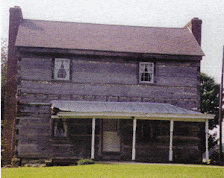
Butler County Office
7969 Cincinnati-Dayton Road
Suite B
West Chester, OH 45069
(513) 779-5400
(513) 779-5315 fax

Miami County Office
12 South Plum Street
Troy, OH 45373
(937) 339-1524
(937) 339-1878 fax

Sunday, October 4, 2009

550. Holy Day/Holy Space

Reader Beware - this is a rambling religious entry.

Some people have favorite days of the year, days such as their birthdays or anniversaries; others have favorite holy days, such as Christmas or Hallowe'en, which has its roots as a the vigil of a holy day in Christianity, which borrowed the day from earlier worship forms. Then their are those non-official holy days, such as Thanksgiving or, more recently, Patriot Day, which is September 11th.

For me, one such non-official holy day is October 4th; it is in fact one of my favorite days of the year. I had said yesterday that October was my favorite month. If I have a favorite day of that month it is certainly Hallowe'en. But if I have a second favorite day it would be today - for reasons religious. Today marks the "Feast Day" for Saint Francis of Assisi, one of the church's true characters from the 12th and 13th centuries. September 17 is also a feast day for Francis, marking the impression on him of the stigmata.

Oddly, September 17 also serves as a feast day for Saint Robert Bellarmine (Roberto Bellarmini), who died on October 4th. Robert Bellarmine was a doctor of the church who lived in the 16th and 17th centuries. Bellarmine is the man who first brought Galileo before the church councils to warn him about his theory on a heliocentric universe. Louisville's Bellarmine University, which I attended off and on in the early 1980s when it was still called Bellarmine College, is a namesake of Saint Robert Bellarmine.

One of my teachers at Bellarmine was Monsignor Raymond J. Treece, a sometimes crotchedy old bastard given to long lectures on the sins of the modern era, usually making barbs at the business of modern business. I remember attending Mass one October 4th at Saint Francis of Assisi Church, three blocks from Bellarmine. Monsignor Treece gave a Hell, Fire, and Damnation sermon with LG&E playing the role of Lucifer. I always liked the old man, to be honest. He was a Civil War buff and I believed had served in the United States Navy. On that count, he reminded of my grandfather, also a Navy man. Both were born in 1912. My grandfather died in 1983; Treece in 1985. He was a remnant of the old social justice mentality of the Roman Catholic Church, a mentality which, like the monsignor, is no more. The absence of that social justice curriculum is one of the major reasons I have been departing Holy Mother the Church in favor of the American offspring of the Church of England, the Episcopal Church. I think Treece would have been comfortable in the present-day Episcopal Church. I'm pretty sure Francis of Assisi would as well. My take on Robert Bellarmine is not as liberal. Such a jump for him would be a giant leap of faith, indeed.

Today being Sunday, I attended mass as the Episcopal Church of the Advent, where the gospel reading was taken from Saint Mark, one of Jesus' lectures on marriage. It included the familiar words most of us hear at weddings. Dr. Dru Kemp, a counselor of some sort dealing with relationships, gave an excellent homily, covering a broad amount of territory in her discouse of Jesus' treatment of the matter. She carefully and tactfully explained her way around the prohibtion on divorce with its subsequent pronouncements of adultery, as well as how in the 21st century, there are many types of relationships and families, not just the familiar ones we read about in the Bible.

After church, I took in a different form of worship, one which addressed the blue sky father, the green earth mother, and various colors of a prayer bracelet representing the four directions, a total of six ideas or dimensions. Tying them altogether was the 7th dimension, the heart. My attendance was at a retreat held on the Oldham County land of Eleanor Bingham Miller, known as Harrods Creek Farm, named for the creek which forms its southern border. It is a vast acreage, as large a single piece of property as I've ever been on in my life. It is located near the "C" on the aside map, actually across Harrods Creek and on the west side of KY 1694. The farm backs up to the Hermitage Farm, all in the Goshen or Shiloh area of southwestern Oldham County.

The retreat involved trust building efforts, a workshop of sorts amongst a group of us working together with a particular goal in mind. It was far more pleasurable than I anticipated. I tried a few things I've not done before, and while I wasn't entirely successful at one of them, I wasn't entirely unsuccessful either. In addition to learning to rely on my peers in our efforts, What I was, mostly, was overwhelmed by the vastness of the property. There was a period where we were directed to spend fifteen minutes walking aimlessly among the paths listening to our souls, perhaps making an appeal to the sky above and the earth below for guidance in our future plans. At the comment part of the retreat, I expressed my awe at the property itself.

As someone who lives on a postage stamped sized inner-city lot (about 27'x130'), I was overcome by the open fields, the woodstands, the forest, the land set aside as habitat for wild animals, and just the land in general. One of our participants, a young man from Washington DC who just arrived in the city talked about how two weeks ago he never expected to be in the middle of the woods in rural Kentucky, yet here he was. I had the same feeling. And there was something deeply religious about spending time on the land that I have so often written about here on the blog.

Our land and its history are as important religious symbols and icons as any words from a Bible, injunctions of Jesus, or sermons on a mount. They are collectively our world, to be cherished and worshiped. As the retreat fell on this well-favored day of mine, I have had a remarkable time of it. It has been a day, and an experience, I will not soon forget.

Thanks Be To God.

Saturday, October 3, 2009

On The Occasion of an October Harvest Moon


Shine On, Shine On Harvest Moon, for me and my gal.

Those are the words of an old song I learned to play on the electric organ, a Magnus 300, when I was about five years old. You may have had one - a little brown box with maybe 25 black and white keys. Most of us learned to play by numbers. C=1, D=2, and so on. I still remember the last bars of the Stars and Stripes Forever as 1 - 2 - 6 - 5- 4, and will usually say those numbers out loud as I did earlier this year listening to the closing song performed by the Cincinnati Pops Orchestra one summer night in Madison, Indiana.

Last night and tonight holds for us the rare occurrence of an October Harvest Moon. They typically fall in September closer to the Autumnal Equinox. Nonetheless, the sky last night and tonight is full of the silvery beams which bring loves' dreams - oh wait, that is a different song.

I am a big fan of October. Football weather, cool days, cooler nights, the turning of the leaves, the anticipation of Hallowe'en, and every thing else. It is my favorite month. Enjoy. Old Man Winter isn't far off.

The Archives at Milepost 606

Personal

Louisville, Kentucky, United States
Never married, liberal Democrat, born in 1960, opinionated but generally pleasant, member of the Episcopal Church. Graduate of Prestonia Elementary, Durrett High, and Spalding University; the first two now-closed Jefferson County Public Schools, the latter a very small liberal arts college in downtown Louisville affiliated with the Roman Catholic Sisters of Charity of Nazareth. My vocation and avocation is politics. My favorite pastime is driving the backroads of Kentucky and southern Indiana, visiting small towns, political hangouts, courthouses, churches, and cemeteries. You are welcome to ride with me sometime.