Wednesday, September 21, 2011

702. John David Dyche, another Republican seeking to limit democracy

Last Tuesday, September 13, 2011, in a copyrighted story in the Courier-Journal, their McConnell apologist-cum-columnist John David Dyche warns of a "dreaded day" when people armed so heavily with voting rights will turn to violence in the streets, becoming clamorous, and look upon property as its "prey and plunder," once again demonstrating that when Republicans want your attention, it is mostly through the use of scare tactics and hyperbole that they will get it.

For a moment let's look beyond Mr. Dyche's idea that the property-less should also be the vote-less, meaning that those in nursing homes can't vote, those in college dorms can't vote, those older adults living with their children in "mother-in-law" apartments can't vote, those divorced or separated children who've returned home to Mom and Dad can't vote, those who live (and work) in long-haul semis and waterborne barges, moving America's products from sea to shining sea can't vote, and so many more he (and many Republicans) wish to eliminate from the voters rolls, let us look for a moment at the people he cited in his article as supporting such an idea.

As most Republicans do when wanting to harken back to the good ol' days, he first cites "The Founders." They use to call them the "Founding Fathers" but Dyche here engages in political correctness, something his ilk usually ridicules when used by others, leaving off the gender identifying noun "fathers."

Would that those in the halls of power today were as formidable a group as "The Founders," to use Mr. Dyche's PC-touched phrase. Thirty-three had served in the Revolutionary War. How many of today's politicians served in any war, or for that matter, in any branch of active service? Forty-two had attended the Continental Congress, and two had signed the Declaration of Independence; two would go on to serve as U.S. presidents, sixteen as governors, and two as chief justices of the United States. They were an unusual group of leaders who, on average, were in their early 40s. The notable exception was Ben Franklin. And, they were all male and all white. Their beliefs were governed by a world which was governed by white males. Naturally, some of their decisions were improper and we've corrected those over the years. Mr. Dyche, hoping to avoid being called racist or sexist (and he may not be), rightfully points out that limitations based on race and sex were wrong and have rightly been reformed. And at that point he begins his elimination of the franchise by saying that others - plural - other restrictions "made sense and merit reconsideration."

Since the only two restrictions he defines as being illegitimate are sex and race, one is left to believe that Mr. Dyche is approving of any and all other restrictions Americans have which would restrict their access to the ballot box.

He then goes on to outline one in particular, property ownership, which deserves reconsideration.

His first "witness" for his argument is British Commissary General Henry Ireton. Ireton married into the Cromwell family in England in the mid-17th century. One would think as Oliver Cromwell's son-in-law and heir to his political gains, that out of duty he would be supportive of Cromwell's policies. But, at discussions at the time, he supported retention of kings, nobles, and commoners - antithetical to Cromwell's plans. He called for a constitutional monarchy. (This may be why Dyche, a McConnell-ite, is drawn to him). But he was also antagonistic to the king, Charles, and eventually worked to overthrow him. Ireton was ruthless in battle, known to have executed those who stood in his way or supported the wishes of the king. He is known to have driven the Irish cities of Waterford and Limerick to famine and to have killed or killed himself several dignitaries of Limerick, including an alderman; Terence O'Brien, the Catholic Bishop of Limerick; and many others. Upon the restoration of the English monarchy, nine years after Ireton had died, his body was exhumed and summarily executed for his crimes against England. Such is the type of person Dyche would have us follow.

Mr. Dyche's next witness is a far cry from the rebellious Ireton. James Kent was and is a well respected jurist from New York who flourished in the late 18th and early 19th centuries, leaving his mark on a great deal of New York and American jurisprudence. He was the first law professor at what would become Columbia University and was a Chief Justice of the New York Supreme Court. Mr. Dyche quotes Kent as saying "The tendency of universal suffrage is to jeopardize the rights of property, and the principles of liberty." Mr. Dyche and his ilk love to use the word "liberty" when and wherever they can. Justice Kent made this statement in the 1777 New York State Constitutional Convention. It seemingly advises against widespread suffrage. Another statement made by Kent is one Mr. Dyche obviously chose not to use because it served the exact opposite purpose. Just as "The Founders" had some restrictions which were "rightly reformed" by later decisions, Justice Kent had by 1821 changed his mind on suffrage. In the 1821 New York State Constitutional Convention, Kent was again a member. And this time his statement, specifically speaking against a movement to take the vote away from African-American property owners, was as follows, "we did not come to this convention to disenfranchise any portion of the community, or to take away their rights." Other than the idea that it clearly did not serve his purpose, one must wonder why Mr. Dyche chose to ignore this statement of Justice Kent.

Mr. Dyche's next witness for disenfranchisement is Daniel Webster. Little research is needed to point out the flaw with the particular statement Dyche chose as representation for Webster's views. "Those who have not property . . . cannot be favorable to laws made for the protection of property." There is no argument with such a statement and if property were the sole purpose of our separation from England, then its inclusion in Mr. Dyche's essay would be understandable. But our Constitution's protections in the Fourteenth Amendment didn't stop with the word property. That sentence, which neither Mr. Dyche nor Sen. Webster seems concerned with states " [N]or shall any State deprive any person of life, liberty, or property, without due process of law . . ." Is Mr. Dyche concerned about life and liberty, in addition to property?

We know that Daniel Webster was, in fact, concerned with far more than property. One type of "property" at the time was slaves. Webster is known to have bought the freedom of (at least) three slaves, a woman named Monica McCarty, a man known only as Bean, and a man who worked in the White House and was once owned by Dolly Madison named Paul Jennings. However his good work is marred somewhat by his support of the Fugitive Slave Act, a part of the Compromise of 1850, generally attributed to Kentucky's Henry Clay. While it is unknown whether Monoca McCarty or Bean ever enjoyed the freedom to vote, Paul Jennings, as a resident of Washington DC until 1874 did, thanks in part to Daniel Webster.

The inimitable John Randolph is then quoted by Mr. Dyche for a few lines aimed mostly at those receiving government benefits of some kind. Randolph, a Virginian, does come close to the current mood and movement of those for whom the government is too big. He was a classic libertarian before such a thing existed. Mr. Dyche has expanded from a few sentences Randolph spoke against falling under the control of "King Numbers" into an ecstatic manifesto against anyone and anything on the public dole. But there is, to my knowledge, no clear connection between Randolph's sincere abhorrence of "King Numbers" and any desire on Randolph's part to limit participation in voting to the propertied class. Mr. Dyche here veers off of his original premise into the larger (and popular) argument of some present day anarchists - my friend Preston Bates comes to mind - who believe that government - any government - is a problem. King Numbers is the government itself, not the poor huddling masses called to be served by it. I believe Mr. Dyche has misappopriated the words of a man who probably is close to him in political philosophy. But the misappropriation is actually a broadside against the New Deal, the Great Society, and other programs created and passed to make better the lives of as many Americans as possible. These are commitments America owes to its citizens.

Big government is the object against which Mr. Dyche is truly writing. It is no secret that he and his Party favor a smaller government, with fewer laws, fewer restrictions, and fewer taxes. But, over the years our government has expanded, by the will of the people through the votes of the Congress. Part of that will, that of providing what Republicans and Libertarians like to call "entitlements" but what others like to call "commitments made and expected to be kept," has gotten our Republic into a sea of Red Ink over the years. The ink never dries as the Congress, which has the sole power to tax the citizens to pay for the programs it has approved, has failed in its mission of keeping up with its own priorities. We allegedly "misguided liberals" aren't blind to the current fiscal crises. We, in fact, believe that it was largely created by Republicans who insisted on paying for two wars over the last eight years, who enacted a series of tax cuts to the wealthy, and who in general are themselves blind to the current fiscal problems - read commitments - and ideologically opposed to correcting it.

And while Tea Partiers and others lament America's "high taxes" they ignore the reality that taxes are lower today than they have been for many years. And the Congress, whether led by Democrats or Republicans, is unwilling to cough up - in the form of higher taxes - the obligations to which it has bound itself over the years. The piper has come to collect his pay and few are willing to admit that we actually owe the bill.

Rather than face the reality of a bankrupt system, irrespective of who or what bankrupted it, Mr. Dyche suggests for the future a limited democracy of property owners only as the panacea for America's problems, including what he sees as its moral decline. He doesn't fully explain the connection but the implication is that those who own no property are guilty of the moral decline of America. I would argue, as did the Bible, that the love of money - filthy lucre - is the root of all evil. And as America is a country based on capitalism as opposed to some other form of government, we are pre-disposed to a corrupt culture, something Ben Franklin and John Randolph warned against - the root of all evil which is the love of money.

The dread day draws nigh when only the propertied, only those with money, control who we are, where we go, what we eat, how we work, what we read, who we date, and what we believe. This is a far cry from the concepts of communal harmony set forth in our Constitution, written and approved by those "Founders" Mr. Dyche cited at the beginning of his esssay.

"We the People of the United States, in Order to form a more perfect Union, establish Justice, insure domestic Tranquility, provide for the common defense, promote the general Welfare, and secure the Blessings of Liberty to ourselves and our posteritym do ordain and establish this Constitution for the United States of America." One must be struck by all those collective, non-restictive words in this single-sentence preamble to America's bible.

How are the words "we," "Union," "common," "general," and "ourselves and our posterity" protected if only those select few property owners are allowed to govern us? To reverse the words of the jurist Kent, "would not the tendency of such an electorate jeopardize the rights of the non-propertied?" Using the logic Mr. Dyche has appplied, yes, they would. He would have all those without property governed solely by those with property. How does this promote the general Welfare of the citizens of our Republic?

Mr. Dyche didn't address that concern because for him and those of his ilk, it is not a concern at all.

And while I am not looking forward to it, I am waiting for Mr. Dyche's follow-up on the "other" restrictions he believes merit reconsideration. In the last sentence of his third paragraph is to be found the plural noun "others." Tell us, Mr. Dyche, how next you would restrict access to the ballot?

701. Variety Pack - HL#20 revealed; Fischer to Obama; A Man of No Importance; Redistricting

HIDDEN LOCATION #20
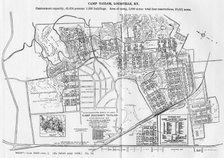
Hidden Location #20 was promptly located in Camp Taylor by Nancy Howard, and properly identified by Fr. John Schwartzlose, Johnny to those of us who watched him grow up, as the foot of Indiana Avenue, where Belmar Drive and Lee Avenue intersect. I lived one door off this corner for seventeen years. I used to tell people I lived at the very bottom of Camp Taylor, which was true. Johnny grew up a few blocks down Lee and up the hill on Orchard.

At one time Indiana Avenue didn't end here. It ran along what is now called the 1600 and 1700 blocks of Belmar Drive out to Poplar Level Road. As a side note, for many years Belmar Drive did not have a 1700 block at all, as it does now from Fincastle Road out to Poplar Level Road. A second side note is that the Fante's house in the beginning of the 1600 block used to have a 1/2 attached to its address - 1603 1/2. It was renumbered sometime in the 1970s.

The other part of Belmar Drive, that from Lee Avenue westward back to Preston Highway was originally called Kentucky Avenue, one of several scattered around what was then rural Jefferson County. Another Kentucky existed in Fern Creek, another in Middletown, and two others, all in addition to the Kentucky Street in Louisville. When the Camp Taylor post office was annexed into the Louisville post office, Camp Taylor's (and Prestonia's) Kentucky Avenue was renamed Belmar Drive. Loosely translated, Belmar means pretty lake. One may recall that the area where Standiford Field, Edgewood, and the north end of Okolona now exist was once basically a swamp called the Wet Woods. Perhaps calling the street Belmar was an attempt at a euphemism.

FISCHER TO OBAMA
I've read some criticism and cynicism about the mayor's visit and chat with the president over the Sherman Minton Bridge, which has locally been dubbed Shermageddon, a name which at least four of my friends, and I am sure countless others, are taking credit for. I have to think about the president visiting Ohio and our neighbors in northern Kentucky, where very few people cast their ballots in the president's favor in November 2008. On the other hand, the two counties which are connected by the Sherman Minton, Jefferson in Kentucky and Floyd in Indiana, gave candidate Obama a 38713 vote margin over the very senior United States Senator from Arizona. [I have to admit the margin was all on the Kentucky side of the river. Floyd cast 3694 fewer votes for Obama than McCain]. As Greg is mayor of the largest city in this area of vote-largesse for Obama, I can't imagine anyone being in a better position to address the absence of traffic on the Sherman Minton than our mayor, who hasn't already offered up an opinion. And we know Obama likes Louisville. He was here several times as a candidate and once, on a beautiful September night in 2006, even before he was officially a candidate. And our side of the river is represented by one of his earliest supporters in the Congress, which can't be a bad thing. Our congressman alerted The White House to the situation twelve days ago and has been in constant contact with the Federal Highway Administation officials on a non-stop basis, and is bringing the top two from that department to Louisville in the very near future. The next logical person to get involved, since the two Republican United States Senators do not seem too interested, is the mayor. To the naysayers who have something nay to say on all-things-Fischer, give it a rest. Quite a few people in the community who didn't vote for him last November are having second thoughts, crossing over to his side. I will admit Greg and I do not entirely agree on the Bridges issue, although we do both support building the East End Bridge first. But our agreement ends there. He is supportive of a downtown bridge which I oppose. Where he stands on a Southwest bridge, an idea I've supported for a decade, I do not know. But, he is the mayor and I am happy to have him communicating with the president on our current lack of a second bridge across the Ohio.

A MAN OF NO IMPORTANCE
Last week I attended Pandora Productions' 16th season opener, A Man of No Importance, with music by Stephen Flaherty, lyrics by Lynn Ahrens, and book by Terrence McNally. Set in 1964 Dublin, it is a story of a man's sexual identity, church identity, hidden loves, and ultimately long-lived friendships. That's quite a few hot buttons to hit in one play, but it was all well done, moving, and enjoyable. Pandora's Michael Drury played the lead (and title role) as Alfie Byrne and it was an excellent perfomance of a tragic character. Although I've never had a sister, the role of Alfie's sister Lily, played by Tiffany Taylor, is an excellent role model and played as such. Alfie's love interest, Robbie, was acted by Jason Brent Button, the adorable blue collar worker who isn't quite the lover Alfie wants but proves to be a very good friend. Alfie's other more prurient interest, Breton Beret, was played quite well by an alluring Michael Mayes, a student at U of L. I know a lot of people recognized the character, the ploy, and the ultimate but sad reward of giving in to one's temptation, as Oscar Wilde counsels Alfie to do. The entire play has as a backdrop Oscar Wilde, my favorite playwright, and the name is, of course, taken from one of the great writer's plays. In the production, the presence (or ghost) of Wilde is played understatedly and dramatically by Patrick Brophy.

The entire cast is an ensemble of fifteen players, playing both their roles and those of their assigned roles of the play-within-the-play, Wilde's Salome, which causes problems for the players' venue, Saint Imelda's Church. I've been a fan of the play-within-the-play genre since my own performance in high school of a production called Here and Now. But, I digress.

I have to say I very much enjoyed A Man of No Importance. The other actors, besides those mentioned above, are Laura Ellis, Rusty Henle, Obadiah Ewing-Roush, Josh Richard, Bob Zielinski, Kristy Calman, Betty Zielinski, Chris Cook, Meg Caudill, Daniel Cooper, Anthony Ransom, Amos Dreisbach, and Blair Boyd.

METRO COUNCIL REDISTRICTING
Back on March 17, 2011, we learned that the official 2010 population of Jefferson County was 741096 people, and it is on that number that under state law the Council is required to reapportion its people into 26 districts of legally-equal size. The ideal population for a district is 28503.69 persons and legally-equal is a measure created by previous court cases allowing a difference of 10% of that number between the most populated and least populated districts. Redistricting is a fascinating once-a-decade project which purists love, I being one of them. Unofficially, I created a map of 26 districts, with some help from Ray Manley and others, back in May, a map which met certain requirements and parameters.

Once you agree on those certain requirements and parameters - that incumbents (of both parties) will remain in their respective districts, that districts with minority representation will remain (or achieve) minority-majority status, and that you will comply with all legal requirements, and that you will split as few precincts as possible - there really aren't very many ways to divvy a county up into twenty-six districts of legally-equal size. Most districts retain 70%-80% of their original territory, one way or another. There are exceptions in far southwestern Jefferson and susburban southeast Jefferson.

Metro Council President Jim King (D-10) has, since August, done an excellent job of bringing the maps from computer-images to paper and an ordinance will soon be introduced redistricting the Council constituencies. That map will look remarkably similar to one a few of my seven faithful readers have seen. I've very happy with President King's guidance on this very delicate matter.

Monday, September 12, 2011

Hidden Location #20 - Please answer in Comments below


Here is a new Hidden Location, the 20th in our series. I'm hoping to stump you on this one, although it should not be too difficult. Good luck.

Sunday, September 11, 2011

We Remember


A Song
Oh, say, can you see, by the dawn's early light,
What so proudly we hailed at the twilight's last gleaming?
Whose broad stripes and bright stars, thru the perilous fight,
O'er the ramparts we watched, were so gallantly streaming?
And the rockets' red glare, the bombs bursting in air,
Gave proof through the night that our flag was still there.
O say, does that star-spangled banner yet wave
O'er the land of the free and the home of the brave?

On the shore dimly seen through the mists of the deep,
Where the foe's haughty host in dread silence reposes,
What is that which the breeze, o'er the towering steep,
As it fitfully blows, half conceals, half discloses?
Now it catches the gleam of the morning's first beam,
In full glory reflected, now shines on the stream:
Tis the star-spangled banner: O, long may it wave
O'er the land of the free and the home of the brave!

And where is that band who so vauntingly swore
That the havoc of war and the battle's confusion
A home and a country should leave us no more?
Their blood has washed out their foul footsteps' pollution.
No refuge could save the hireling and slave
From the terror of flight or the gloom of the grave:
And the star-spangled banner in triumph doth wave
O'er the land of the free and the home of the brave.

O, thus be it ever when freemen shall stand,
Between their loved home and the war's desolation!
Blest with victory and peace, may the heav'n-rescued land
Praise the Power that hath made and preserved us a nation!
Then conquer we must, when our cause it is just,
And this be our motto: "In God is our trust"
And the star-spangled banner in triumph shall wave
O'er the land of the free and the home of the brave!

Words by Francis Scott Key

And a prayer
Lord, in the midst of our grief and the memory of our loss, we gather in your presence and remember: We have feared the terror of the night; We have seen the sacrifices of the brave; We have cried the tears of the lost, and we have clenched our fists and raged against the pain and damage. We have wept and mourned, lashed out and retaliated, we have healed and hoped. Now we gather in your presence to be whole and to walk humbly with our God as the years unfold.

For the families of the many victims we pray that by your mercy life may rise even from ashes. We pray especially for those whose lives are still broken by the tragedies of that day, and ask that by your grace and mercy tattered hearts may know your touch, healing their shattered spirits, reknitting for them a world of hope, and granting them rest from the fury and frustration unjustly imposed upon them.

In the many heroes who sacrificed themselves for others we see the face of Christ. Strengthen those who hold their memory sacred in their needs as you have strengthened all who lay down their lives for their friends.

We pray also for our enemies, Lord. And what we pray for our enemies you have also taught us to pray for ourselves: that they, we, and all of your creation may be free from the powers that turn blessing into burning; free us and them from all that warps our minds and turns to hate the love you intend for all.

Holy one, you are our God in trial and rejoicing. As we remember past tragedy, we seek your wisdom that we may proffer future blessings in your name. Now and in the years to come, help us to place our trust solely in your word and way, and not in imperfect paths of our own design. Our hope is not in the towers we build, or in the roar of war, or in the fervor with which we proclaim our outrage or our piety. Our salvation is in the way of your Christ, in your mercy, and in our kinship with you. Though we mourn and are poor in spirit, may we yet find your kingdom and be blessed.

Thus bless those who gather and remember this day. Bless those who seek the healing after the hurt, and grant us the wisdom we need in this year and all that follow: that we may reap what is of life even in the midst of death. In every circumstance, Lord, bless your people and your world that we may rest and rise, live and die and be reborn in the compassion of Christ. In so doing, may we live always as sisters and brothers at peace, healing a broken world. Amen.

Written by the Rev. Kent H. Gilbert, Pastor, Union Church, Berea, KY

Saturday, September 10, 2011

699. A local theater review - Theatre [502] - from (Louisville's) Broadway

Last night I went to the Saint Francis Building's Land of Tomorrow Gallery where in the southwest corner of the historic building at Third and Broadway is a space large enough to house a small theater setting and seventy or so patrons. I had expected a friend to join me with his friend, but neither did, so my viewing was solo, which was fine. As usual, I seated myself in the rear-left of the room away from the acting area, and not far from where a decent glass (or plastic cup) of red wine could be had for a few shillings.

The night's production was the second perfomance of the first show by a new Louisville theater group known as Theatre [502], making use of some local numbers of distinction, Louisville's area code, just as I make use of our location, at Milepost 606 on the Ohio River. Mat Smart's work The Debate Over Courtney O'Connell of Columbus, Nebraska (hereinafter Courtney) is one of Smart's many works in both full-length plays, a musical, and several one-act performances. This play has had recent performances in Minneapolis ealier this year by The New Theatre Group, and previously at the Cafe Metropol in Los Angeles, and originating with the Slant Theater Project in New York where the play's author is a co-founder.

I was drawn to the performance by its director, Gil Reyes, whose works, or at least a few of them here and there, I have been following for about eight years. A few of my friends have performed in his works and I've enjoyed seeing them on stage - both my friends and the plays. Gil is a graduate of Kenyon College and has also studied at Middlesex College in London. Locally, he serves on the board at Walden Theater as well as the coordinating committee for the Fairness Campaign. I've come to know Gil best through our mutual friend Stuart Perelmuter.

Courtney is played in two acts, the first in the present, the second about 117 years ago, and set in the town of Columbus, Nebraska. The first scene involves a debate citing an old morality law concerning consensual relations between a man and a woman where two men square off to receive the full attention of a woman, Courtney, one to whom she has enjoyed a short engagement, the other who has been her beau of many years. One is a rather handsome California rich-kid recently out of grad school with promises of money and foreign travel. (I meant to slip him my card as that would work for me). The other is a plain looking and spoken local boy, an hourly wage earner, and a long history with Courtney. The debate takes a turn when the theater patrons are asked to vote on which man gets Courtney's affection. The audience is asked to vote. Ballots and pens are distributed and votes are counted.

I suppose there could be three different outcomes to such a vote, with either man winning the vote or there being a tie. The play is presented with two of those outcomes.

The second act reverts back to 1894 and the genesis for the law creating the debate. A man not happy with the outcomes of his advances toward a certain woman takes revenge on her friends, killing (offstage) over a dozen women in a local factory. After some on-stage antics between two sisters, a would-be hero, and a barkeep, there is more rather stylistic bloodshed - no blood - and in due time, the local sheriff arrives and cites the need for a law to prohibit such carnage in the future.

The play is performed by three key actors and two others in minor roles. I've seen two of them in other local productions - Zach Burrell and Leah Roberts. Burrell plays the debate moderator in Act I and both the barkeep and the sheriff in Act II. Leah Roberts is the star of the show as Courtney. She returns (in drag) in Act II as Amos Morgan, the outlaw whose actions prompt the morality law. Drew Cash, who I recognize but I'm not sure why, is the California kid in Act I, returning in Act II (in drag) as one of the sisters, and as the would-be hero by the name of Sherman Wilkes.

As an aside, the name Sherman Wilkes sounds to be as "southern" a name as could be and I'm sure a determined writer could build a play, book, or movie around such a name. Or, perhaps, that was already done with the name Rhett Butler. But, I digress.

The other key actor is Eli Keel. I have no familiarity with Mr. Keel but his performance as Scooner in Act I, the local boy, and as one of the sisters, Willamina (in drag) in Act II are solid decent work, much like the solid, decent local boy in Act I who won the votes of at least last night's patrons. The two minor actors were Sarah East and Jeremy Sapp.

Intermission provided time to mingle, get a second cup of wine, and listen to some interesting fiddle and banjo playing by Nick Peay and Scott Anthony. To be honest, they weren't playing a fiddle or a banjo, but I am not familiar enough with small stinged instruments to know what to properly call them. The interluding music was a combination of bluegrass, pop, and folk and made for very good listening.

The play, the music - and the wine - created a wonderful evening, albeit alone, in a space I had never visited in the past, the Land of Tomorrow Gallery.

Theatre [502] has three more productions planned for their "pulse-pounding" inaugural season.

Hunter Gatherers, by Peter Sinn Nachtrieb and directed by Mike Brooks, will be performed in the Victor Jory Theater at Actors, running October 14, 15, 17, 21, and 22.

It Can't Happen Here, by Sinclair Lewis and directed by Greg Maupin in a co-production with the LePetomane Theatre Ensemble, will be staged October 24 at the Parkside Studio Inside at Iroquois. To be honest, I don't know if that means at the park or the high school, or somewhere else.

The final production of Theater [502]'s inaugural season will be Broadsword: a heavy metal play, by Marco Ramirez and directed by Amy Attaway, also set for the Parkside Studio Inside at Iroquois, for November 4-19.

Local theater is important for our community and talent. If you have a chance, go see a production. The website for the theater group is www.theatre502.org.

Friday, September 2, 2011

Hidden Location #19 revealed - Minor Lane Heights


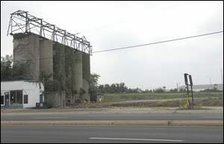
In Hidden Location #19, we had two pictures of streets which intersect. The sign above still stands at the intersection, though little else remains.

As some of you know, I also post these blog entries over on Facebook. Unfortunately, more people respond over there than over here. I wish that weren't the case but it is. Over there, the first respondent was my friend Jason Hope. He misidentified the first street for the second one. He correctly identified the missing houses as being due to the airport's expansion process which began the year before Jason was born.

The two pictures are of Donna Boulevard above and Minor's Lane below. I grew up not far from this intersection which at one time boasted a gas station, a Convenient Food Mart and, across the street, a Wesleyan Cumberland church congregation. All gone.

Donna Boulevard was the main street of a subdivision and later incorporated city known as Minor Lane Heights, located off Minor's Lane in southern Jefferson County, about halfway between Okolona and Fairdale. Minor Lane Heights was originally incorporated to avoid annexation into the Louisville Metropolitan Sewer District, choosing instead to receive its sewer services from the former Okolona Sewer Construction District, which at one time had its facilities just north of the small city. That sewer district was eventually taken over by MSD. The municipality's location led to its eventual demise - or sort of demise.

As mentioned earlier, the Regional Airport Authority (RAA) began expansion of Louisville's Standiford Field in the mid 1980s. Building a double north-south runway greatly increased the noise concentrations over large parts of Jefferson County. Minor Lane Heights sat a little over two miles due south of the airport and in the direct line of the new flight paths.

In 1995, the RAA received permission to purchase the entirety of the city, 552 households, as well as the adjoining city of South Park View. They have eventually acquired nearly all the property between I-65, the L&N, Southern Ditch, and South Park Road. (Mayor Fischer calls this area a renaissance zone). The approach for the purchase of the entire city took a weird turn in 1999 when plans were approved to move the city, en toto, to a new location about ten miles to the east of its then-site. Cities had been moved in the past due to dam construction and flooding, places like Eddyville, Kentucky and English, Indiana. The RAA proposed to rebuild the subdivision and reincorporate the city in a similar semi-suburban/rural setting along Cedar Creek Road southeast of McNeely Lake Park.

The process is ongoing but very near completion. The city was renamed from Minor Lane Heights to Heritage Creek. The entire city moved. The process is now cited as a model for the future relocation of similarly situated municipalities.

The lower photo in the picture is of Minor's Lane, looking northward toward Outer Loop. The driveways off to the left were for the former gas station and food mart. The few properties remaining in the area not owned by the RAA are two mobile home parks and about 25 scattered homesites.

Two other proposed subdivisions in the area were never built because of the airport plans, one on South Park Road just east of the former city of South Park View, and the other, proposed by David Dulworth, who built the nearby Silver Heights subdivision off Blue Lick Road, to be called Four Diamonds, in the acreage on the east side of Minor's Lane, just north of the old Pape's Hardware property, which has never been purchased by the RAA. In the South Park Road site, streets were constructed, sewer lines dug, and electric lines strung, and two homes were begun, but it was all closed down shortly after it began.

Minor's Lane, the street in the lower photo and named for the Okolona pioneer family of Spence Minor, was at one time a part of the road between Okolona and Fairdale, beginning in Okolona where the current Minors Lane (or Minor Lane as it is called by Metro government) intersects with Preston Highway. The road made a series of 90 degrees curves first south (past Evangel Tabernacle), then west (now a part of the I-65/Outer Loop interchange), then south again (along the Minor's Lane in our picture), the west again (toward Fairdale) joining what is now called South Park Road at Locust Grove, an old watering hole. Other former businesses on that corner were the aforementioned Pape's Hardware, French's Produce (still operating but now located in the southern Bullitt County community of Bardstown Junction), and a DX service station. (As a note, our young Mr. Hope who got as close as anyone in identifying this location has grandparents living a little west of this intersection which may explain his familiarity with the pictures). South Park Road, the called Deposit Station Road, was evenutally completed from this corner west over to Blue Lick Road and even later from Blue Lick over to Preston Highway, making the Okolona/Fairdale journey just a little straighter.

Having grown up in the area it is weird to drive through there which I do most every Sunday when visiting my mother. As a kid, I watched the area grow up, be built, add sidewalks, add churches, an elementary school, several business, and about 2000 residents. Two different precincts voted at Minors Lane Elementary which opened in 1968 (and somehow remains so). None do now - one votes at Coral Ridge Elementary, and the other over in Okolona at a union hall. It is a ghost town and drive, all gone. The streets and sidewalks remain as do some of the electric lines, but nothing more.

RIP Minor Lane Heights (and South Park View). Congratulations to Jason Hope for his answers.

Wednesday, August 31, 2011

Hidden Location #19

The two pictures below are each of one street which intersects with the street in the other picture. Name either street.


Happy Trails.

Also, Happy End of August and Happy Birthday to Rick Lusardo. The year I was dorm president at Kirwan II, Rick was my vice president.

Saturday, August 13, 2011

300 W CARDINAL BLVD

As many of my longtime seven faithful readers know, I have a pet peeve about incorrect or ill-designed streetname signs. It has been a problem in Louisville since about 1986, with the dismissal of a former streetname sign worker in the Signs and Markings office of the former Louisville City government. Since that time, I've watched as Louisville's streetname signs have changed sizes, shapes, and degrees of accuracy over the years, usually not for the better. I have complained and complained to former members of the Board of Aldermen and former Directors of Public Works, all to no avail. I gave up officially complaining about six years ago.

But this entry isn't about the former City of Louisville, or the former County of Jefferson, or their successor-government, Louisville-Jefferson County Metro, although I have much to say on the same subject as it pertains to Louisville Metro, but not in this entry.

This entry concerns streetname signs you may have recently noticed in and around the University of Louisville campus. They are new and bigger than most of our standard signs, and they are red- and black-lettered in honor of the school's colors. They display the streetname and street-type designation (in an abbreviated form) as well as a direction where appropriate, and a block number. To my knowledge, they have all the streetnames correct. And, to my knowledge they have all the abbreviated designations correct although it took me a minute to figure out that OVPS means Overpass, as in the Denny Crum Overpass, which is co-signed with the inordinately long 100 block of Central Avenue, which runs about four blocks long all the way over to Crittenden Drive. The only longer 100 block of any street in Jefferson County is that of the Outer Loop, where the 100 block runs for about two miles from Third Street Road eastward to the Northern Ditch. But, I digress.

This discussion is about the block numbers U of L has posted on these beautiful new signs. The signs, I am told, were erected as part of a beautifying effort, perhaps to lure a professional fraternity designation to the school, perhaps not. If I were trying to beautify the campus, the least I would do is check the addresses to make sure that the new signs had correct block numbers. About 1/4 of all the new signs U of L has erected in this program are incorrect, which doesn't say much for our local college.

Several months ago I brought this to the attention of Dr. James Ramsey, the University's president, by pointing out several of these errors via his Facebook page. Dr. Ramsey responded that such matters were handled "somewhat below his level" and that he would look into it. Because of the respect I have had for Dr. Ramsey dating back to his budget days in state government, as well as the good work he has done during his U of L tenure, I expected something as simple as correcting a few streetname block numbers would be an easy task. Especially on a college campus where pizzas and Chinese food, and perhaps other commodities are regularly delivered, one would think such correct signage would be a given. These signs should and could also be helpful to police, fire, and EMS personnel in times of emergency, except these, which are incorrect, could possibly delay life saving assistance because the University apparently doesn't deem public safety an important enough issue to correct the signs.

I understand that Dr. Ramsey doesn't deal with correcting streetname block numbers. I was only bringing it to his attention. I believed him when he said others would look into the matter. Either they've ignored his assignment or he never made it. None of the incorrect signs I addressed to Dr. Ramsey several months ago have been corrected. Since that time, more incorrect signs have been erected. How diffiuclt can it be to ascertain a correct block number? Obviously, too difficult for the U of L sign erecting crew.

This afternoon me and a friend drove out 4th Street observing the dammge from this afternoon's powerful storms. There, in front of the Bettie Johnson Hall dorms, which are clearly marked with the address of 401 W. Cardinal Boulevard is a brand new streetname sign, directly in front of the building proudly, but incorrectly, proclaiming that section of road to be 300 W CARDINAL BLVD.

Such errors are uncalled for and should be addressed and corrected.

Tuesday, August 9, 2011

697. In Memoriam

Remembering my paternal grandmother today. Grace Irene Noble, the daughter of Isaac "Ike" Lee and Lorraine "Gussie" Schlenck Lee Hall died thirty-five years ago on this date. She was born January 8, 1915, married to U. G. Noble in 1933, and had three sons, Donald - born in 1936 and died in 2005, my dad Urban "Gene" - born in 1939, and Vincent "Chris" - born in 1953. She was grandmother to me and my brother Kevin, and sister to the late Mary Hiner. Rest in peace.

Sunday, August 7, 2011

696. The ups and downs of getting to and from Fancy Farm, Kentucky - the second of two unrelated entries

This will be a boring entry for most of my seven faithful readers. It is an exercise in geographic names, inspired by Dr. Tom Owen and, unrelated, some Facebook postings I made yesterday and Friday during my trek to and from west Kentucky.

At least twice, most recently on two tours of Jefferson County with then-candidate and later the elected Louisville mayor Greg Fischer, Tom Owen has announced at the crest of certain hills that "we were now leaving the Pond Creek watershed and entering the Pennsylvania Run Creek watershed." That may not have been the exact words to one of them, but then again it might have been at that crest along the Outer Loop between Okolona and Highview, in front of the old abandoned Hi-Li Swim Club property. According to Dr. Owen, and I agree, knowing your watersheds is an important part of knowing your community. I'm sure Mayor Fischer came to agree whilst on these two trips, if he didn't already before Dr. Owen's discussion. As a note, the states of Virginia and Tennessee, and perhaps others, mark their major watershed divisions along their Eisenhower Interstate System Highways.

The second inspriration for this boring entry which is to follow rises out of several Facebook updates made when crossing Kentucky's waterways to and from Fancy Farm, the first of which, I believe, was "Crossing the Cumberland." The first one would have been "Crossing the Green" but I had no signal at that point along the Western Kentucky Parkway.

So, what follows are not the watersheds, a la Dr. Owen, but the names of the creeks, forks, rivers, and other bodies of water crossed along my weekend journey of just over five hundred miles. As I said, it will be boring to most - just a litany of names. I'd appreciate, though, any comments you might have on any of them. I'll list them by county in the order they were crossed. As a note, my journey began in South Louisville around 3rd Street and the Watterson Expressway.

JEFFERSON COUNTY
Northern Ditch
Southern Ditch (Pond Creek)
Fishpool Creek
Mud Creek

BULLITT COUNTY
Brooks Run
Clear Run
Blue Lick Creek
Salt River
Barley Creek
Crooked Creek
Cain Run
alongside Paradise Lake
Rolling Fork of Salt River

HARDIN COUNTY
Patty Creek
Brown Branch
Broad Run
Cole Creek
Valley Creek
West Rhudes Creek
alongside Boiling Spring

GRAYSON COUNTY
Clifty Creek
Laurel Branch of Bear Creek
South Fork of Caney Creek
Buck Creek
Dog Creek
Brown's Branch of Caney Creek

BUTLER COUNTY
(none)

OHIO COUNTY
Dogwalk Branch of Indian Camp Creek
North Prong of Indian Camp Creek
Sixes Creek
Wild Branch of Sixes Creek
Hickory Konb Fork of Muddy Creek
Threelick Fork
Lewis Creek
Green River

MUHLENBERG COUNTY
Little Cypress Creek (two crossings)
Thompson Creek
Pond River

HOPKINS COUNTY
alongside Long Pond
Drakes Creek
Flat Creek Ditch
alongside Bold Duck Spring
Pleasant Run
Fox Run
Cane Run
Lambs Creek Ditch
North Fork of the Tradewater River
East Fork of the Tradewater River
alongside Beshear Spring
Tradewater River

CALDWELL COUNTY
East Fork of the Flynn Fork of the Tradewater River
Ward Creek
Wiley Creek

LYON COUNTY
Poplar Creek
Flat Creek
Cumberland River

LIVINGSTON COUNTY
Tennessee River

MARSHALL COUNTY
cypress Creek
Little John Creek
Bloodyshin Branch of Cypress Creek
Eggner's Branch
East Fork of the Clarks River
Smith Creek
Soldier Creek
Bowie Branch of Soldier Creek
Dry Branch of Soldier Creek
alongside Hale Spring
West Fork of the Clarks River
Moss Branch of the West Fork of the Clarks River

GRAVES COUNTY
Ray Branch of Panther Creek
Panther Creek
Pryor Branch of Panther Creek
Mayfield Creek
Key Creek
West Fork of Mayfield Creek

----- Arrival at Fancy Farm in Graves County
----- Departing from Fancy Farm in Graves County


West Fork of Mayfield Creek
Kess Creek
Mayfield Creek
alongside Little Mayfield Creek
Minnow Branch of Watson Creek

CALLOWAY COUNTY
Sand Lick Branch of the West Fork of the Clarks River
West Fork of the Clarks River
Bee Creek
East Fork of the Clarks River
Jonathan Creek
Little Jonathan Creek
Coal Creek
The Kentucky Lake on the Tennessee River

TRIGG COUNTY
Elbow Creek
Elbow Bay
Lake Barkley on the Cumberland River
Caney Creek
Little River
Stillhouse Branch of the Little River
Steele Branch of the Sinking Fork of the Little River

CHRISTIAN COUNTY
Sinking fork of the Little River
North Fork of the Little River
South Fork of the Little River

TODD COUNTY
West Fork of the Red River

LOGAN COUNTY
Whippoorwill Creek
Dry Fork of Whippoorwill Creek (two crossings)
Town Branch of the Mud River
Mud River
alongside Hancock Lake
Patterson Creek

BUTLER COUNTY
Brushy Fork
Richland Creek
Renfrow Creek
Big Branch of Renfrow Creek
Green River
Lindsey Creek
East Prong of the Indian Camp Creek
Wolfpen Hollow
Honey Fork of Welch's Creek

GRAYSON COUNTY
Dog Creek
Buck Creek

- Returning to the WK Parkway and Jefferson County in reverse order from above.

Any comments? Any one have any stories, particularly of the smaller waterways? Just curious. Thanks for reading. Happy sailing.

695. Fancy Farm, 2011. One of two unrelated entries.

I've been going to Fancy Farm off-an-on since I was about 18 - mostly on. Most everyone is attracted to the tiny little town in far-western Kentucky because of the political histrionics displayed by the candidates who are, for the most part, less histrionically inclined in most other situations. The Tea Party-Republican candidate for Secretary of State may be an exception to that generalisation - he seems to be histrionically inclined at all times.

Besides the politics there is, of course, the food. I've written about this in years past. One should not engage in the fun and frolic of Fancy Farm if one is watching their weight or waistline. Beginning on Thursday, perhaps earlier, and continuing through to at least Saturday evening, there is no excuse to be hungry as there are events galore where food is to be had in plenty, sometimes for a few pieces of silver, and often for no silver at all. Clearly this year's food-extravanga was the Alison Lundergan Grimes party on Executive Drive late on Friday night after the Marshall County Bean Dinner.

The other reason to go, the most important, is the chance to see, chat, hug, eat, and otherwise engage and be entertained by friends, and even political opponents from across the Commonwealth, sometimes friends you only see once a year.

All of these reasons sufficed for me to make it down to this year's picnic. But, I have to admit, as many of you know, I also go simply for the drive. My Facebook friends are aware from my posts over on that medium that I've not enjoyed this summer as well as I should have, due to a number of complications which have mostly had me mentally fatigued. Those have continued into this first week of August, so the ride itself, which, according to Google, should be 236 miles each way, is one of my compelling reasons to make the journey. By the way, it has never taken me only 236 miles to get there, and it has certainly never taken me only 236 miles to return, as I have that rule about never going-and-coming the same way. Other than the 88 miles between here and Caneyville along I-65 and the WK Parkway, I adhered to that rule.

So the trip began, as stated, along 65 South and the Wendell H. Ford Western Kentucky Parkway, the standard route to anywhere in the western part of Kentucky, the exception being Western Kentucky University, which is either misnamed or mislocated, as it is clearly not in western Kentucky, but more in southern Kentucky. Poignantly, as I passed Exit #107 at Leitchfiled, I thought of my friend Rob. His girlfriend's grandparents had a place at the lake on Nolin, a place the three of us often sojourned to, or, in some cases, a place I went to gather him up when she was staying for the week, but he had to return to Louisville for work or school. KY259 south was the beginning of the path one took, and still may take, to find Conoloway and the Just family getaway located there.

I continued westward on the WK, though not the entire length, as I usually depart for the "old road" a few miles before the 137 mile parkway comes to an end at Interstate 24. A side note, the WK is almost the exact same length from Elizabethtown to Eddyville, or start to finish, as I-65 is from the Tennessee line to the Indiana line. My departure from the parkway was at Princeton. I was tempted to leave the road a few miles earlier at the Dawson Springs exit, #24, so as to venture through the ancestral hometown of Kentucky's governor, Steve Beshear. But, I didn't. I drove into and through Princeotn, meaning to continue south on KY293, past the Caldwell Chapel and through the town of Saratoga, as I wanted to at least see, if not drive up into, the Mineral Mounds State Park, a place I've never visited.

Somehow, I missed the turn or, perhaps, made an incorrect turn, and instead found myself on US62, westbound, a road I've travelled many times. It was just as well, as I also wanted to say hello to a friend who lives in Eddyville, and this road, as well as the other one I didn't take, eventually led just past his house on Lake Barkley Drive, which is actually in Kuttawa, or even Old Kuttawa, a few miles west of Eddyville. We visited long enough for him to have a beer and me a glass of Sweet Tea. He was undecided on whether he would make it "all the way over to Fancy Farm" as he put it. Thus, I departed.

My overnight accomodations were at the Days Inn-Calvert City, a place I've overnighted before fairly successfully. I arrived amidst a heavy downpour of rain. Getting there from Old Kuttawa requires crossing the Cumberland and the Tennessee from the Pennyrile area of Kentucky into the Purchase area of Kentucky, each name representing a geographical area with non-geographic names. Sometime we'll go into that - I've explained "The Purchase" in a previous entry. Crossing the Cumberland and crossing the Tennessee inspired the entry I intend to write following this one, the second of two unrelated entries, as noted in the title.

I will note that crossing the Tennessee isn't nearly as inspirational on the new bridge as it was on the old bridge, where you were actually atop the Kentucky Dam with the wide and wonderful waters of Kentucky Lake clearly in view immediately to the left, or southern side of the highway/dam. The new road and bridge is just north of there and to be honest, I could not even tell you if the bridge is beautiful or not as I was looking over at the backside of the dam, where you could plainly see the water level of the lake versus the water level of the river, well below the dam. Interesting, but not inspiring.

The first stop of the night was the Marshall County Bean Dinner, an annual fundraiser for the Marshall County Democratic Party, where they confer awards on their friends and reward the rest of us with an interesting dinner of bean soup (which was excellent), cornbread (sweet and not-sweet), watermelon, banana-pepper salad, and iced tea (again, sweet and not-sweet), along with a barrage of speakers warming up for tomorrow's big day, all presided over by the tall and handsome Will Coursey, who represents the area in the General Assembly in Frankfort. There is also a silent auction quietly going on over on the tables along the wall. I entered several bids but each was outbid. At the dinner I sat with my friend Kathy Jo Stubblefield, a retired school teacher from Calloway County, one county south of where we were. It was good to catch up with Kathy Jo.

Later that night, it is tradition to attend parties in the Executive Cabins, located a bit west of the lodge where the dinner is held. It was my intention to visit at least two parties in these cabins - not cabins at all as each has three or four bedrooms. I only made it to one. But before I got there, I did my traditional foot-dipping. I have a tradition of sticking at least my feet, if not more of my body, into the great bodies of water which I cross in my travels. From Executive Drive, I wandered down to the marina, shed my shoes and socks, and wandered on a boat dock about twelve feet out into the waters of if not the Tennessee River, at least the Kentucky Lake, formed by the damming of the river.

From this ceremonial event, I began my night at the Alison Lundergan Grimes cabin and party, a place I really never got away from for the rest of the night. Most of these parties have finger foods, some barbecue, maybe hamburgers and hotdogs, and most anything you may wish to drink, from diet Dr. Pepper to little mason jars of white lightning brought from unnamed friends and unnamed places, and beer.

But, Alison Grimes has as her father Jerry Lundergan, a well-known Lexington caterer and politcian, and a dear friend of mine. And Jerry doesn't do anything by halves and this cabin lawn party was no expecption. Food was a buffet of breakfast food - bacon, sausages, biscuits and gravy, fruit, strip steaks, scrambled eggs, hashed brown potatoes, and salsa. All you can eat. I ate a lot. Music was provded by a young foursome of kids singing rock-a-billy songs at the start - an interesting cover of Blue Moon of Kentucky - and later morphed into some jazz and fusion, and even later was just a jam session of sorts. The crowd kept growing and growing and I estimated it about 150 when a large tour bus arrived from ACFSME, swelling the numbers. Later in the night I counted, at one point, 250 - easily the largest of these afterparties anywhere in the area and at anytime in my memory. If Alison spoke, I don't remember, this despite the fact that I was only drinking Sierra Mists. I finally made my way over to her and lamented that I was tired and it was time for me to leave. And so I did.

There are usually two stops on Saturday morning, both involving food and both in Mayfield, the county seat of Graves County, with Fancy Farm located a few miles to the west. The earlier one is the annual Graves County Democratic Party Breakfast, another fundraiser, held at the Mayfield High School on the east side of the city. Somehow, I managed to missed it as I had slept in with the rain falling and a late night the night before. I enjoyed the extra hour or so of doing nothing.

I did eventually arise and took a circuitous route toward Mayfield, stopping first in the Marshall County seat of Benton, where the clock-steepled court house sits atop a high hill at the corner of 11th and Main Streets. Directly across the court square on the back side of the court house is the Marshall County Republican Party headquarters. While the local government is decidedly Democratic, under the long-time control of Coumty Judge/Executive Mike Miller, the county's federal votes nearly always go to the Republican Party. I'm hopeful that the new and young blood I've seen at Party events will reverse that trend, which at this point isn't a trend, simply a fact.

I left Benton along KY58 to the south which just west of the Brewers community joins up with the old route of KY80, Kentucky's southern parkway. There is a new KY80 in town and this old section, from Brewers west to Mayfield is now, simply, KY58. The old KY80 to the east at Aurora, is now KY402. My destination in Mayfield was the Fayette County Democratic Party Breakfast, a free event, held at a banquet hall on the northeast side of the city. I began the event with a State Party By-Laws discussion with George Mills, a Lexington atrorney and one of the co-hosts of the event. There for the food was a polite table of shrimp, sausage filled mushroom caps, bacon-wrapped potatoes, fruit, and a variety of drinks, including an orange juice with a little punch to it, something I wasn't expecting but didn't mind. I was joined by my friend Elizabeth Sawyer, of Louisville, and recently appointed as the new Executive Director of Emerge Kentucky. We sat and listened to speeches by First Lady Jane Beshear, former Louisville mayor Jerry Abramson, the current Secretary of State Elaine Walker, and all the Democratic nominees for the statewide offices, again, all prepping for the speeches later in the day, all probably repeating the speeches they had given an hour earlier at the Graves County Breakfast, and may give yet again at the Chamber of Commerce Brunch, before trekking the thirteen miles westward on KY80 to the village of Fancy Farm, the parish of Saint Jerome, and the reason for the entire trip.

Ok, I didn't go west on KY80, because I knew when I left, I'd be driving eastward back towards Mayfield. I left Mayfield a few miles to the north, then west on KY121, a long diagonally-running highway which crosses the Purchase from Wickliffe in the west in Ballard County, and ending at Fort Heiman in the east on the Calloway County line with Henry County, Tennessee - although much of it between Mayfield and Murray has been replaced by the new KY80. More on that later,

KY121 heads northwest and is crossed by KY339, the road from Lone Oak in McCracken County to near Cooksville in Graves County. About halfway along that route is our destination city, or village, Fancy Farm. The event, for the uninformed, as actually a political speaking encapsulated by a typical summer Catholic festival, in this case, the Saint Jerome Catholic Picnic. So, along with the speechifying are games of chance (pulltabs), bingo, and lots of food - and really good food, most especially mutton and pork sandwiches which can be lathered with the ubiquitous contents of Fancy Farm's own bar-be-cue sauce which are everywhere to be found. The best deal of the day, although for the first time in many years one I did not take part in, is the all-you-can-eat dinner in the Knights of Columbus hall located in the rear of the church grounds. You can read about this in previous years' entries.

The speaking began with a prayer from Owensboro Bishop Bill Medley, afterwhich political histrionics ruled the day. I won't go into them here. I usually begin my departure shortly after the speeches begin. Along my way out, I spotted my friend Greg Anderson of Murray and we chatted briefly promising to keep in touch, a promise I hope we both keep. My favorite line of the afrernoon wasn't all that rude or smartaleck, although many were, especially from the Dark Side of the Aisle. It came from the Republican candidate for Lieutenant Governor, Richie Farmer, who needs no other introduction. Of his Democratic opponent, former Louisville mayor Jrry Abramson, he said "Jerry has been mayor of Louisville for 316 years." Well, it wasn't that long, but it was a long time, from 1986 to 2011, saving four short years under Dave Armstrong, who was Louisville's best mayor in decades.

Most of the rest of the speaking was barbs and theatrics, although I was quietly shocked by the Republican Secretary of State's suggestions that homeless American citizens should be denied the right to vote. No American citizen who isn't otherwise barred from voting should be openly denied the right to vote. For a candidate for Secretary of State, the office in charge of elections, to call for a denial of the right to vote to otherwise eligible American citizens is unfathomable, perhaps even treasonous. We have penalties for treason. Denial of the right to vote should not be a penalty for homelessness. I have stronly supported my friend Alison Lundergan Grimes since she began her campaign for Secretary of State. If anyone hasn't yet found a reason to support her, I would suggest that the stance of denying American citizens the right to vote due to homeslessness is a good reason not to support her opponent. His speech made me livid and I really didn't hear much after that. So, I left.

One more note before I leave the picnic grounds. I had noticed several - many - people, young and old, walking around with little puppies. While that's something I expect on Bardstown Road, it seemed oddly out of place there. Eventually, I stopped a teenager, a sophomore at Graves County High School so his t-shirt read, and asked about the puppies. He informed me that the local Humane Society had made available for adoption about 100 puppies which would otherwise be euthanized in the near future. He also informed me that all the puppies, including the one in his protective arms, were adopted. While I am not a "dog person" and have not followed as closely as perhaps I should have the discord surrounding the Louisville Metro Animal Service, I found this work in Graves County to be the best news of the day.

One more note - for the first itme in memory it wasn't unbearably hot and there was a vry brisk, if warm, wind, something never before experienced. So, the weather was unusualy cooperative.

As planned, I left Fancy Farm along KY80 east back to Mayfield. For the past several years, the Commonwealth has been constructing a new fourlane KY80 between Mayfield, Murray, and the old one at Kenlake State Park. It is now finished and I wanted to drive it for no other reason than I hadn't heretofore. The new highway from Mayfield to Murray largely follows the route of KY121. From Murray eastward, it follows just north of KY94, which it generally replaces. It rejoins its former self at Aurora with the intersection of US68, where eastward, my direction, one crosses the Eggner Ferry Bridge over the Tennessee River and Kentucky Lake into Trigg County and the Land Between The Lakes National Recreation Area. The highway through the eight miles of vacant land in this former TVA reserve has also been rebuilt and greatly widened. Just before leaving the area, I stopped at Elbow Bay, a bay of Lake Barkley on the Cumberland River, and repeated the tradition of foot-dipping in the great waters. This task completed, I ventured across the Henry R. Lawrence Memorial Bridge, through Canton, past Lake Barkley State Park, and into downtown Cadiz.

Downtown Cadiz sits atop a long hill at the top of which are two opposing court houses, old and new. The old one appears to be me to be an old bank. While I do not remember this for certain, I believe the new building was buit on the site of a much older court house. Maybe, maybe not. I stayed on the mutti-plexed US68/KY80 through the business community of Montgomery at the intersection with I-24, and then into Christian County, where the town of Gracey sits off to the south along the old highway route. Were it not for Hopkinsville sitting right in the middle of it, Us68/KY80 in Christian County is essentially a long straight four-lane highway, leaving Christian and entering Todd at the village of Fairview, again off to the south along the old route, and at the state historic site of an obelisk honoring the birthplace of Jefferson Davis, the only president of the Confederate State of America, those elements in rebellion to the United States from 1861 to 1865, although it seems in some corners, the Old South has yet to give up the ghost. My dear friend Preston Bates once called me as he was visitng this site. As a measure of friendship, I pulled up into the park and returned his call. I had taken his; he didn't mine.

Us68/KY80 continues its rarely curving passage through Todd County, past the town of Elkton, again off to the south, which serves as the county seat. The road is known through here as the Jefferson Davis Highway. Down into Miller Vally past Daysville, we cross out of Todd and into Logan. THe road turns decidedly northeasterly as you head into the county seat of Russellville. At Russellville, I left US68/KY80 and took in its place the northeasterly route of KY79. To be honest, I do not ever remembering travelling this road before between Russellville and Morgantown, so this was to be a small adventure. It is a fairly good two lane road up and down the hills and valleys of northern Logan County, past Hancock Lake, and through Chandler's Chapel, through Costelow and as you come up a hill past two bald knobs - curious looking and worth doing some research upon - into Butler County. At the top of the hill is the rural crossroads hamlet of, appropriately, Davis Crossroads, with rolling hills to the east and a valley to the west. Again, this was all virgin territory for me, so I was taking extensive mental notes. The still up-and-down pattern continued almost to the route's junction with US231, just south of 231's intersection with the Edward T. Breathitt Pennyrile Parkway, itself just south of the county seat at Morgantown.

I've always thought the court house at Morgantown looked like an Ivy League college campus building built in the early part of the 20th century. It is brick, not very tall, and long - ranch-like in design, with an expansive yard all around. It may be because the building is not so imposing that the grounds seems to be so expansive. Its college-like atmosphere was calming for me, as I seem to be more content when I am on a college campus, whether real or otherwise, as is the case here. The main road out of town turns westward and down a hill before veering northward across the Green River and into the mostly residential area known as Aberdeen. No, I did no foot-dipping at Aberdeen, Kentucky, although I have at Aberdeen, Ohio, but into a different waterway. But, I digress.

At Aberdeen, I stayed with KY79 toward Caneyville as opposed to US231 toward Beaver Dam and Ohio County, the county of my new young Democratic friend Tim Morris, a a native of Horse Branch, which sits along the Paducah and Louisville Railway at its junction with another railway off to the north. KY79 continues the up-and-down pattern through the communities of Flenor, Welcome, and Welch's Creek, all hardly noticeable, and crossing into far southwestern Grayson County just shy of Dog Creek. A couple more miles steadily up a very slight hill brings you to KY79's intersection with the Wendell H. Ford Western Kentucky Parkway. As I said at the beginning, this last 88 miles are simply the reversal of the first 88 and I won't bore you, as I'm sure I have so far, with any more narrative.

The short version would be "it was a nice long drive with plenty to eat, but now I'm back home." Thanks Be To God.

Tuesday, August 2, 2011

694. Congressman Yarmuth's NO vote.

Yesterday, in my response to Ed Martin as to Congressman Yarmuth's work on the debt ceiling resolution, I offered the following, "If John [Yarmuth] didn't call for cuts associated with tax increases, and not just the elimination of loopholes, then I, too, share your displeasure in his actions."

Well, there is no displeasure for me to share with Mr. Martin's disapproval of Congressman Yarmuth's actions. John voted NO on the matter and did so because of a lack of tax increases, particularly on those who can best afford it. Good work, Congressman. You were sent to Washington to listen to your constituents and vote in their best interests and in the best interests of the Republic. Yesterday's NO vote was an instance of serving those sometimes opposing interests.

Here is the text released yesterday by the congressman's office explaining his correct NO vote.

Yarmuth: Statement on Vote on Budget Control Act(Washington, DC) Tonight, Congressman John Yarmuth released the following statement in response to his NO vote on the Budget Control Act:

“Tonight, I chose to stand up for what the American people have demanded.

Throughout this politically-induced crisis, my constituents have been loud and clear: any plan to reduce our debt must protect Medicare and require millionaires, billionaires, and big oil companies to share in the sacrifice.

This plan asks nothing of the wealthy few and will inevitably lead to cuts in Medicare, education, and the investments we need to create jobs and get our economy back on track.”

Monday, August 1, 2011

693. Statement of Jeff Noble on the Debt Ceiling Resolution

"Really," you ask. "Isn't that a little uppity?" Who the hell cares what Jeff Noble has to say about the debt crisis? What makes him an expert? All good questions.
Let me offer two phenomena from the past, one a one-time occurence, the other an annual event here along the Left Bank of the Ohio River near Milepost 606.

When I was 19 years old, the Winter Olympics featured an American team in hockey whose star was Mike Eruzione, the team's captain, in their wins over the Soviet Union and Finland. Everyone I knew that winter became an expert on hockey. We all seemed to know the stats, who the left wings were, and why the Soviets were so good yet still fell to the Americans. It was a good feeling. The truth is I don't know a thing about hockey, have no idea who the stars were then or are now, but I remember the Miracle on Ice and Mike Eruzione and the American hockey gold medalists. Why? Because that's how popular culture works.
If you spend more than one year in Louisville, for at least one week or so every year in late April or early May, you will find yourself and everyone else making comments about "the latest star filly and her workout last week in the Bluegrass," or yet another fine stallion whose "lineage includes Northern Dancer" so he is a sure winner. We all become horse racing fanatics and experts for a few fleetings moments, perhaps only two minutes, prepping for the annual renewal of America's longest running horserace held on one track, the Kentucky Derby, the mile-and-a-quarter run for the roses begun in 1875. We participate in "pots" at work, send bets out to the track on Wednesday and Thursday, because even Oaks Day is getting too crowded, and we all watch in anticipation for the call late in the afternoon on the First Saturday in May, Louisville's local holiday.

So is it any surprise that the talk of the town, or to borrow the title of an NPR program, the talk of the nation, is "how do you feel about the debt ceiling stuff?" We all seem to have an opinion. Those of us who live and work and play in politics - a motley crew - get asked probably more often about such matters than the general populace, but sometimes a matter grabs the collective attention of the Republic and requires all of us to participate - or at least to pretend to do so.

Well, I have a confession. July was a particularly bad month for me in a number of ways - friends out-of-work, parents hospitalized, and the damned unrelenting heat. I have felt rather Hamlet-like, to be honest, losing interest in a number of things which normally interest me. Recall the words of Prince Hamlet, late in Act II, in a discussion with Ros and Guil, the famous "What a piece of work is man" soliloquy, to wit -

I have of late--
but wherefore I know not--
lost all my mirth, forgone all
custom of exercises;
and indeed it goes so heavily with my disposition that
this goodly frame, the earth, seems to me a sterile promontory,
this most excellent canopy, the air, look you, this brave o'erhanging firmament, this majestical roof fretted with golden fire,
why, it appears no other thing to me
than a foul and pestilent congregation of vapours.

What a piece of work is a man!
how noble in reason!
how infinite in faculty!
in form and moving how express and admirable!
in action how like an angel!
in apprehension how like a god!
the beauty of the world! the paragon of animals!
And yet, to me, what is this quintessence of dust?
man delights not me: no, nor woman neither,
though by your smiling you seem to say so.

Now, to be sure, I'm not as deep in the morass as was Horatio's dear friend Hamlet. I've just been bored and stressed about a number of things and the debt ceiling crisis was not one of them.

Yet, I've been asked several times in the last seventy-two hours my opinion on the resolution allegedly being hammered out in the Federal City 606 miles northeast of here. My brother has asked, a woman at work who I had not seen in two months has asked, a mechanic friend who works on Poplar Level Road has asked, even a lady I didn't know inquired of both me and my friend Preston Bates our opinion as we were sharing a drink at the Bristol on Bardstown Road yesterday. She went as far as to share her 83 year old mother's opinion on the matter showing us on her phone an email she had received from dear ol' Mom. It seems we all have something to offer. Like the 1980 fanfare over the American Hockey team, everyone either wants to know your opinion or wants to share their own. It is natural and I am faulting no one. I believe - deeply believe - that most Americans mean well, even some of those with whom I share few political values.

Below is an exchange of thoughts in a chat box between me and Ed Martin, someone with whom I share some, though not many, political values. Mr. Martin and I have had quite a few exchanges of thoughts and ideas on how the Republic is and isn't properly ran. I find him for more knowledgeable than many on the subject of Economics, several classes of which I took whilst a student at the various institutions of higher learning I attended back when I was into higher learning. He cites a number of articles here and there, most more libertarian than my usual fare of reading, but many very articulate in matters related to the fiscal operation of our Republic and the World. He talks about a lot more subjects but it is his political and economic views which have caught my attention.

Many of you may remember Mr. Martin in his appearance on the KET debate during the 2010 Third Congressional District campaign. He was the independent candidate, largely a national libertarian although he didn't identify as such, against the incumbent, my friend and representative in Washington, Congressman John Yarmuth, and the Republican challenger, a UPS pilot who tried to blame his loss of work in the mid 1990s on Yarmuth's political policies, policies Yarmuth could have only begun to enact with his swearing in in 2007, over a decade later. [As a side note, Congressman Yarmuth's congressional career began the same day as did this blog]. But, I digress.

Mr. Martin is something of a social liberal, and certainly libertariansitic and fiscally conservative. He also seems to be far more intelligent than many who have wandered into the Secretary of State's office and filed for a national office, including our recently elected junior United States Senator from Kentucky. I've learned all this by following him on Facebook, where he makes his opinions widely known on a wide number of topics. I would not want to be his political handler without some abbreviation of those postings, worthy as they might be. The truth is I've learned a lot from reading them. He and the aforementioned Preston share many values; Preston and I discuss a lot of those ourselves, irrespective of Ed, and disagree on much of it. Ed and I haven't discussed as much - it is mostly me reading whatever it is he has to say - and he says a lot. One large difference is that I believe, and I may be wrong, that Ed believes there is some legitimate function for government, however large or small that it might be. Preston, at least lately, doesn't conceive of a proper role for government at all, a discussion he and I have had several times. But, again, I digress.

Below is a short exchange between Ed and me earlier today on the matter at hand, the ubiquitous debt ceiling discussion. It expresses his frustration to the present situation and my response in a rather concise way, far more concise than this stream-of-consciousness entry you've been reading thus far - assuming you are still reading. I might add that Ed and I have been very informally engaged in a dialogue cocerning him affiliating with one or the other of the major political parties.

Here is today's exchange --

Edward Martin -- Given the lack of imagination and innovation, I'd say the dems (in particular) need someone like me...more than ever. Their performance in DC was pathetic...I'm sorry to say that includes Yarmuth.

Me --- This email deserves a thoughtful response but I am not up to it at this point. I must confess I grew weary of the debt ceiling stuff and, as if an abbreviated season of Lent were upon us, gave it up for the last 40 hours or so. I have no idea what they finally did, but I am sure whatever it was, I am not happy about it. You and I disagree on the size and role of government so I doubt there could be a solution pleasing to both of us. If John [Yarmuth] didn't call for cuts associated with tax increases, and not just the elimination of loopholes, then I, too, share your displeasure in his actions. But, again being honest, I didn't follow the closing hours and, unlike you, I'm not intelligent enough to get my head around the big picture. A final thought - as you know - and apparently have been saying for some time - we did not get here overnight or over the course of a single 60% completed presidential administration. Should we honestly expect the problem to be resolved by a single action of a single Congress? I think not. I do know that some of what was voted on concerns matters in the future, specifically beyond the 2012 election. While that is certainly a good political move, it is also, probably, a good practical move. The American public will respond to this at the polls in November '12. I believe it should properly take the actions of three or four Congresses to correct the failures of the last thirty-five years. I'm beginning to think that other than Clinton our last good president fiscally, domestically, and in foreign policy was Richard Nixon.


The main idea I wish to leave you with is contained above in the line, "Should we honestly expect the problem to be resolved by a single action of a single Congress?" I think not.

So, now that you've read mine, do you have a statement on the Debt Ceiling Resolution?

692. Blog Roll

After four and half years, I am adding a blog roll. These are some blogs which I visit from time-to-time, some more than others. I'll include a single sentence about each one. Most of my seven faithful readers are probably familiar with the ones I've added so far, but there will be others. Take a walk on the wild side and visit those you don't recongnise.

Happy August.

Today would have been my maternal grandmother's 95th birthday. Her name was Vivian "Tommie" Lewis Hockensmith (08/01/1916 - 02/18/1976).

Saturday, July 30, 2011

691. Going my way?


This morning's drive gave me a new perspective on the old Louisville Male High School building on the corner once affectionately known as "Brook and Breck." As I was driving southbound on Brook Street, the majestic brick building, which dates from 1915 and is one of Louisville's most beautiful buildings, took on new beauty. This was the first time I had approached it from this direction, which was from the north, the perspective shown in this picture.

I continued my trek southward on Brook to Hill Street, where I turned right for a block, and turned right again, this time headed northbound on First Street. First Street originally ended a half block north of Hill at what is now Hill Bend Place. I continued north taking in the southern exposures of many homes, especially those on the east side of the street, for the first time. The smaller craftsman types homes which occupy Ouerbacher Court looked particualrly different from this angle. I continued northward past the home of my friend Ken Herndon, which sits at the northwest corner of 1st Street and Ormsby Avenue.

This persepctive on Ken's house was not new. We were walking the area back in 2004 when he was looking for a new house and first caught glimpse of this one while looking at another at 1313 S. 1st, a few hundred feet south of there. But, again, we were walking. This time I was driving.

I continued northward on 1st until one is forced to turn either left or right onto West or East College Street, respectively, as the oncoming traffic is literally that, oncoming and all one way headed your way.

Several years ago, the late George Unseld, Louisville's 6th District Councilman for many years, began talk of making First and Brook streets two-way thoroughfares. For at least the last sixty years, they've been one-directional - First Street southward and Brook Street northward. Especially south of Kentucky Street, both streets are heavily residential, occupying the eastern flank of Louisville's victorian masterpiece of a neighborhood, Old Louisville.


The plan was to make the streets two-way from somewhere south of Broadway, where both have intersecting ramps with I-65, to Hill Street, generally accepted as the southern boundary of residential Old Louisville. South of Hill Street, Louisville's large educational campus begins to intermingle with the residences. Both the old and new Gavin Cochran Elementary School buildings are in the area, as well as Samuel V. Noe Middle School, and duPont Manual High School, all joined by the ever-expanding University of Louisville. But, I digress.

Councilman Unseld's proposal was met with both support and pushback. The residents wanted it; the city pushed back with a series of encumbrances seemingly designed to keep the Metro Council from ever changing any street from one-way to two, something the previous mayoral administration could and did do (perhaps illegally) on Main Street between 3rd and 4th with an Executive Order. A number of "percentages of residents' signatures" were suddenly needed to accomplish the plan. Unstated was the answer to the question will homeowners' signatures suffice or does it have to be the residents, even if they are renters, as there are a number of apartments and condos scattered in the several two, three, and four story homes in the neighborhood. And how do you count vacant residences and businesses into the equation? Every time a question was answered, either the percentages changed or a new question was asked.

The truth is the pattern of one-way streets in Louisville is governed by a vote of the Metro Council, successor to the old Board of Aldermen. It is a part of the traffic code, which itself is a part of the Louisville Metro Code of Ordinances. Nowhere in that code were any of these percentages mentioned. To some, including me, it seemed that a majority vote of the Council should have sufficed to change the traffic pattern. As one to-remain-nameless assistant county attorney often says (about any matter), any group of 14 votes of the 26 member council can change the local code. To be honest, I did not support the change; but also, to be honest, it was none of my business. I did not live in the affected area, although I did at one time.

Councilman Unseld did not live to see the street pattern changed. Upon his death last year, he was succeeded by an interim councilman, Dr. Deonte Hollowell, who was succeeded last November by the newly elected David James. Both Dr. Hollowell and Mr. James continued Mr. Unseld's efforts at changing the pattern.

During the last several weeks, driving in the area meant noticing the new two-facing stoplights and a number of new directional and no-turn signs. Early this morning, a double-yellow line was striped down the middle of both streets, effectively dividing them into two-way thoroughfares, thus completing the work began by the late Councilman Unseld several years ago.


I might note that when Mr. Unseld began this plan, no busses travelled along Brook Street, thus there was no need for any wide-berth swings which the busses need on some corners. The two most notable of these corners are 4th and Broadway, where southbound 4th Street busses swing widely into northbound 4th Street, and 3rd and Woodlawn, where northbound 4th Street busses swing widely into southbound 3rd Street. In the interim, the northbound Preston/18th Street line has been moved in this area from Preston/I-65/Jackson to Preston/Hill/Brook/Burnett/Preston/Jackson, passing along the new route, I might add, the eating establishment, Juanita's Burger Boy, of my friend Dan Borsch. Again, I digress.

The newly striped lines at Brook and Hill will, no doubt, have to be restriped to accomodate these northbound busses, as the current striping doesn't, something I experienced this morning when one of the busses attempted the turn with me in an up-close-and-personal perspective - perhaps too close.

So, if you are in the area, watch out for the new double yellow lines - and that TARC turning onto Brook from Hill. That bus is bigger than your car.

Happy Trails.

Tuesday, July 26, 2011

Disappearing Places


My friend Christa Robinson, who works for Congressman Yarmuth, has listed on her Facebook page that she is a resident of West Louisville, Kentucky. I happen to know that while she does live in west Louisville, she doesn't technically live in West Louisville, which is an entirely different place. I may or may not have rudely pointed this out to her - probably not because had I been rude to her, I am certain she would have responded in like manner, and that hasn't happened.

West Louisville, Kentucky is a place in Daviess County, a little burg along KY56 at its interesection with the Calhoun Road, numbered as KY815. I mentioned KY815 and West Louisville in a blog entry on August 27, 2010. Other than the Diamond Lakes Club and Whitaker's Gun Shop, there is very little in West Louisville other than a post office.

If you are old enough, you might remember when Shively was called Saint Helen's, named for the Catholic Church which itself has been recently renamed. But you'd have to be real old. One of the reasons Saint Helen's in Jefferson County became Shively was because of another town, Saint Helen's, in Lee County, a few miles east of Beattyville. That Saint Helen's, which I mentioned in a blog entry on Febraury 14, 2007, isn't as big as West Louisville. The only thing I remember on a drive through that area was a burnt out church, and, as usual, a post office. Alongside of the Middle Fork of the Kentucky River, you really couldn't even call it the proverbial "wide place in the road."


In another 2007 posting, this one on July 27, I copied the obituary of Mr. States Rights Aycock, II, dead at the age of 73, of Wickliffe, in far western Kentucky. One of Mr. Aycock's relatives hailed from the town of Columbus, Kentucky, which is in even-farther west Kentucky, a small town best known for its state park, the Columbus-Belmont State Park, which marks a Civil War battle best known as one of the places General Ulysses Grant first made a name for himself to people who mattered like President Abraham Lincoln. At that point in General Grant's career, several bureaucrats were on the ladder between him and the Commander-In-Chief. By the end of the war, Grant would like climb that ladder to the top rung. Columbus is located in northwestern Hickman County at the intersection of KY58, KY80, and KY123. It is spread out on several mostly unpopulated lanes including one called Hoover Parkway. As the map at left indicates, the town plan is quite extensive. The actual town that remains is very, very small. There is a the aforementioned state park, a fire house, and the post office.

In an entry on August 23, 2007, while writing about a Special Session of the Kentucky General Assembly, to be called by then-governor Ernie Fletcher, I included the lyrics of John Prine's famous song about the Paradise Coal Mine, Muhlenberg County, and the Green River. In one of those verses is mentioned the dam on the Green at the town of Rochester, which is in western Butler County. Of all these places I mentioned thus far, Rochester really is a town, with a few actual city blocks - maybe three. It is situated at the aforementioned dam on Green, at the mouth of Mud River along KY70, where Butler, Muhlenberg, and Ohio counties meet. KY70 to the west heads into Muhlenberg; the ferry across the Green follows KY369 into Ohio; and KY70 south (and east) leads past the town cemetery on the west side of the road up South Hill to Morgantown, the county seat. Aside from a few bait shops, the only other place of record is a post office.

In each of these places is a common denominator - the local post office. Over the years my travels have taken me past many post offices, large and small, decorative and plain, all of them having responsibility not only for delivery and pickup of the local mail, but also, importantly, for identity. Alas, all of these places above, and 127 others in Kentucky, and 3649 others across the Republic, are slated for possible closure.

Closing post offices can be divisive and traumatic. A few years ago there were rumors of the Valley Station Post Office in Jefferson County closing. It isn't on this list but three others in the area are - the Shelby Station, the Dr. Martin Luther King Branch, and the Air Mail facility at Standiford Field, the latter of which seems a little oxymoronic.

Victim to less mail and the internet, post offices are becoming questionable expenses in some people's minds. A few days ago, my dear friend Preston Bates and I had coffee at Sunergos on S. Preston Street, two blocks north of the Shelby Station Post Office. Preston offered that post offices should not have a monopoly on the delivery and pickup of mail - that postal service was one area of the government which should be parcelled out to private enterprise. While I disagreed with most of what Preston had to say, on this point he may have a point. More and more of our mail has been converted to email and social media outlets. More and more of our parcels are delivered by Fedex and UPS. Many years ago the Post Office got out of the banking business. Were it not for penal institutions and certain other places requiring postal money orders, these would have probably disappeared many years ago. Post office boxes can now be rented at storefront businesses - Louisville has at least two such locations, one of E. Broadway and the other on Bardstown Road.

Does the loss of a post office actually cause a place to disappear? The answer to that may be found by answering these questions -

Where in Kentucky is Athertonville?
Where in Jefferson County is Coral Ridge?
Where in Jefferson County is Kosmosdale?
Where in Bullitt County is Nichols?
Where in Hardin Couty is Stithton? The Stithton Post Office is shown in the picture at the end of this post, a photograph taken in 1900. The town of Stithton was located in northern Hardin County on land now consumed by the Fort Knox Military Reservation.

I could go on. Other than the last one, all of those places are still there, but unless you are paying close attention you may not know those names, as they are all places which used to have their own post office but no longer do. Kosmosdale was around long enough - meaning into the 1960s - to even have a zip code of its own at one time - 40149.

Do you have any memories of places where there once stood a post office but no more? Let me know.

Here is a link to the list of post offices across Kentucky scheduled for potential closure:

http://about.usps.com/news/electronic-press-kits/expandedaccess/states/kentucky.htm

Sunday, July 24, 2011

690. Rob

My friend Rob Spears died twenty years ago today in a motorcycle wreck. July 24, 1991 was a Wednesday. I think about him everyday of the world. I miss him very much.

May his soul and those of all the departed from this life Rest In Peace.

Monday, July 4, 2011

The Fourth of July, 2011


The lights and sounds of fireworks are the closest most of us will ever be to real war and conflict. When the thunder ceases, the flames burn out, and the party is over, send up a prayer for the women and men in American uniforms we've sent into harm's way who will hear it all again tomorrow and the next day and the next.

Happy 235th Birthday, America!

The Archives at Milepost 606

Personal

Louisville, Kentucky, United States
Never married, liberal Democrat, born in 1960, opinionated but generally pleasant, member of the Episcopal Church. Graduate of Prestonia Elementary, Durrett High, and Spalding University; the first two now-closed Jefferson County Public Schools, the latter a very small liberal arts college in downtown Louisville affiliated with the Roman Catholic Sisters of Charity of Nazareth. My vocation and avocation is politics. My favorite pastime is driving the backroads of Kentucky and southern Indiana, visiting small towns, political hangouts, courthouses, churches, and cemeteries. You are welcome to ride with me sometime.