Saturday, February 28, 2009

455. The ride home

As announced in the last entry, the State Democratic Party met today and did what is was expected to do, which was to elect Charles Moore as the new chair. That left me with a decision to make - which route to take back home.

I've written before of the twelve ways to and from Frankfort. Because I haven't been out in the state much since the turn of the year (with one notable exception), I had decided when I left this morning for the meeting that coming home would be a leisurely drive. I had/have no where to be until later tonight for a dinner date. I did not have tickets to see UK's 70-73 loss to LSU, who had their tenth win in a row and thus seized this year's SEC regular season title. So there was no sense driving over to Lexington, something I usually do following a meeting.

But I did want to do some driving. As I've mentioned before I keep track of which counties I've been through during the course of a year by marking them on a Kentucky Highway Map, such as the 2009-2010 version just released. This year, due to ice storms, windstorms, and what seems like a much-longer-than-usual winter, I've really been no where out of the ordinary. In fact, I haven't been much anywhere in the ordinary. The notable exception mentioned above was the trek across the state en route to President Obama's Inauguration in January, and the return trip along the same roads. In that trip, I had planned a short side-trip, but weather conditions prohibited everything but a straight east-west route on I-64. The truth is, other than the counties encountered on that trip, I've only been to one other, Bullitt.

Today's trip back only added one county, but it provided for a nice drive nonetheless. So, when leaving the KDP HQ, from Democrat Drive to Duncan Road, I turned left, which is to say directionally north onto westbound US60, called Versailles Road and from there entered upon the ramp to westbound I-64, the most normal route between the Left Bank of the Ohio River near Milepost 606 and Kentucky's capital city, which is located along both banks of the Kentucky River near Milepost 66.

After passing the new three-lane wide portion of the interstate, the three lanes which start nowhere in particular and end a few miles further on, also nowhere in particular, I decided I'd be exitting at the Shelbyville/Taylorsville exit onto KY55, which having arrived there, I did, to the south. This road very quickly leaves the built-up sections of Shelbyville and for several miles is a cascade of large country estates and small rural homes, evenutally yielding to the village of Finchville. My youngest uncle and his wife were married at the Baptist Church is this little burg almost thirty years ago. Passing through town the road becomes a rural highway once again, but an interesting thing happens once you cross out of Shelby and into Spencer County (the newest addition to my 2009 travels).

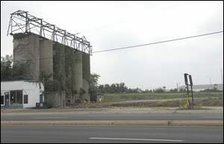
Suddenly much of the farmland has been given over to subdivisions. Northern Spencer County has grown by leaps and bounds during the last fifteen to twenty years, as is evident by this stretch of road. Before very long, KY55 comes to an intersection with KY155, and the 55 designation is directed to the south into the Spencer County seat of Taylorsville, a fairly sleepy little town, even on the busiest of days, and this wasn't the busiest of days. I drove into downtown Taylorsville, which is two blocks along Railroad Street, and four more along Main Street (shown in the picture looking east, not west as I was travelling). The town of Taylorsville and the name Main Street come to an end upon KY44's crossing over Brashear's Creek, where the name of the road changes to Mount Washington, the next town of importance along this route.

I will add here that the route KY44 traverses from here westward to Shepherdsville is known in history as the Wilderness Road, the old buffalo trail which begins in Kentucky (arguably) at the Cumberland Gap, proceeds to Crab Orchard, and from there to Harrodsburg, thence westward to this area and Shepherdsville, thence north to Okolona along Preston Highway, ultimately ending around where 26th Street would meet the Ohio River in the Portland neighborhood of Louisville, at which point the animals would ford acorss when the water levels at the Falls allowed. But, I digress.

Back in Spencer County, along KY44W, west of Taylorsville, at the top of the hill on the right is the Valley Cemetery, one of Taylorsville's older cemeteries, but also the one which during its recent growth has, invariably, grown as well. A dear friend of mine from many years ago, Gary Housley, is buried there. He was born the year after me and passed away in 1991. I always stop at his grave when in the area and did so today.

This stretch of highway, like KY55 on the northside of the county, is quickly becoming a string of subdivisions, dotting both sides of the road, and this pattern continues from this side of Mount Washington where you cross into Bullitt County, through that city, and from there over to Shepherdsville. I can remember when there were very few structures between these two towns, and the only excitement along the road was the old bridge across the Floyd's Fork of Salt River near Brasher's Station, named for the same person as was the creek back in Spencer County. That narrow steel bridge has been replaced by a very plain but also very wide standard-issue concrete deck, along with wide approaches from both directions, far more safe that the older decking, but not nearly as emotive.

Eventually the Bullitt County seat of Shepherdsville came upon me, at which point I entered onto the northbound ramp of I-65 and made my way northward making the ride home.

That's all for February.

Friday, February 27, 2009

454. (S)Election Day in Frankfort; Limited Electorate


Tomorrow the Kentucky Democratic Party State Central Executive Committee will meet at 11:00am at the Wendell H. Ford Headquarters on Democrat Drive in Frankfort. The agenda includes the election of a new Chair and Vice Chair, thus passing the gavel of the Party's leadership. The By-Laws provide different ways of achieving this goal. Article VIII, Section D of the KDP By-Laws outlines the process. These By-Laws may come in handy tomorrow as no names have been confirmed for the lesser position. In 2005, a vacancy occurred in the lesser position and a committee was formed to interview nominees. I served on that committee as the 3rd Congressional District's representative. We'll see if tomorrow brings into play a similar scenario.

Getting the governor's nod for Chair (and thus my support), according to word on the street and in the electronic media, is Charlie Moore, a Union County attorney with a long-standing and well-considered law practice in neighboring Daviess County. Mr. Moore's wife, Brucie, is the Union County Attorney, having first been elected (I believe) in 2002. They reside in Waverly, which is also home to a former college roommate of mine.

This will be my third meeting as a State-At-Large member of the Committee, having been appointed to that position by the full Committee in September, 2008. As with all meetings of the Kentucky Democratic Party, any registered Democrat in the state may attend.

Wednesday, February 25, 2009

453. Obama

Last night, the 44th President of the United States of America addressed the Congress and the people of America in prime time. His report on the state of the union was grim but hopeful. By now everyone has written all the highlights as well as the afterthoughts and responses of those in lesser positions of leadership, including Governor Bobby Jindal of Louisiana. In his speech, the president asked for much and for the sake of the country, the Congress should give him what he has asked for.

But for a minute, let's revisit Election Night 2008. Several people asked last night and in this morning's papers, and no doubt on all the talking-head shows I never watch, "What gives him the idea he can ask for so much?" The answer is simple. He has a mandate from the people of America. Back on November 4th, in an historic election with the greatest turnout in 40 years, 52% of the voters cast a ballot for Barack Obama - I was one of them. 9,522,083 more people thought a Democrat should lead the nation than a Republican. Of the 50 states, Obama won 28 of them. He also picked up the electoral vote of Nebraska's Second Congressional District, which is made up of the city of Omaha and its suburbs in Douglas and Sarpy counties, an area represented in the Congress since 1999 by Republican Lee Terry. The point is President Obama has a right to ask for these things because we the people gave him that right in no uncertain terms.

Watching the President's Address to the Congress, I was mostly struck by those occassions, several, where the Republicans sat on their hands, denying the decision of the November 4th voters, and defying the current 64% approval rating of the president and by extension, his policies, programs, and proposals. I did see Senators McCain and McConnell occassionally offer applause, but not much. When the entire Republican House and all but three members of the Republican Senate decided with their No votes that partisanship is more important that patriotism, I then decided we don't need them.

Although the Democrats don't have the magic 60th Senate vote to keep the Republican Obstructionist-In-Chief Mitch McConnell from obstructing progress for the next two years, it is very obvious the Democratic Party is in ascendancy, an ascendancy begun in 2006 along the Left Bank of the Ohio River near Milepost 606 here in the 3rd Congressional District of Kentucky by the election of Congressman John Yarmuth. That determination, to set right the politics and policies of Republicans leading back from Dick Cheney to George Bush to Newt Gingrich to Ronald Reagan and to the Barry Goldwater of 1964, is spreading from that 2006 beginning - spreading into places like North Carolina and Indiana and Virginia and Colorado and Nevada and the Second Congressional District of Nebraska.

Back in January, I posted an entry which, inter alia, speaks of the 2010 congressional midterms, a time when the Party in control of the White House historically loses seats. And while the current times are historic, they are demonstrably different than most midterms given the state of the economy. Many have said or are saying we are in the worst economic times since the Republican-created Great Depression of the 1920s. Others have said we are, in fact, in a second Depression. In 1932, the voters elected a Democrat, Franklin Roosevelt, who proceded to try and fix what was wrong with America - and then like now, much was wrong. The history books write the fixing didn't happen right away. In fact, it took a very long time. But the voters, the people who make our Democracy a Republic, were fed up with the Republican excesses of the 1920s and they gave FDR something different in his first set of midterms - even more Democrats, and thus even more time.

So, with the support of the American people, the Democratic Congress led by the Democratic President are taking steps to reform and rebuild America while the Republicans are, as they were last night, doing nothing but sitting down on the job.

Saturday, February 21, 2009

452 - 9617

452-9617 was my uncle's phone number when I was a kid. Back then, you could look at the first two digits of a phone number and be able to generalize as to where in Louisville that person (or business) was located. The numbers beginning with 45- were generally somewhere between Preston Highway and Taylorsville Road, from Broadway out to about the Watterson, except over in Buechel those numbers went all the way out to where Fern Creek (the creek named Fern, not the town named for the creek) crosses under Bardstown Road. I grew up with a 96- number. That area was out Preston Highway, Poplar Level Road, and what was then called Old Shepherdsville Road, but now is known as simply Shepherdsville Road. To the east of this area, starting around Vaughn Mill Road and extending east to Seatonville Road, and south of the aforementioned creek named Fern were the 23- numbers. To the west of the 96- area was a large swath covered by the 36- numbers. It started just south of Eastern Parkway and ran from Preston Highway over to 7th Street Road, and out to Fairdale and the county line. West of that area, all the way out Dixie, from south of Rockford Lane were the 93- numbers. North from there from 7th Street Road, south of Berry, and west over to the Ohio River, were 44- numbers. The west side of downtown Louisville had 77- numbers, while downtown was restricted to 58- numbers. Starting south of Oak Street, from 9th over to Preston and out to Churchill Downs were 63- numbers. The upper east side, from the other side (meaning the east side) of Cave Hill and out Lexington Road, Frankfort Avenue, Brownsboro Road, and Shelbyville Road to the Watterson were 89- numbers. On the northeast side of the county were 22- numbers, fitting in with the 22- numbers in Oldham County. Generally those in Jefferson were 228, while those in Oldham were 222. From Brownsboro Road around to about I-64 and out to the Snyder Freeway were 42- numbers. Beyond that, along the eastern edge of the county were 24- numbers. And finishing up the county, on the southeast side, south of Middletown and east of Fern Creek (the community, not the creek), were 26- numbers. Here and there were a few anomalies, but not many. For instance, way out Dixie were the 922 and 942 numbers, serving West Point (in Hardin County) which was a local call and Fort Knox (in Hardin, Meade, and Bullitt) which wasn't. All along the Bullitt County line, the 95- numbers creeped across the line here and there as did the 47- numbers from Spencer County. On the east and northern sides, the system worked the other way with the 24- and 22- numbers lapping, respectively, over into Shelby and Oldham counties. At that time, calling across the river involved adding the prefix 50- to the number. To call my aunt in Clarksville, one would dial 50- then the number. This was true for all the numbers over there in New Albany, Georgetown, Galena, Clarksville, Sellersburg, Jeffersonville, and Charlestown. However, parts of Clark County, north of Sellersburg (such as Borden and New Washington) were then and still are long distance. Even so, we had an extensive local calling area, with all of Jefferson and Oldham being able to call all of those two counties, plus much of Floyd and Clark across the river, and quite a bit of northern Bullitt County, which had three or four different phone systems. The folks in the northern part of the county were on the Echo Telephone Company, later Pioneer, and finally BellSouth, which is known this year as AT&T. That part of the county, now known as Hillview, was previously defined by two communities, the more rural Zoneton and the subdivisions off Preston originally called Maryville. If nothing else, they had a great local calling area, encompassing all of Jefferson and Oldham in Kentucky, part of Floyd and Clark in Indiana, but interestingly, not all of Bullitt, their home county. For many years, and it may still be the case, Shepherdsville, Zoneton, Mount Washington, Lebanon Junction, and the western environs of the county within the Fort Knox reservation, had differing phone services. East and west, the divide was along Floyds Fork on the east of Shepherdsville, and Blue Lick Creek on the west. North and south, the line was less defined, but somewhere south of KY245 on the south side of Shepherdsville, and along Bells Mill Road on the north side. Fort Knox had its own system. I do not know if all this is still the case.

Now, we have caller ID. It tells us the number and usually the name. But it doesn't tell us from where they are calling. No longer can we automatically judge a caller by their phone number. That's might be a good thing. Maybe.

The next time you are downtown at the Main Library, pull out an old telephone directory from the 1960s or 1970s. The are on the second floor, to the right when you exit the elevators. In the center was the map telling you where it was people were calling from - a kind of old-fashioned precursor to Caller ID.

Wednesday, February 18, 2009

451. If you burn books, what will people read? By extension, who is reading this blog?


Ray Bradbury's Fahrenheit 451 was written in the early 1950s. I read it in college and it wasn't as easy a read as I had thought it would be. I read it the same year I read George Orwell's 1984, which relates a related but totally different take on how governments might [or have] come to control our thoughts.

While both books deal with thought control in different ways, Fahrenheit 451 has as its central theme book burning. This entry isn't going to be about book burning, an abhorrent thought to a bibliophile such as myself. Rather, I want to visit a subject I haven't in some time - my five faithful readers. Truth be told, my readersip has dropped off considerably in the last eight weeks for a variety of reasons, the main one I suppose being my lack of posts.

As for the five faithful readers, I know who some of you are and I'm surprised now and then by others who out themselves as a regular visitor here along the Left Bank of the Ohio River near Milepost 606. That has happened in some odd places - at a church dinner, at a party at Bowman Field (a Republican no less), and at my late Uncle Paul's funeral visitation in Clarksville. There are cities other than Louisville that regularly pop up in the list of visitors and I've come to expect them when I check my statistics.

But there are always others and I wonder about them. Some come for only a moment - literally one or two seconds, others for a page or two, and a few for extended periods. I've listed below some of the different cities listed in my visitors log of the last 100 visitors. I've eliminated the regulars. If you are a first time visitor, make a comment - I'm curious as to who you are and how you got here. The comments can be very short or lengthy. I do not promise a reply - I rarely reply to comments, but then again I rarely get commments. The entry with the most comments is, oddly enough, not about politics or travel or history or the weather - categories which constitute most of my entries.
So, below are some of the cities listed. If one of these is yours, and you feel like leaving a few words, please do so. If any of the five faithful readers have any comments on these towns, cities, villages, and burgs, feel free to tell me about it.

Here is the list of cities, followed by their approximate distance from Louisville, distances which are usually about 20 to 40 miles shy of the actual distance:

Perryville, Missouri 229 - this one is getting to be regular visitor.
Bloomington, Indiana 75
Nashville, Tennessee 156
Harrisburg, Pennsylvania 500
Hastings, Minnesota 577
Raleigh, North Carolina 426
Jamestown, New York 434
Alpharetta, Georgia 300
Round Rock, Texas 865
United Kingdom Belfast 3,742
Chambersburg, Pennsylvania 446
West Liberty, Kentucky 140
Glouster, Ohio 215
United Kingdom Brighton, East Sussex 4,060
United Kingdom Burnley, Lancashire 3,901
Birmingham, Alabama 333
Saint Charles, Illinois 289
Charlotte, North Carolina 344
United Kingdom Norwich, Norfolk 4,067
Indonesia Surabaya, Jawa Timur 9,997
Italy Gioia Tauro, Calabria 5,172
San Francisco, California 1,982
Detroit, Michigan 316
Northport, New York 686
Asheville, North Carolina 255
Orlando, Florida 720
Salem, South Carolina 276
Georgetown, Indiana 13* - this one is within the local calling zone, but a newcomer nonetheless.
Holland, Michigan 310
Sacramento, California 1,919
Mount Sterling, Kentucky 100
Canada Waterloo, Ontario 451
Rockport, Kentucky 93 - since I know someone in Rockport, I probably know who this is.
New Castle, Indiana


Thanks for reading.

Sunday, February 15, 2009

450. After Five Years, I've Decided

This morning, at the 10:30 am service of the Episcopal Church of the Advent, just prior to the service beginning, I approached Mary, who has some official pastoral role, and told her that when the "Inquirers Class" begins during Lent, I wanted to be a part of it. This will be the first real step toward separation from Holy Mother the Church, which is to say the Roman Catholic Church, and communion with other Episcopalians in the Anglican Communion.

There is a line in an old hymn, "Burdens are lifted at Calvary." This one was lifted at Baxter and Broadway.

Thursday, February 12, 2009

Happy 200th, Mr. Lincoln

From the White House website --

16. ABRAHAM LINCOLN 1861-1865

Lincoln warned the South in his Inaugural Address: "In your hands, my dissatisfied fellow countrymen, and not in mine, is the momentous issue of civil war. The government will not assail you.... You have no oath registered in Heaven to destroy the government, while I shall have the most solemn one to preserve, protect and defend it."

Lincoln thought secession illegal, and was willing to use force to defend Federal law and the Union. When Confederate batteries fired on Fort Sumter and forced its surrender, he called on the states for 75,000 volunteers. Four more slave states joined the Confederacy but four remained within the Union. The Civil War had begun.

The son of a Kentucky frontiersman, Lincoln had to struggle for a living and for learning. Five months before receiving his party's nomination for President, he sketched his life:

"I was born Feb. 12, 1809, in Hardin County, Kentucky. My parents were both born in Virginia, of undistinguished families--second families, perhaps I should say. My mother, who died in my tenth year, was of a family of the name of Hanks.... My father ... removed from Kentucky to ... Indiana, in my eighth year.... It was a wild region, with many bears and other wild animals still in the woods. There I grew up.... Of course when I came of age I did not know much. Still somehow, I could read, write, and cipher ... but that was all."

Lincoln made extraordinary efforts to attain knowledge while working on a farm, splitting rails for fences, and keeping store at New Salem, Illinois. He was a captain in the Black Hawk War, spent eight years in the Illinois legislature, and rode the circuit of courts for many years. His law partner said of him, "His ambition was a little engine that knew no rest."

He married Mary Todd, and they had four boys, only one of whom lived to maturity. In 1858 Lincoln ran against Stephen A. Douglas for Senator. He lost the election, but in debating with Douglas he gained a national reputation that won him the Republican nomination for President in 1860.

As President, he built the Republican Party into a strong national organization. Further, he rallied most of the northern Democrats to the Union cause. On January 1, 1863, he issued the Emancipation Proclamation that declared forever free those slaves within the Confederacy.

Lincoln never let the world forget that the Civil War involved an even larger issue. This he stated most movingly in dedicating the military cemetery at Gettysburg: "that we here highly resolve that these dead shall not have died in vain--that this nation, under God, shall have a new birth of freedom--and that government of the people, by the people, for the people, shall not perish from the earth."

Lincoln won re-election in 1864, as Union military triumphs heralded an end to the war. In his planning for peace, the President was flexible and generous, encouraging Southerners to lay down their arms and join speedily in reunion.

The spirit that guided him was clearly that of his Second Inaugural Address, now inscribed on one wall of the Lincoln Memorial in Washington, D. C.: "With malice toward none; with charity for all; with firmness in the right, as God gives us to see the right, let us strive on to finish the work we are in; to bind up the nation's wounds.... "

On Good Friday, April 14, 1865, Lincoln was assassinated at Ford's Theatre in Washington by John Wilkes Booth, an actor, who somehow thought he was helping the South. The opposite was the result, for with Lincoln's death, the possibility of peace with magnanimity died.

Wednesday, February 11, 2009

448. The Mayor's Talk of the Town at the Metro Democratic Club

For those of you who are stopping by to see which backroads I travelled lately or which theatre seats I've warmed, this entry will be a distraction for you. You can choose to leave now without any concern on my part.

Despite the high winds (with gusts up to 60 mph from the WSW) which blew through here along the Left Bank of the Ohio River near Milepost 606 (winds which have died down to a mere 18 mph at present, still a pretty good clip), His Honor the Mayor of Louisville-Jefferson County Metro made an appearance at the Metro Democratic Club. For the second year in a row, he has given a speech on the State of the City, although his handlers are quick to point out that this speech isn't the State of the City, as that is a speech reserved for the very Republican-leaning Rotary Club. Thus far this year the State of the City address has not been made due to weather calamities. Tonight's less formal Talk of the Town was nearly derailed by a windstorm which passed through earlier in the day.

This year's speech to the Metro Democratic Club was far more somber and detailed than last year's, which according to some listeners was a bit too rosily-tinted. When the mayor spoke last year, 61 of the 64 people in attendance rose at the end to give him a standing ovation with a plesant amount of applause. I was among the three who didn't and was called out by one of the mayor's handlers the next day at an impromptu meeting in the Capital Annex in Frankfort. There were statements made last year which, in my opinion, had no basis in reality. Like so many of the speeches the mayor has made since his first election in 1985, there was too much cheering and too little serious examination. This year's speech was remarkably different, so much so that at the end most of the 72 people in attendance, while not rising, did applaud, and I was among them.

The mayor gave an honest account of the state of the City, as well as insights into the state of the Commonwealth and the Republic. I appreciated his very forthright speech about the economic peril all of the governments find themselves in. Much of the beginning of his speech was given over to a monologue on the Acts of God which have recently been perpetrated upon our big town: Hurricane Ike, an Ice Storm, and today's windstorm, all within a six month period, and more importantly, all within the current Fiscal Year, which was already facing a $20,000,000.00 shortfall - more on that in a moment.

Once the mayor got past the weather reports, his attention focussed in on economics and opportunities. The opportunities he spoke of were related to President Obama's Stimulus Bill, which has made considerable progess over the last twenty-four hours and is now being conferenced with a hopeful final vote very soon. According to a mayoral aide, the House version of the bill was 40% infrastructure money, something dear to me as well as many on both sides of the local Bridges Issue. The mayor said no money was requested for the Bridges Project in the current bill although there is a $6,000,000,000.00 setaside for a National Significant Projects fund [that may not be the exact name - the mayor struggled with its title], money which conceivably be used for Louisville's one, two, or three unbuilt bridges. For the record, I am opposed to a new bridge downtown.

The mayor talked about Louisville's tax revenues being tied to our occupational tax receipts. As a former member of the Louisville-Jefferson County Revenue Commission, I know whereof he speaks. Downfalls in employment are felt right away by the resulting decreases in occupational income. The mayor reported 25,255 new unemployment claims here in Jefferson County in December. That's at least 25,000+ employees no longer paying in to the government coffers, and that's just one month.

A question was raised about the proposed sixteen month downtime supposedly coming up for the Ford plant. The mayor was unaware of the sixteen month timeline, something UAW President Rocky Comito seemed to confirm my shaking his head up and down. That the mayor and Comito are not reading from the same page of the hymnal on this matter is of some concern.

Another question, which brought the only testy moments of the evening, was posed by my friend Dan Borsch. An aside - I find Borsch to be one of the more intelligent and creative young leaders in Louisville. Borsch, an attorney among other things, is a former candidate for the Metro Council in 2004 and the campaign chair for John Yarmuth's 2006 Congressional Primary. He asked about how the city's economic forecasters came up $20,000,000.00 short on their estimates last year. The mayor did not seem to know who Borsch was. Nonetheless he offered an answer defending his economic forecasters including one who is the economics chair (or something like that) at the University of Louisville. The mayor asked Dan if he was a U of L grad. I know he isn't. His degrees are from Michigan and Indiana. The mayor offered that our economic forecasters didn't do as poorly as those of some other cities in our region. That isn't exactly a consolation, although it does answer the question. "They were all wrong; our's weren't as wrong as their's but, again, they were all wrong."

Another light hearted question came from Ray Crider, Louisville's Democratic Party computer and camera guru. Ray asked what the mayor had done with all the money he had gotten from Anne? Everyone in the room knew what and who Ray was referring to but the mayor, politely smiling, demurred. Unlike the question asked by Borsch, for which the mayor found the justification for an answer, he properly felt Ray's question on the former congresswoman was best left unresponded-to.

The speech eventually came to an end, and with it the meeting. In attendance were Metro Council President David Tandy, Councilwoman Vicki Welch, Councilman Jim King, one of Jefferson County's District Court Judges (although I'd be lying if I pretended to know her name). Four bloggers were also there: Jacob Payne, Rick Redding, Ben Carter, and Ashley Cecil (who is also an artist). Stephen George of LEO and Dan Klepal of the C-J were present as part of the mainstream media's coverage, which is to say the LEO is getting more and more mainstream even while the C-J is wasting away to nothing. Marty Meyer was representing Congressman John Yarmuth's office. Kentucky Democratic Party Chair Jennifer Moore spoke briefly, then sat down eight feet from me, with nothing between us but space. But, she didn't speak. Not only is she not reading or responding to my emails, she apparently isn't speaking at all. Jefferson County Democratic Party Chair Tim Longmeyer was also present, and he too, didn't speak. Finally Lisa Tanner, who raised money in the Miller/Maze race in the Primary of 2007, and was a state organizer in the General of 2007 for Beshear/Mongiardo, as well as serving as John Yarmuth's 2008 Field Director, was also present.

It was a good meeting.

Sunday, February 8, 2009

447. Belknap Theater Visit and a Review

Last night I was unexpectedly invited to attend a play with my friend Chris. We had just finished a dinner celebrating his recent hiring to a new position. Another friend of his was in the cast, a young lady I had seen in a role last summer at Shakespeare in the Park, properly the Kentucky Shakespeare Festival. Before we arrived for the play, we were joined by another friend who is a student at the University of Louisville. The play was performed at the historic Belknap Theater, on the island between 2nd and 3rd streets, just south of Cardinal Boulevard, which older Louisvillians sometimes still refer to as Avery Avenue.

The play, commissioned by the University for Abraham Lincoln's 200th birthday, was written by Minneapolis based actor and playwright Carlyle Brown, who has also been commissioned for other Louisville area productions. Its title was Abraham Lincoln and Uncle Tom at the White House. The play borrowed from Harriet Beecher Stowe's Uncle Tom's Cabin in the first act, and used the second act for an imagined dialogue between Uncle Tom, played by Cecil Washington, Jr., and Abraham Lincoln, portrayed by Obadiah Ewing-Roush. While the history was intact, the play itself lacked. There was only so much the actors could do with the work they were given. Chris' actress friend, Tiffany LaVoie, played two different roles, one in each act, including, in the latter, that of Mrs. Mary Todd Lincoln, the belle of Lexington who was well-known to be more than a little off-balance.

Two lines for me stood out, and neither because of the historicity of the play. In one scene Uncle Tom is begging the president to sign the Emancipation Proclamation, who responds "I'm waiting to do it, I'm wanting to do it, I'm willing to do it . . . " or something like that. The words seems to have come straight from Alfred Doolittle in My Fair Lady, one of my favorite plays in all of theaterdom, in response to a response from Professor Higgins as to why Eliza is at the professor's house. Another point in the play had Uncle Tom explaining he didn't know how he came to be in the White House, that he was just a character in Mrs. Beecher Stowe's play seeking an outlet. That is related to the premise of Luigi Pirandello's 1921 work Six Characters in Search of an Author. That's about all I can say about the play without being overly critical.

So, instead, let me write a short bit about the Belknap Theater or "The Playhouse" as it is called on the University campus. Randy, the U of L student with us, said the playhouse looked like a church. There is good reason. It was built in the 1870s to serve as a chapel as part of the House of Refuge, which served as the Jefferson County Poor House or Children's Asylum, as they were sometimes called back then. The House of Refuge was located where, at the time, Third Street came to a dead end. About 100 years after its construction, it was dismantled to make way for the William F. Ekstrom Library and relocated to its present location, north of the Confederate Monument, in what is now called Freedom Park. As it was rebuilt it was expanded to serve a number of needs of the University's Theater Arts Department.

I attended events at the Playhouse quite a bit shortly after its relocation with friends of mine who had been students in the very early days of the Youth Performing Arts School, a block north of the site on Second Street. Last night's return was my first in nearly three decades, as best I remember. My ticket, by the way, indicated I was seated in Row K, Seat 105. No one else would have noticed, but that happens to be the Jefferson County precinct number, K-105, where the Playhouse is located.

Friday, February 6, 2009

446. Warmer Weather Warms the Weary

The temperature today is set to push through the 20s this morning, then through the 30s and 40s, and end up at 50 or so. The warmup continues tomorrow into the 60s. For friends and neighbors, both here along the Left Bank of the Ohio River near Milepost 606, and elsewhere across Kentucky and southern Indiana, Thanks Be To God.

Tuesday, February 3, 2009

445. Snow

Ok, it's better than ice.

This morning we woke up to snow. One to three inches expected.

If LG&E's track record is any indication, the power should start failing any minute now. That's assuming you already have power. About 30000 customers are still without it from last week's ice storm.

Sunday, February 1, 2009

444. Movie Reviews - Spoiler Alert (sort of)

Those of you who know me well know I do not do movies. Up until a few weeks ago, I hadn't been to a movie in years. I've never liked dedicating a few hours of my life to a less-than-acceptable made-up story often portrayed by less-than-capable made-up actors. It is related to my aversion to television although I'm not quite sure exactly how. In the nearly twenty-five years I haven't watched television, I've probably been to a movie theatre twenty times at most. Several of those would have been to see Rocky Horror at the old Vogue Theatre in Saint Matthews, and maybe two or three more were special films, the most recent of which was Fake ID in 2003. Doing movies just isn't my thing. Over in the categories column on the right, there really isn't one that doing a movie review will fit into, unless it is uncategorized.

Having said all that, I must tell you in the last three weeks, amidst illness, inaugural, and icestorm, twice I've been found in the dark confines of a movie theatre. My friend Preston and I agreed to see two movies, both for their historical significance. Historical must be taken in context here. The movies both covered real political, cultural events which took place roughly a year and a half apart. I hesitate to say they were historical out of vanity. Both occurred during my lifetime; neither occurred during Preston's so for him the historic appellation is more appropriate.

The movies we viewed were Frost/Nixon and Milk. Both are strong representations of events that historically occurred, each having significance in American history. The Frost/Nixon debates took place in April, 1977, just as my junior year of high school was coming to an end. It was a politically and historically siginificant time in my life as I had just won my first big race, that of Student Government President of my high school, defeating the favored pick in a big way. I had ran for class office in 7th, 8th, 9th, and 11th grades, losing every single time, several times to the same person. Finally, at the end of 11th grade, my election as Student Government President of Durrett High School was an important milestone. David Frost's interviews with the former president were taking place at exactly the same time. As a politically interested and active student, I am sure I followed the interviews, although I'd be lying if I said I actually remember doing so - I don't.

I have always been something of an apologist for the former president on certain matters. I think because of his criminal activity with regard to Watergate, his domestic policy contributions have long been overlooked. I've written here before that he was one of the last of the "government can be the answer" New Deal type presidents. In his early years, and perhaps in his personal life and belief system, Nixon may have been a conservative. On the other hand his presidency, other than the problems with Vietnam and his involvement in Watergate, was an example of pragmatic liberalism, fostering programs such as the Environmental Protection Agency, the Occupational Safety and Health Administration, the Consumer Product Safety Commission, and the Philadelphia Plan of Affimative Action. He was also one of the first presidents since Harry Truman (and one of the last) to seriously address the idea of universal healthcare for all Americans, although like Truman, the plan never got off the planning paper. But, all of that, much good and well-known bad, was put down with the interviews by the British television personality David Frost.

The movie tells two distinct stories; first that of Frost, who agonizes over how to finance the project, an agony which was not overcome until after the broadcasts. The other story is that of the lonely yet oddly and uncomfortably amiable Nixon, with a mind and persona fully permeated by the deep rejection he received from the American people after Watergate. Both actors play their characters well, but I think the dark and brooding offering from Frank Langella as the president is sure to remain in people's minds as a reminder of this once great presence on the world's stage then reduced by a belief that the president can and should be above the law. It was an excellent movie.

About a year and half after the Nixon/Frost interviews, word came from the city of San Francisco on November 27, 1978 that its mayor, George Moscone, and one of its supervisors (councilmembers), Harvey Milk, had been assasinated by another supervisor, Dan White. At the time, I was a freshman at the University of Kentucky, enrolled as a political science major, and honestly not very focussed on anything at all, school or otherwise. Upon arrival at UK, I had been elected president of my dorm (Kirwan II) and a few weeks later was elected a vice-president of my pledge class in my fraternity (Sigma Pi). Once elected, my mind turned to partying and little else. The great diversion at the time were the protests both by and against Iranian students just before and after the uprising and subsequent revolution in Teheran, deposing the Shah and institution religious control. The gay revolution occurring in San Francisco was not on my radar screen despite my interests in the support and promotion of gay rights as a personal belief. My political barometer, which had started on the right when I was in my early teens had been gradually moving well to the left. Like the Frost/Nixon debates, I can't honestly say that I remember the San Francisco assassinations clearly. That isn't to say I don't remember them at all them as I clearly do. But, I've never really studied the background story leading up to the assassinations. I do remember all the controversy over Mr. White's so-called "twinkie defense" and his subsequent conviction on manslaughter charges. And I remember years later when it was reported that he committed suicide believing God has a way of spinning the wheel around.

The movie offers an deep-insider's look at the story of Harvey Milk, America's first openly gay politician, elected as a San Francisco City/County Supervisor in 1977. Milk is portrayed by Sean Penn. It is part history and part love story, but it is entirely lifted from a page of real American life; events which happened during my lifetime. With the possible exception of Matthew Shepard, Harvey Milk is America's only gay political martyr, a martyrdom which has only increased over the years. The movie portrays a number of characters, several of whom are still living, while others have passed on, notably that of Scott Smith, portrayed by James Franco, Milk's long-time lover and business partner who died in the 1990s from complications from AIDS. Among others still with us are Dan Nicoletta, Cleve Jones, and Anne Kronenberg, and each of their roles are memorably portrayed in the film.

At different points throughout the movie, I was moved to tears, mostly out of joy for the successes Milk made as a cultural leader, despite his losses as a political candidate. The movie goes through all of his races, and then his tenure as a supervisor, and finally his death. But nothing - nothing - prepared me for a scene at the film's end of the impromptu Memorial March from 18th and Market streets to City Hall in Milk's memory. Estimates then and now put the number at 30,000 to 50,000. The scene is partially recreated, combined with vintage footage from the actual march. It took my breath away and left me sobbing. While the movie may or may not be the greatest, it does tell a great story and, as stated, the ending is an eruption of emotion. The picture at left was taken, at the time, by Danny Nicoletta who is one of the characters portrayed in the film.

If history is any judge, I won't be back in a movie theatre for several years. And emotionally speaking, that might be a good thing as I need some time to recover.

Saturday, January 31, 2009

443. The Ice Man Stayeth

Here's the good news - the temperature is 34 degrees and the sun is shining brightly here along the Left Bank of the Ohio River near Milepost 606. That's the extent of the good news.

Today's Courier reports 122,000 Louisville customers are without electricity. That's a bare minimum of one in seven Louisvillians, assuming that every customer accounts for only one person, which we all know is not the case. Chances are that up to 33% of Louisville residents remain without electricity. Louisville's population is around 711,000. That could mean just over 200,000 people in the dark. There are no closed-end estimates on when electricity will be fully restored. The problem is widespread throughout the state and well into other states. I've talked on the phone with friends in Green and Grayson counties, to the south and southwest, respectively, all of whom are power-less and powerless to get any power back. We are all at the mercy of the utility companies, which have brought in help from all over the country. Another friend in Elizabethtown says there is some problem with the water supply there, although they didn't fully explain themselves. There have been several deaths including a few here in Louisville.

Fortunately, I have power - as does my mother, although her's is not coming in a full force - her lights are dim; her furnace is only working part-time. I met my brother and a guy who works with him for a morning cleanup at mom's house. To be honest, my brother did most of the work which I thought was only fair since he hasn't cut the grass there since the 1980s. My mother's yard, property that has been in my family since 1951, is dotted with trees, large and small, old and young, leaf-bearing and needle-bearing, all of which suffered damage. Even with my mother's description (made entirely from looking out the windows as she has not been outside in four days), I wasn't prepared. There are several branches from every tree down in her yard, criss crossing the lawn, some against the house, her car, the street light, the electric line, and every other configuration. The fact that she has electricity at all is a little beyond belief. At the southeast corner of her driveway is a utility pole from which extend the wires to her house and three others. Branches from other trees, including one across the street, have severed the lines to the other three houses. Those lines, along with a large branch, are blocking the road. Rudely, people have been detouring around the lines driving about 30 feet up into her yard and then through it to another to get back upon the road. I'm not quite sure people would think some lady's yard is the appropriate place for a detour. Her street is a U-shaped lane, with double access to South Park Road. The impromptu detour has been closed. We piled about one half of the branches across it, a stack about 35 feet long and five to ten feet high. The street is, for the moment, a dead end at my mother's driveway.

On the north side of her house, a huge branch looked like it was torpedoed into the yard, taking part of her guttering with it. All that is fixable. The backyard seems to have lost trees as opposed to branches. When my brother and I were little, our grandfather built us a cabin in the far back corner of the yard. Over the years we planted trees here and there, all of which are 35 to 45 years old now. Over time, a few have come down through one means or another, always falling in the triangular space between the garage, the pool, and the house. And such is the same today. Several huge trees are down, but none of them hit anything, other than themselves. Looking for the silver linings behind the clouds, I told my mother that the Ice Storm of '09 probably saved her $10,000.00 in tree costs. All the trees have been topped out and trimmed up, at no cost, other than the removal of the debris. She smiled, but, like the electrical current in her house, it wasn't a very strong smile.

What is amazing is driving through entire neighborhoods that are still fully without power. Between here and there, it seems most of Smoketown and Germantown lacked power, as did Audubon Park and parts of Camp Taylor. Stoplights along much of Shelby Street and Poplar Level Road were not working. The picture shows Winter Avenue looking west toward the intersection at Barret Avenue - no lights. Closer to mom's house, there did seem to be more electricity for longer periods of space. Instead of entire neighborhoods out, the shortage is limited to a house here and a house there. But restoration will not come quickly as every street and every house on every street will be checked and rechecked before the grid is fully restored and power is flowing freely.

The first month of January has been interesting, if rather unproductive. It seems we can't quite get the year started. Between getting over Christmas and New Year's, the anticipation and then celebration of a new presidency (as much a celebration of getting rid of the old one), and then a cold spell and ice storm, it is time for January to take its leave. Bring on Month Number Two.

Wednesday, January 28, 2009

442. Hurricane Ike (Ice) Revisited

Back in September, (the remnants of) Hurricane Ike passed through Louisville, ripping hundred year old trees from their roots, wreaking havoc on roofs and power lines, closing most schools and businesses for nearly two weeks while the city went without electricity and most services. Fortunately, the temperatures at that time were moderately warm and there was little precipitation once the storm passed through, which was on a Sunday. As reported in the last post, the Left Bank of the Ohio River near Milepost 606 has been hit by an ice storm leaving us in very similar circumstances to the outcome of Ike, the difference being the temperature and the precipitation.

Very shortly after entering the previous post, sometime around 2:45 am the power went out in most of the city, and since that time in several surrounding counties, and presently remains so. It is Hurricane Ike all over. Except, the temperature is in the 20s, there is a cold wind, there is an inch and a half of ice, under which is three inches of snow, and over which is three more inches of snow. Schools, colleges, and businesses have announced they are closing tomorrow and Friday, much they way they did in September. Most remained closed for nearly two weeks back then. Can we afford it all again? A call to the LG&E service center reports all power is expected to be restored in seven to ten days. Seven to Ten Days!

No amount of preparation by the city street crews can counter the effects of having no electricity in the areas you serve. With street lights out in a number of locations, and ice crystals bending over some of the city's biggest trees, many of which snapped, while others offer a very delicate canopy over cars, which was the case with my car this morning. While one tree did snap, another simply leaned over the car and I drove out as if exiting Batman's tunnel into Gotham City.

Out at my mother's, the situation is both better and worse. She has electricity, although it has come and went a number of times. She also has considerable damage to her home and property from falling trees, although nothing apparently pierced the roof. Her car is below one such branch. And because there are downed power lines in the street in front of her house, several cars have detoured around the lines and into her yard, only to find that very slight eighteen inch hill in her side yard is maybe seventeen inches more than most cars can navigate through snow and ice. She reports a van and a wrecker are presently well lodged in her side yard. Both have been abandoned, and the detour is cutoff by their presence. As in the picture above, trees and cars have become rather familiar with each other.

The governor and the mayor are here and there on the media (so I am told) explaining the reality that there is little anyone can do under the circumstances. And since the two major utility companies serving the greater part of the Commonwealth are German-owned, getting someone local on the phone is proving difficult. I could make a pitch for municipally owned utilities here, but I wont. Even if our's were locally owned, the overwhelming nature of the storm probably would allow the same response, which seems to be very little.

Like the van and the wrecker at my mother's - abandoned - I've left my house for warmer climes, those of a friend from where I am presently posting. My nephew is serving as a sentinel keeping watch over the house where the temperature is hovering in the 30s. There is a gas-fired faux-fireplace which keeps an area of about 10 square feet in a radius immediately in front of it quite toasty. I wasn't content with that idea - my nephew was.

We'll see what tomorrow brings.

441. Ice

I woke up about 20 minutes ago to the very loud sound of limbs breaking and falling somewhere close to my bedroom windows. A small tree, the only one left in front of the house after the first two were taken out by Hurricane Ike back in September, is now history, bent over in three places, snapped in two like wooden matchsticks. Further noises, so far, have proven to be ice and snow sliding off the gabled portion of the house as well as the garage in the back. There are two very slender and tall trees between my house and the house to the west which have me greatly concerned. Out in the alley in the back, the remains of a large tree, most of which came down back in September, are now scattered like kindling. While looking out the front door, the limbs of a tree in the alley behind the house across the street fell out of the sky, creating a noise as if they were within a few handspans. The lights have blinked a few times, but thus far, as is evident by this entry, power is on. It's been a few years since we've had a serious ice storm. I can only remember three or four really bad ones in my life - this is another one. The last I recall was in 1994 - surely there has been one since then. We'll see what tomorrow brings although the forecast isn't too promising.

I used to really like winter. Maybe I am getting old.

Monday, January 26, 2009

440. Ill Winds - Thoughts of William Henry Harrison

It is a well known fact that William Henry Harrison, our Republic's ninth president, spent too much time in the cold March air of Washington DC, delivering his inaugural address, the longest ever, and dying a few weeks later from the after-effects. Last Tuesday, in a simlar manner, me and 2,000,000 of Barack Obama's closest friends spent upwards of six hours waiting in chilling temperatures to hear the 44th president deliver a speech of remarkably shorter length. President Obama emerged from the warmth of the Capitol to take the Oath of Office and make his speech. Meanwhile, large numbers of frozen attendees at the swearing-in never quite made it to their assigned posts. The section I was to be seated in (Blue) was big enough for maybe 15000 people if we all got really familiar with each other. Jessie, Brandon, and I had scoped the Blue ticket zone out the day before while touring the area. We even decided on the ideal place to be to see Barack Obama take the oath.

Alas, getting to that spot was only a fantasy, of phenomenal proportion. Instead, we began the morning waiting in a line which snaked its way from 3rd and New Jersey streets SE to 2nd and Washington streets SW. Standing next to me during part of my wait was Georgetown U. and Miami Heat standout Alonzo Mourning, who at 6'9" and 261 pounds, frankly, needed a little more space than I did. Fortunately, because of his height, he occasionally gave updates as to where the line ahead was headed, although ulitmately, that wasn't very far. Getting close was going to be a problem for the 15000 the area could hold. But the real problem was this - a total of 52000 tickets were relased for that section. And, based on commentaries after the fact, most of the ticket holders did not get to their assigned spot. My guess is about 7500 made it past security and into the Blue section. To be sure, out lot wasn't nearly as bad as that of the Purple ticket holders. They were herded into the I-395/3rd Street Tunnel and some remained there for the duration, underground with limited light and no amenities. It was not a good example of planning and execution. I heard a friend comment that all of candidate Obama's event, irrespective of attendance, had come off without a hitch. I reminded her they were choreographed by a well-oiled campaign. The inauguration was conducted by the government (actually several governments working in concert), which is well versed in screwing up any number of things, now including inaugurations. None of this complaining is to take away from the experience. I'm very grateful to Congressman Yarmuth for the tickets and the hospitality shown my his staff during my visit. Without reservation, I had a great time. But I digress.

Back to William Henry Harrison. Harrison, one time governor of the Indiana territory, was a two-time candidate for president, first unsuccessfully in 1836 (against among others Kentucky's Henry Clay, who was also unsuccessful), then successfully in 1840 against the incumbent Martin VanBuren. Harrison had been a territorial governor, military hero, congressman, and diplomat before ascending to highest office in the land. On March 4, 1841 (inaguration day in that era) he delivered the longest inaugural speech on record, over 8400 words. A few weeks later, he became ill, probably with pneumonia. He delivered the speech with neither hat nor overcoat to protect him from the weather. And then he died, serving the shortest term on record for president, a little over 30 days in office.

On the other hand, knowing that the temperature in Washington last week was forecast to be 30, with a wind chill right at 10, I bundled up in multiple layers of clothing, much the way my grandmother would dress me when I was a kid going out to play in the snow. I had on sweatpants and pants, three pair of socks, two t-shirts, a shirt, my duPont Manual hoodie, and a jacket over that, with a tobaggon on my bald head. But five hours in the cold takes it toll. After the inauguration, we all returned to the hotel room where, unceremoniously, I told every one to leave - that I was taking a hot shower, and going to bed, given that I had gotten no sleep the night before, and would be driving the twelve or so hours back to Louisville the following day. There is another story here having to do with my sleeping and snoring, and I owe a huge apology to all my hotel-mates over this rude dismissal from the room. Nonetheless, they all left, without an argument, and I went to sleep. Needless to say, it apparently wasn't enough.

Wedensday's agenda brought us back to Louisville, with several stops along the way. Once home, I didn't sleep well, but I did go to work. Struggling through Friday, I've come down with a cold, possible pneumonia, and an intense amount of wheezing. I should have gone to bed Friday, but instead took my mother to a funeral visitation in Frankfort for her cousin. Saturday morning, still ailing, I attended and spoke (along with Chad Aull) at a workshop for the Shelby County Democratic Executive Committee, a three hour session of give-and-take with Democrats in that county seeking to regain some seats lost to the Republicans over the past few years. I did go to bed Saturday afternoon and remained there until time for Sunday morning Mass. Since returning from church and a quick trip back to Shelby County to retrieve my jacket, I've basically been in bed, struggling to sleep and breathing with slight difficulty. I tried to go to work today, but instead brought my work home with me. Hopefully by tomorrow, I'll feel better. Lots of juice, lots of rest, and nothing on the schedule.

Friday, January 23, 2009

439. Sixty Degrees; The Inaugural Address

What a difference a few days make. Three days ago, when upwards of two million people flooded The National Mall to witness the inauguration of President Barack Obama, the temperature there was 30 degrees with a well-felt windchill of about 8 to 10 degrees. Today, it is 51 degrees in the Federal City. Here along the Left Bank of the Ohio River near Milepost 606, the thermometer is registering 60 degrees of mercury making for a very pleasant Friday afternoon. Of course, this being Louisville, it could very possibly snow tomorrow and a few flakes are expected as tomorrow's high is predicted to be 35 with a low of 17. As we are not quite to the midpoint between the Winter Solstice and the Spring Equinox, more cold days and nights are anticipated. That day will fall February 2, where, at least in the United States, we rely upon a groundhog in Pennsylvania to play meterologist for six weeks, as opposed to listening to well-educated men and women playing at meteorologist on the TV and radio airwaves. Who knows, maybe Phil the Groundhog is a better choice.

*****

Below, in case you missed it, is President Obama's Inauguaral Address, as released by the White House. I do not think it was of the caliber of the one he gave election night, but it is an extraordinary speech - one appropriate for the challenging times.


My fellow citizens -

I stand here today humbled by the task before us, grateful for the trust
you have bestowed, mindful of the sacrifices borne by our ancestors. I
thank President Bush for his service to our nation, as well as the
generosity and cooperation he has shown throughout this transition.

Forty-four Americans have now taken the presidential oath. The words
have been spoken during rising tides of prosperity and the still waters
of peace. Yet, every so often the oath is taken amidst gathering clouds
and raging storms. At these moments, America has carried on not simply
because of the skill or vision of those in high office, but because We
the People have remained faithful to the ideals of our forbearers, and
true to our founding documents.

So it has been. So it must be with this generation of Americans.
That we are in the midst of crisis is now well understood. Our nation
is at war, against a far-reaching network of violence and hatred. Our
economy is badly weakened, a consequence of greed and irresponsibility
on the part of some, but also our collective failure to make hard
choices and prepare the nation for a new age. Homes have been lost;
jobs shed; businesses shuttered. Our health care is too costly; our
schools fail too many; and each day brings further evidence that the
ways we use energy strengthen our adversaries and threaten our planet.
These are the indicators of crisis, subject to data and statistics.
Less measurable but no less profound is a sapping of confidence across
our land - a nagging fear that America's decline is inevitable, and that
the next generation must lower its sights.

Today I say to you that the challenges we face are real. They are
serious and they are many. They will not be met easily or in a short
span of time. But know this, America - they will be met.

On this day, we gather because we have chosen hope over fear, unity of
purpose over conflict and discord.

On this day, we come to proclaim an end to the petty grievances and
false promises, the recriminations and worn out dogmas, that for far too
long have strangled our politics.

We remain a young nation, but in the words of Scripture, the time has
come to set aside childish things. The time has come to reaffirm our
enduring spirit; to choose our better history; to carry forward that
precious gift, that noble idea, passed on from generation to generation:
the God-given promise that all are equal, all are free, and all deserve
a chance to pursue their full measure of happiness.

In reaffirming the greatness of our nation, we understand that greatness
is never a given. It must be earned. Our journey has never been one of
short-cuts or settling for less. It has not been the path for the
faint-hearted - for those who prefer leisure over work, or seek only the
pleasures of riches and fame. Rather, it has been the risk-takers, the
doers, the makers of things - some celebrated but more often men and
women obscure in their labor, who have carried us up the long, rugged
path towards prosperity and freedom.

For us, they packed up their few worldly possessions and traveled across
oceans in search of a new life.

For us, they toiled in sweatshops and settled the West; endured the lash
of the whip and plowed the hard earth.

For us, they fought and died, in places like Concord and Gettysburg;
Normandy and Khe Sahn.

Time and again these men and women struggled and sacrificed and worked
till their hands were raw so that we might live a better life. They saw
America as bigger than the sum of our individual ambitions; greater than
all the differences of birth or wealth or faction.

This is the journey we continue today. We remain the most prosperous,
powerful nation on Earth. Our workers are no less productive than when
this crisis began. Our minds are no less inventive, our goods and
services no less needed than they were last week or last month or last
year. Our capacity remains undiminished. But our time of standing pat,
of protecting narrow interests and putting off unpleasant decisions -
that time has surely passed. Starting today, we must pick ourselves up,
dust ourselves off, and begin again the work of remaking America.
For everywhere we look, there is work to be done. The state of the
economy calls for action, bold and swift, and we will act - not only to
create new jobs, but to lay a new foundation for growth. We will build
the roads and bridges, the electric grids and digital lines that feed
our commerce and bind us together. We will restore science to its
rightful place, and wield technology's wonders to raise health care's
quality and lower its cost. We will harness the sun and the winds and
the soil to fuel our cars and run our factories. And we will transform
our schools and colleges and universities to meet the demands of a new
age. All this we can do. And all this we will do.

Now, there are some who question the scale of our ambitions - who
suggest that our system cannot tolerate too many big plans. Their
memories are short. For they have forgotten what this country has
already done; what free men and women can achieve when imagination is
joined to common purpose, and necessity to courage.

What the cynics fail to understand is that the ground has shifted
beneath them - that the stale political arguments that have consumed us
for so long no longer apply. The question we ask today is not whether
our government is too big or too small, but whether it works - whether
it helps families find jobs at a decent wage, care they can afford, a
retirement that is dignified. Where the answer is yes, we intend to
move forward. Where the answer is no, programs will end. And those of
us who manage the public's dollars will be held to account - to spend
wisely, reform bad habits, and do our business in the light of day -
because only then can we restore the vital trust between a people and
their government.

Nor is the question before us whether the market is a force for good or
ill. Its power to generate wealth and expand freedom is unmatched, but
this crisis has reminded us that without a watchful eye, the market can
spin out of control - and that a nation cannot prosper long when it
favors only the prosperous. The success of our economy has always
depended not just on the size of our Gross Domestic Product, but on the
reach of our prosperity; on our ability to extend opportunity to every
willing heart - not out of charity, but because it is the surest route
to our common good.

As for our common defense, we reject as false the choice between our
safety and our ideals. Our Founding Fathers, faced with perils we can
scarcely imagine, drafted a charter to assure the rule of law and the
rights of man, a charter expanded by the blood of generations. Those
ideals still light the world, and we will not give them up for
expedience's sake. And so to all other peoples and governments who are
watching today, from the grandest capitals to the small village where my
father was born: know that America is a friend of each nation and every
man, woman, and child who seeks a future of peace and dignity, and that
we are ready to lead once more.

Recall that earlier generations faced down fascism and communism not
just with missiles and tanks, but with sturdy alliances and enduring
convictions. They understood that our power alone cannot protect us,
nor does it entitle us to do as we please. Instead, they knew that our
power grows through its prudent use; our security emanates from the
justness of our cause, the force of our example, the tempering qualities
of humility and restraint.

We are the keepers of this legacy. Guided by these principles once
more, we can meet those new threats that demand even greater effort -
even greater cooperation and understanding between nations. We will
begin to responsibly leave Iraq to its people, and forge a hard-earned
peace in Afghanistan. With old friends and former foes, we will work
tirelessly to lessen the nuclear threat, and roll back the specter of a
warming planet. We will not apologize for our way of life, nor will we
waver in its defense, and for those who seek to advance their aims by
inducing terror and slaughtering innocents, we say to you now that our
spirit is stronger and cannot be broken; you cannot outlast us, and we
will defeat you.

For we know that our patchwork heritage is a strength, not a weakness.
We are a nation of Christians and Muslims, Jews and Hindus - and
non-believers. We are shaped by every language and culture, drawn from
every end of this Earth; and because we have tasted the bitter swill of
civil war and segregation, and emerged from that dark chapter stronger
and more united, we cannot help but believe that the old hatreds shall
someday pass; that the lines of tribe shall soon dissolve; that as the
world grows smaller, our common humanity shall reveal itself; and that
America must play its role in ushering in a new era of peace.

To the Muslim world, we seek a new way forward, based on mutual interest
and mutual respect. To those leaders around the globe who seek to sow
conflict, or blame their society's ills on the West - know that your
people will judge you on what you can build, not what you destroy. To
those who cling to power through corruption and deceit and the silencing
of dissent, know that you are on the wrong side of history; but that we
will extend a hand if you are willing to unclench your fist.

To the people of poor nations, we pledge to work alongside you to make
your farms flourish and let clean waters flow; to nourish starved bodies
and feed hungry minds. And to those nations like ours that enjoy
relative plenty, we say we can no longer afford indifference to
suffering outside our borders; nor can we consume the world's resources
without regard to effect. For the world has changed, and we must change
with it.

As we consider the road that unfolds before us, we remember with humble
gratitude those brave Americans who, at this very hour, patrol far-off
deserts and distant mountains. They have something to tell us today,
just as the fallen heroes who lie in Arlington whisper through the ages.
We honor them not only because they are guardians of our liberty, but
because they embody the spirit of service; a willingness to find meaning
in something greater than themselves. And yet, at this moment - a
moment that will define a generation - it is precisely this spirit that
must inhabit us all.

For as much as government can do and must do, it is ultimately the faith
and determination of the American people upon which this nation relies.
It is the kindness to take in a stranger when the levees break, the
selflessness of workers who would rather cut their hours than see a
friend lose their job which sees us through our darkest hours. It is
the firefighter's courage to storm a stairway filled with smoke, but
also a parent's willingness to nurture a child, that finally decides our
fate.

Our challenges may be new. The instruments with which we meet them may
be new. But those values upon which our success depends - hard work and
honesty, courage and fair play, tolerance and curiosity, loyalty and
patriotism - these things are old. These things are true. They have
been the quiet force of progress throughout our history. What is
demanded then is a return to these truths. What is required of us now
is a new era of responsibility - a recognition, on the part of every
American, that we have duties to ourselves, our nation, and the world,
duties that we do not grudgingly accept but rather seize gladly, firm in
the knowledge that there is nothing so satisfying to the spirit, so
defining of our character, than giving our all to a difficult task.

This is the price and the promise of citizenship.

This is the source of our confidence - the knowledge that God calls on
us to shape an uncertain destiny.

This is the meaning of our liberty and our creed - why men and women and
children of every race and every faith can join in celebration across
this magnificent mall, and why a man whose father less than sixty years
ago might not have been served at a local restaurant can now stand
before you to take a most sacred oath.

So let us mark this day with remembrance, of who we are and how far we
have traveled. In the year of America's birth, in the coldest of
months, a small band of patriots huddled by dying campfires on the
shores of an icy river. The capital was abandoned. The enemy was
advancing. The snow was stained with blood. At a moment when the
outcome of our revolution was most in doubt, the father of our nation
ordered these words be read to the people:

"Let it be told to the future world...that in the depth of winter, when
nothing but hope and virtue could survive...that the city and the
country, alarmed at one common danger, came forth to meet [it]."
America. In the face of our common dangers, in this winter of our
hardship, let us remember these timeless words. With hope and virtue,
let us brave once more the icy currents, and endure what storms may
come. Let it be said by our children's children that when we were
tested we refused to let this journey end, that we did not turn back nor
did we falter; and with eyes fixed on the horizon and God's grace upon
us, we carried forth that great gift of freedom and delivered it safely
to future generations.

Thank you.

God Bless You.

God Bless the United States of America

Thursday, January 22, 2009

438. Back Home

We've made it back to Louisville.

After saying goodbyes to friends and hosts, we packed up the little Chevy and headed south along US1 and I-95 out of Alexandria and into Fredericktown, then across VA3, VA20, and US29 to other places, passing through a number of Civil War battlefields, with place names like Manassas and Wilderness and people names like Stonewall Jackson, all familiar stuff. Along the way we stopped at the homes of three former presidents, the 3rd, 4th, and 5th, who were neighbors, so to speak, a county or two southwest of Washington.

James Madison, James Monroe, and Thomas Jefferson all lived within a few miles of each other, particularly the latter two. Monroe has a very humble gift shop of minimal size, and a house to match. The home, known as Ashlawn-Highland, is owned and operated by the College of William and Mary, Monroe's alma mater. Madison's home, Montpelier, is much bigger but formerly even bigger, has an attached gift shop, art gallery, and salons, remnants of the later owners who enlarged the home, the duPont family. The farm covers 2500 acres and includes the family cemetery, a slave cemetery, and a race track, so our "Kentucky Derby" interest was piqued. And, of course, Louisville claims the duPonts as their own. In fact, for most of this week, I've worn (as part of my keeping-warm outfit) a duPont Manual High School football hoodie. Then there is the Jefferson place, Monticello, familiar from the back of most nickels. Jefferson's gift shop alone is bigger than Monroe's entire homestead. And there are classrooms - several of them. And the home itself, and an entire hill to go with it. And vineyards from all around. As the 22nd (today) is my mother's birthday, one of her presents will be a bottle of white wine from the refurbished Jefferson Vineyards. Monticello is overwhelming.

After visiting the homesites, we spent a lot of time being lost in Charlottesville looking for the University of Virginia and a parking space. We eventually ate at a Thai Restaurant on Fontaine Street. We left Virginia along I-64 and I-81 in the Shenandoah Valley (the multiplexing of the signs are shown near Lexington, Va.), and later we dropped off I-64 and rode through the little town of White Sulphur Springs, West Virginia, home to one of America's most special resorts, the Greenbrier. I'm concerned that Big Dick Cheney may have taken up residence in the underground bunkers there now that his lease has ran out at One Observatory Circle.


I-64 continues up over Sandstone Mountain, a 7% grade at time which severely taxed my little Chevy's ability. We arrived at Beckley with the transmission still functioning, and moved north to Charleston past the State Capitol [at left], a beautiful gold-domed structure on the west side of the highway overlooking the Kanawha River. I-64 continues west to Huntington, there crossing the Big Sandy River and entering the Commonwealth of Kentucky. It was about that time that tonight's (technically last night's at this point) basketball game between UK and Auburn was being played, and we tuned first into an Ashland station, and then one in Lexington. By the time Kentucky won, we were fast approaching the Jefferson/Shelby county line bringing us back home here along the Left Bank of the Ohio River near Milepost 606.

Wednesday, January 21, 2009

437. Final post from Our Nation's Capital

We'll be leaving the exhilarating, interesting, and challenging environs of Washington DC here in a few hours. It has been an enjoyable trip coming to see Barack Obama's inauguration as the 44th President of the United States. While we didn't have the view we had sought, we had plenty of views nonetheless. But, not nearly enough.

As in my past trips to DC, I've always had something of an agenda - this time an inauguration - which has limited the ability and timeframe to simply sightsee. For the last few days, mornings have started early and in darkness; time and travel take place well underground on the Red, Yellow, Blue, Green, or Orange lines of the Metro; then hours have been spent waiting (in one significant instance) for literally nothing; and then after standing and waiting, nights have similarly ended in darkness, although more from nature's clockwork than anything else. While Washington and Louisville are both on the Eastern Time Zone, nightfall seems to come about an hour earlier, given here were are much farther east than we are there.
While here we've visited people and places throughout the District, although very little outside of it. We've visited with friends living here in DC and others up from Kentucky for the Inauguration, last night mixing the two at a party organised by my dear friend Stuart Perelmuter in the Old Diminion Restaurant, a little gathering complicated by the fact that it was in the same complex of five of the ten Inaugural Balls the new President and First Lady attended for a few short words and turns on the dance floor. We took some pictures - lots of pictures - including some sitting at the desk of Congressman John Yarmuth and a few more standing in front of the desk of Congressman Brett Guthrie. And we spent hours walking around the area immediately surrounding the Capitol. It occurred to me that in Louisville it would never occur to me to walk out to say Central Park or up to Cave Hill from my office on Jefferson Street. Yet, I probably made hikes of such distances several times over the last few days. I'm sure my infrastructure wasn't hurt by the activity.

None of these little details can take away from the euphoric feeling I get every time I am here which has not been nearly enough in my life. But it is euphoria which later today and tomorrow will give way to a return to normalcy once we've retunred to the Left Bank of the Ohio River near Milepost 606. If I were younger, Washington DC might be an object and option worth pursuing. It was something I did pursue once over twenty-five years ago, and then again, if only briefly, after Congressman Yarmuth's initial election. I spoke with him at length about it and left open the idea of revisiting the subject one day in the future. But then he and I passed over the idea of Mr. Noble goes to Washington and life has since been pretty good for me.

And just as I am returning to normalcy in Louisville, so too is Washington DC. But normal life here seems anything but normal and I expect the pulse of the Federal City will change greatly under the leadership of our new president,

*****

Along the way back to Louisville, if I can get my travelling companions up and on the go, I am hopeful to make some stops down in Virginia. We have a few things on the agenda for the trip back home. I had wanted to attend a few DNC meetings being held today here in Washington, but that is not going to be.

The next post will be made upon my return to the Commonwealth.

Tuesday, January 20, 2009

Live from the Marriott Wardley Park in Washington, DC - The Obama Era

Briefly, as this is a costly computer.

Thank you, Dr. Martin Luther King, Jr. Your presence is both missed and felt.
Thank you, President Lyndon Baines Johnson. Your presence is both missed and felt.

These two people and the efforts they took in the 1960s are writ large upon the body politic of the world today as Barack Obama becomes the 44th President of the United States.

Back on Election Night, when a lot of us were together at the Yarmuth Party in the Waterfront Park Building down by the Left Bank of the Ohio River near Milepost 606, a lot of tears of joy and hope were shed as state-by-ste, the Obama win sprtead across the Republic, each of those states coming after the Kentucky voters registered their "red" preference. We cried a lot that night.

It has all be replicated over and over today as more tears have been shed, this time with people I don't know from all over the United States and more than a few other countries. I've spoken with people from at least 21 states so far and there will be more once we go out on the town tonight here in the Nation's Capital.

I am having the time of my life, even though not all has gone exactly as planned. But no one can doubt it is a good day to be an American, and for the first time in many years, that sentiment is shared by many non-Americans.

Thank you Barack Obama.

Thanks Be To God.

Monday, January 19, 2009

Live from the District of Columbia - Day Two

I took a drive around Washington early this morning, before a lot of people realized it was actually already this morning. I visited the two cemeteries I had wanted to see, on the southeast and north sides of town along with a number of other sites throughout the city. By 9:30 am I had returned to my base and picked up my two fellow travellers for our trip down to Capitol Hill. The three of us visited our congressman's office, seeing old friends, and enjoying some pleasant conversation. Congressman Yarmuth wasn't there but most, if not all, of his staff was. While waiting in line to get into the building, Kentucky's new Second District congressman passed by, Brett Guthrie, a Republican from Bowling Green. His district includes twelve precincts in southern Jefferson County, including the one I was in raised off South Park Road. Congressman Guthrie was very gracious despite our being three self-identified liberals from Louisville. He asked if we had tickets (we did) and offered some if we didn't. He also invited us to his office. Congressman Guthrie had the unfortunate distinction of being the lowest draw for new offices for the incoming freshmen. His office is on an interior wall of the Cannon Building, up on the 5th floor, about as far away from the House of Representatives as one can be. He has taken it all in stride. Before leaving the Cannon building, we made our way up to Congressman Guthrie's office. His staff included two very knowledgeable and helpful folks, one who formerly worked for former Congressman Ron Lewis, and another formerly of Senator McConnell's office. They offered coffee, cookies, some tourist advice, and took pictures for us in his office. Jessie's parents and my parents are all residents of Congressman Guthrie's district. I know I will disagree with much of Congressman Guthrie's votes, but the visit to his office and discussions with him outside the building proved him to be a true southern gentleman. He will likely hold that seat for many years. Before leaving the congressional office buildings, we found Congressman Ron Paul's office as well as Congressman Ben Chandler's. No one was in either which was unfortunate. In a previous worklife, I worked as a paralegal to Congressman Chandler's present chief-of-staff and I would have liked to have seen my former boss and friend. Tonight's plans include a reception in honor of Muhammad Ali and other events taking place at our hotel, the Marriott Wardman Park. Later tonight we'll meet back up with some friends from Congressman Yarmuth's office and no doubt raise a toast to the last day of the Bush Administration, and then another of hope for the future, plans for prosperity, and best wishes for our new president, Barack Obama.


I have to admit I have pretty been choked up all day, and may have shed a few tears here and there. The whole visit has been very emotional.

Sunday, January 18, 2009

Live from Alexandria

Ok, we made it. We should have left later. Leaving the Left Bank of the Ohio River near Milepost 606 around 6:45 am was a mistake. Easy driving from Louisville to Waddy. Then ice - everywhere. We poked along at 10 miles per hour or less, passing overturned and crashed vehicles, all the way to just past the I-64/I-75 split in Lexington. Smoother sailing from Lexington to Huntington, West Virginia, then back to a snail's pace. Cold, snowy, and considerable ice along I-64, then north on I-77/I-79, and continuing on I-79 to the University of West Virginia environs. I drove through the strongest snowstorm I've ever encountered along I-68 right at the Maryland/West Virginia line. The weather finally let up outside of Cumberland, Maryland. At Hancock, we exited the highway down into the little town on MD144, the old route of US40, the National Pike. In downtown Hancock, we turned north on Pennsylvania Avenue and drove the two plus miles out of the State of Maryland and into the Commonwealth of Pennsylvania, crossing the Mason's and Dixon's Line, just to say we did. A fews blocks into Pennsylvania, we U-turned, proceeded back across the famous survey point, and on to Hancock, and then east along MD144 which eventually runs into a ramp back up onto I-70. Here's the best part (so far). At Hagerstown, we took a side road and ended up at a Burger King. While there, a friend from Louisville and his girlfriend pulled into the parking lot and came in. We had been there about ten minutes. I asked my friend, Shawn, how their trip had been. Amazingly, they responded they had had no problems. They left Louisville at 10:00 am, well after the ice had melted and the snow had passed. We could have slept in. Oh well. From Hagerstown, we came on down I-70 to I-270 to the I-270 Spur to I-495 to where we are now in Alexandria, just off Telegraph Road, and right by our Metro Access into the District. Tomorrow, after some sightseeing, we'll leave the car here and take the Metro over to our hotel room on the upper Northwest side of the District out Massachusetts Avenue. The drive, with the snow, wind, and ice, was frankly harrowing - a most perilous ride. But, all is well now.

More later. Off to bed.

Saturday, January 17, 2009

Will 2010 and 2012 compare to 1934 and 1936?

Today is my little brother's 47th birthday. He called last night. He wasn't sure which one of us was 48. I told him I wished it was him but that wasn't the case. I said, "for the moment you're 46. I'm 48. Tomorrow you'll be 47 and I'll still be 48." He isn't a stickler for dates and minutiae. It's amazing we're only sixteen months apart. There are a number of things that set us apart that sixteen months seems to be too small a difference to account for.

Among other things in our twenty-five minute chat (mostly him talking; me listening), we (he) discussed my impending trip to the Republic's seat of government which commences early tomorrow. He, an Obama supporter like me, is specificially concerned that our new president cannot accomplish everything on his agenda anytime soon, an agenda he (my brother) strongly feels needs to find success. On that matter, our sixteen months' difference is much closer. I agree on both counts. There are so many things to correct and undo, things done by the current junta in power that a mere four years will certainly not be enough; but can we afford for these corrections to take that long? An interceding problem is there are mid-term elections in 2010, midterms which historically go for the Party opposite that of the one occupying the White House. The Republicans have already begun the character-assassination -like commentary on most everything Mr. Obama says he plans to do or wishes he will be able to do. At the other end of the spectrum, the screaming-liberal zealotry base [I could at times be called a liberal zealot, but I rarely if ever scream] which played a large part in nominating and electing Mr. Obama now want more than a 100% return on their invested time, donated money, and importantly, their vote.

These folks need to plan on a return on these investments at much the same rate as their checking-with-savings accounts are now paying. Mine is at 0.05% - not five per cent, but 1/20 of a single per cent. Of course, I don't keep enough money in my account for 1/20 of 1% to ever add up to anything more than a penny; the folks of whom I write, including me, justifiably feel they have a lot invested. While the returns will come, they will in all likelihood come ever-so-slowly, perhaps at the rate of 0.05% per annum. Zealotdom will have to stand by and wait. (Many of this group are regularly found around the community doing just that - standing by, usually with a protest sign in tow, in front of the Federal Court House on Broadway, or inspriring horn-blowers at the Bardstown Road intersections of Grinstead Drive or Eastern Parkway). Standing and waiting and getting results will be an arduous process, but it will also be one our country can live with for generations to come. Wiping out the excessive abuses creted under the current administration will take more than a one-time sweep across the windshield with a squigee. The depths of our problems will require not only one sweep but several, and then, probably, several more.

The problem is we are a nation accustomed to instant gratification. We want what we want now and bitch to anyone in sight or earshot when that doesn't happen. We have become a nation of whiners and moaners as opposed to doers-then-sayers. Admittedly, I'm not the most energetic person - I don't do the above-mentioned protests on street corners, and there is a lot of other activity I don't do that is readily apparent by my body shape and size. I am one who often pulls out of the drive-through lanes at McDonald's when either it moves too slowly, or the voice coming out of the speaker is so garbled that understanding is an impossibility. For all of us, such impatience, at least as it regards the successes of the next presidential administration, will - must - be set aside.

There is an old joke comparing the operation of the government and the making of laws to that of the making of sausage. Making sausage may not be pretty, but it is easy. You throw everything in and see what comes out, hoping it is an edible product. But sausage-makers will often add to the adage that they don't always eat the sausage. Back in the 1930s, that was what President Franklin Roosevelt did as a response to the excesses of the Republican-led 1920s which created by 1929 a worldwide depression. FDR made a lot of sausage, some of which was edible and some of which wasn't. He took the time to try several different recipes and the American public gave him much leeway in the process. The Republican Party of his day, while supportive in the beginning, grew to a critical distrust of the centralised power Roosevelt used for correcting the problems of the federal government. But, as stated in a previous entry, they didn't all work in his firm term. Nonetheless, exhibiting support during the midterm elections of 1934, voters went against history and added to the Democratic numbers in both the House and the Senate. A few Republican seats fell not to the Democrats, but to the Progressive Party, which found its base in the upper midwest in states such as Wisconsin. Then in 1936 FDR was reelected to the presidency with an increase of over 21% from his 1932 numbers. On the other hand, the Republican nominee's increase was just under 6%, resulting in an even bigger win for the incumbent president, who economically speaking, hadn't moved the country much at all; the different sausage recipes had not all produced an edible entree.

Will the electorates of 2010 and 2012 be as trusting and supportive of President Barack Obama as were those of 1934 and 1936? I think they will. In reality, they must.

*****

This will be my last post until the return from my Potomac visitation. I'm not advanced enough to do any live-blogging from along Pennsylvania Avenue, or even to download pictures taken at the places I hope to visit, either on The Mall or in a cemetery. My travel partners have agendae of their own; maybe they can be of help. When I next write, America will be in a new era, the Barack Hussein Obama era. I voted for Mr. Obama; it is one of the most important things I've ever done in those forty-eight years my brother and I talked about last night on the phone. Let it begin.
Thanks Be To God.

The Archives at Milepost 606

Personal

Louisville, Kentucky, United States
Never married, liberal Democrat, born in 1960, opinionated but generally pleasant, member of the Episcopal Church. Graduate of Prestonia Elementary, Durrett High, and Spalding University; the first two now-closed Jefferson County Public Schools, the latter a very small liberal arts college in downtown Louisville affiliated with the Roman Catholic Sisters of Charity of Nazareth. My vocation and avocation is politics. My favorite pastime is driving the backroads of Kentucky and southern Indiana, visiting small towns, political hangouts, courthouses, churches, and cemeteries. You are welcome to ride with me sometime.